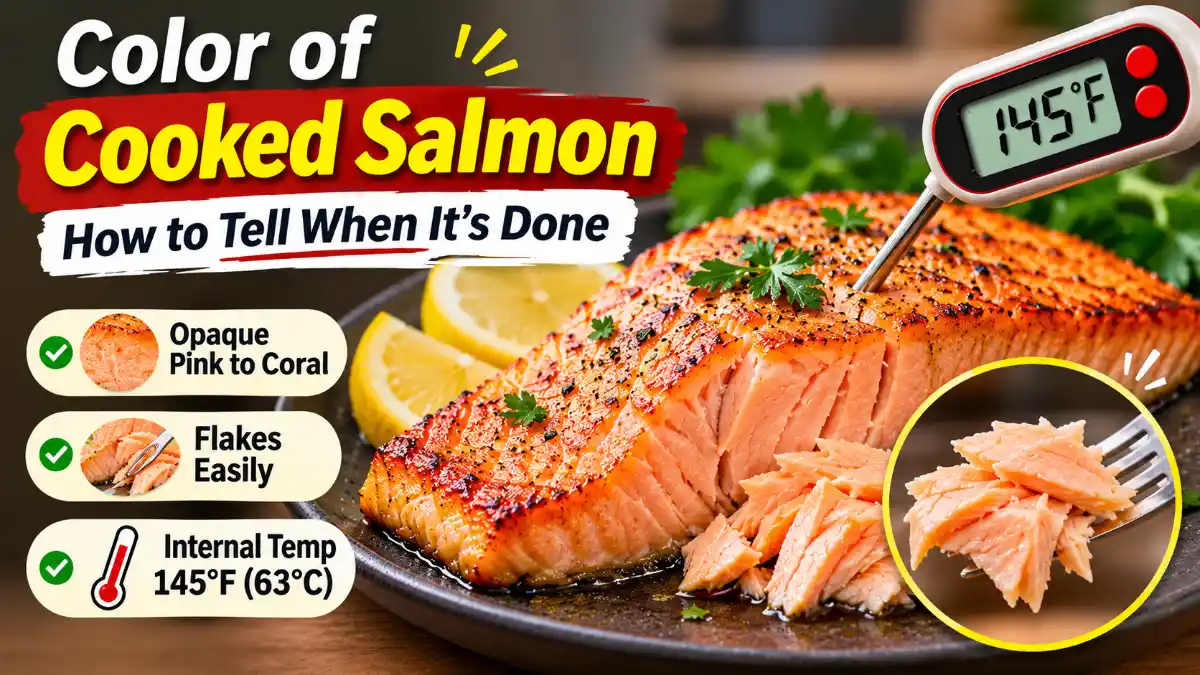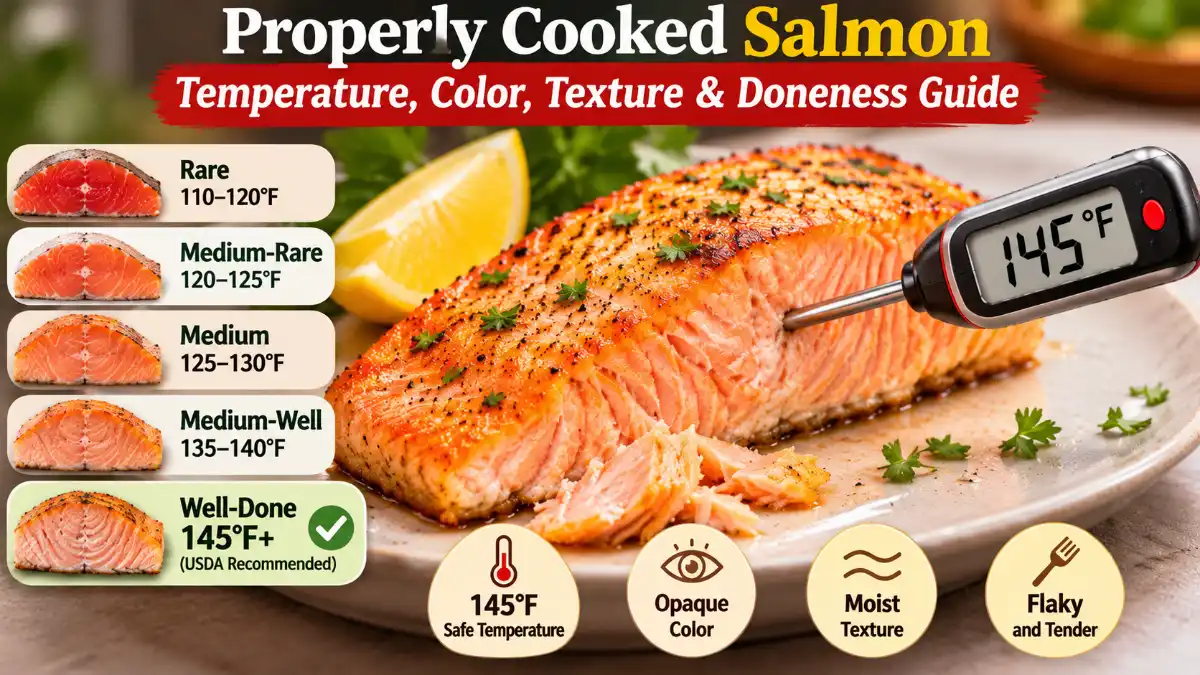
Cooked Salmon Color Chart usually has opaque, moist flesh that ranges from light pink and peach to coral, orange, or deep reddish-orange, depending on the species. Raw salmon looks glossy and translucent, while cooked salmon becomes more opaque and separates easily into flakes. However, color alone cannot confirm whether salmon is safe to eat. The recommended safe internal temperature is 145°F (63°C), measured in the thickest part of the fillet, as outlined in the FDA’s safe food handling guidelines.
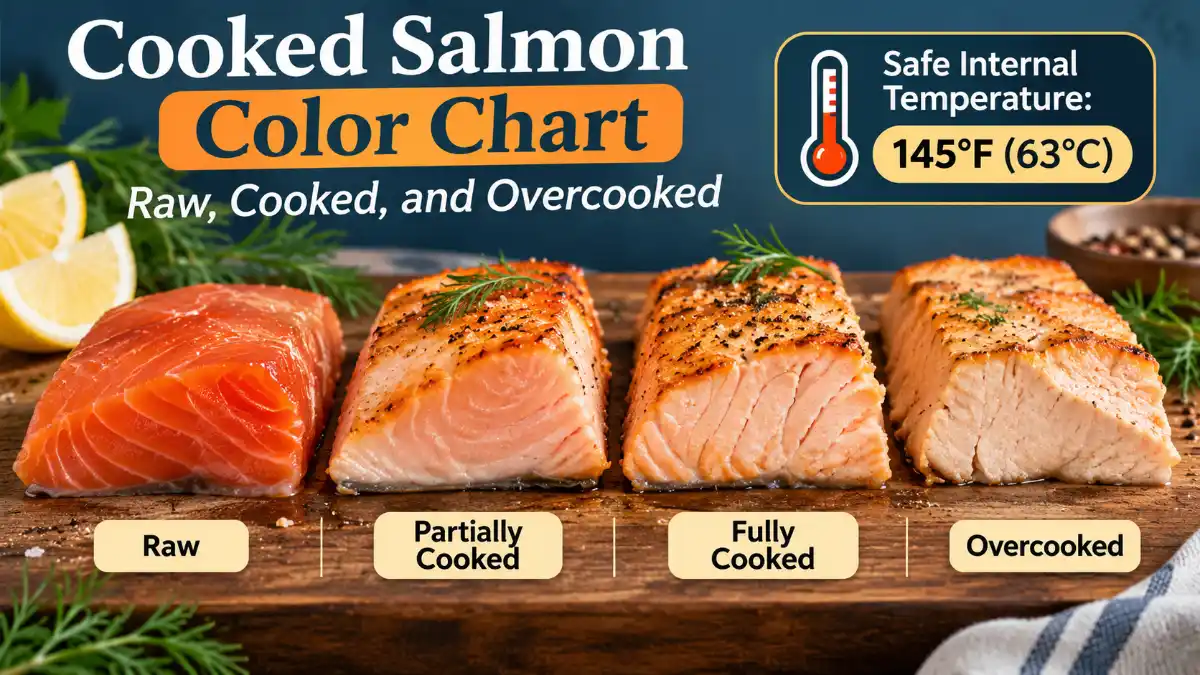
A cooked salmon color chart helps you distinguish raw, partially cooked, fully cooked, and overcooked salmon by comparing their color, texture, and appearance. Whether you’re baking, grilling, pan-searing, or air-frying, these differences make it easier to recognize changes during cooking. For dependable results, though, a food thermometer is your best tool.
Cooked Salmon Color Chart: 4 Stages of Doneness
As salmon cooks, its flesh gradually becomes more opaque and changes texture. The exact color depends on the species, natural pigmentation, and cooking method. That’s why no single shade can tell you whether every salmon fillet is fully cooked.
| Cooking Stage | Typical Color | Texture and Appearance | What It Indicates |
|---|---|---|---|
| Raw salmon | Translucent pink, orange, or deep red | Glossy, soft, and smooth | Uncooked |
| Partially cooked salmon | Opaque outer edges with a potentially translucent center | Uneven firmness; softer middle | Doneness is uncertain |
| Fully cooked salmon | Opaque pink, peach, coral, orange, or reddish | Moist, firm, and separates easily into flakes | Confirm 145°F (63°C) |
| Overcooked salmon | Often pale pink, dull orange, or lighter than its raw color | Dry, firm, and sometimes chalky | Cooked beyond the preferred texture |
These descriptions are general guidelines, not precise measurements. Sockeye salmon, for instance, can stay noticeably red after cooking, whereas Atlantic salmon usually has lighter pink or orange flesh.
One of the clearest changes is the transition from translucent to opaque flesh. According to safe seafood cooking guidance, fish can be assessed by whether its flesh is no longer translucent and separates easily with a fork. A thermometer remains the more objective way to verify its internal temperature.
Read Also: Color Chart Cooked Salmon Color: 5 Stages, Doneness & Safe Temperature Guide
What Color Should Cooked Salmon Be Inside?
Cooked salmon should generally look opaque inside rather than glossy or translucent. Depending on the variety, its flesh may be pale pink, peach, coral, orange, or reddish.
Salmon doesn’t need to turn white to be fully cooked. Its natural pigments remain visible after heating, so a pink or orange center isn’t automatically a sign of undercooking.
Different salmon varieties also have distinct flesh colors:
- Atlantic salmon: Usually pink to orange, becoming more opaque as it cooks.
- Sockeye salmon: Naturally deep red or reddish-orange, often retaining its rich color even after cooking.
- Coho salmon: Typically orange-red, with flesh that becomes more opaque when heated.
- Pink salmon: Generally lighter pink than sockeye or coho salmon.
The Alaska Seafood Marketing Institute’s sockeye salmon guide explains that sockeye’s distinctive deep-red flesh retains its color during cooking. This is one reason a fully cooked salmon fillet may look much redder than expected.
Much of salmon’s characteristic coloring comes from carotenoid pigments, particularly astaxanthin, which salmon obtain through their diet. As explained in NOAA Fisheries’ information about aquaculture feeds and salmon pigmentation, both wild and farm-raised salmon acquire their coloration through dietary pigments.
Pigment levels differ among species and feeding conditions, which helps explain why salmon fillets don’t all look alike. Neither wild nor farm-raised origin determines whether the fish has been safely cooked.
Besides color, pay attention to texture. Cooked salmon should separate relatively easily along its natural muscle layers when you gently press it with a fork. It can still be moist and tender without having a translucent center.
How to Tell if Salmon Is Cooked Safely
The most dependable way to check whether salmon is cooked safely is to measure its internal temperature with a food thermometer.
The recommended safe minimum internal temperature for salmon is 145°F (63°C).
Here’s how to check it:
- Insert a food thermometer into the thickest part of the salmon fillet, placing the sensing tip near the center.
- Keep the tip away from the cooking pan and any bones, which could affect the reading.
- Allow the temperature reading to stabilize.
- Confirm that the center has reached 145°F (63°C).
If you’re cooking a thin fillet, inserting the thermometer from the side often makes it easier to position the tip correctly.
Without a thermometer, you can gently press the thickest part of the salmon with a fork. Cooked flesh generally appears opaque and separates along its natural layers.
A glossy, distinctly translucent center may indicate that the fish needs additional cooking. Still, softness and moisture aren’t reliable proof of undercooking. Salmon can remain tender even after reaching the recommended temperature.
Because visual checks cannot measure temperature precisely, a thermometer is particularly valuable when cooking for pregnant people, older adults, young children, or anyone with a weakened immune system. These groups face greater risks from foodborne illness, making safe seafood selection and preparation especially important.
Undercooked vs. Overcooked Salmon: Key Differences
Undercooked and overcooked salmon often feel noticeably different, even when their colors are similar.
Potentially undercooked salmon may have an opaque exterior but a glossy, translucent center. The middle can feel softer than the surrounding flesh, particularly when a thick fillet is exposed to high heat.
Overcooked salmon, on the other hand, often becomes firmer, drier, and more crumbly. As moisture escapes during cooking, the flesh may also develop a pale or chalky appearance.
The difference matters because undercooking can pose a food-safety risk, while overcooking mainly affects tenderness and flavor.
Keep in mind that moist salmon isn’t necessarily undercooked, just as pale or dry salmon isn’t automatically cooked to a particular temperature. When appearance leaves you uncertain, check the center with a thermometer.
Does Cooking Method Change Salmon Color?
Yes. Baking, grilling, pan-searing, and air-frying can produce different exterior colors, even when the salmon reaches the same internal temperature.
Baked salmon often keeps a fairly even pink or orange appearance with little browning. Grilling may create darker surfaces or grill marks, while pan-searing can produce a golden-brown crust where the fish touches the pan. Air-frying may also leave the outside lightly browned or crisp.
These differences come from how heat reaches the fish, not necessarily how thoroughly the center has cooked.
For example, pan-seared salmon can develop a beautifully browned exterior while remaining below the recommended temperature inside. Baked salmon, meanwhile, may look relatively pale even after it’s fully cooked.
Whatever method you use, judge doneness by the thickest part of the fillet rather than its surface color.
Frequently Asked Questions
Why does cooked salmon sometimes develop white spots?
The white substance that sometimes appears on cooked salmon is usually albumin, a naturally occurring protein. As the fish heats up, its muscle fibers contract and push some of this protein toward the surface, where it coagulates and becomes visible.
Albumin is harmless and safe to eat. Its appearance doesn’t automatically mean your salmon is overcooked or spoiled, although cooking conditions can influence how much of it develops.
Does frozen salmon change color after cooking?
Frozen salmon generally keeps its natural pink, orange, or reddish pigmentation after cooking. Freezing and storage conditions can affect its appearance, but the fish doesn’t need to turn white to be fully cooked.
Whether you cook salmon directly from frozen or thaw it first, the recommended safe internal temperature is still 145°F (63°C). Checking the thickest part with a thermometer is more reliable than judging the finished color.