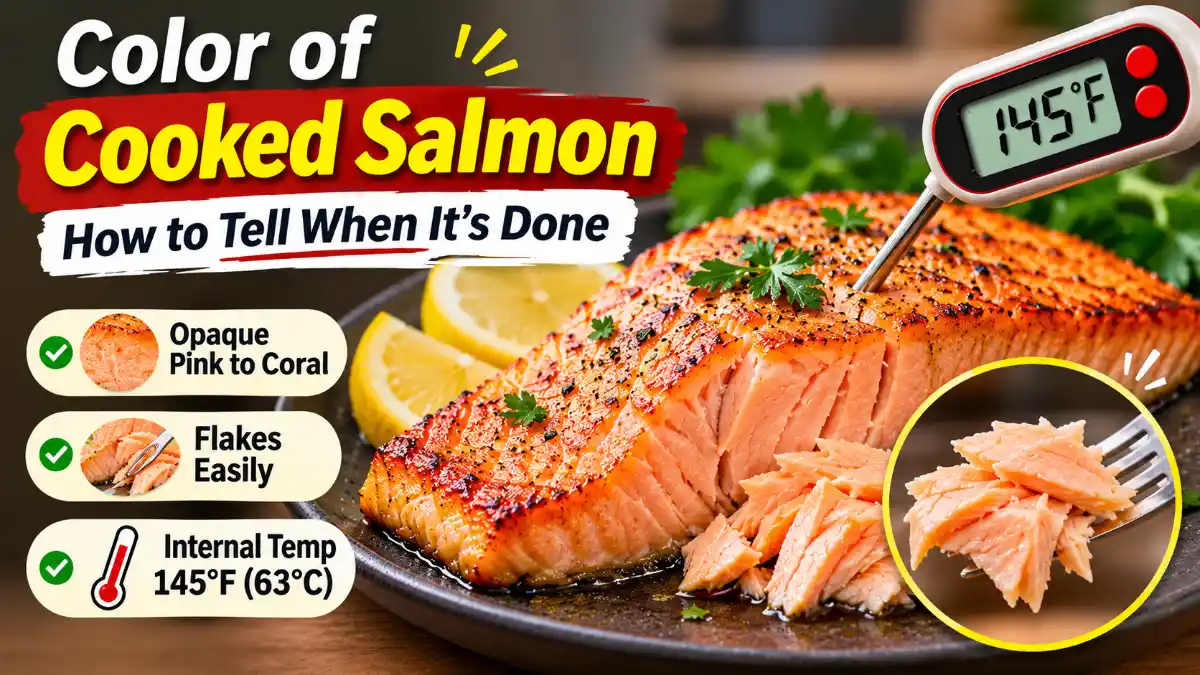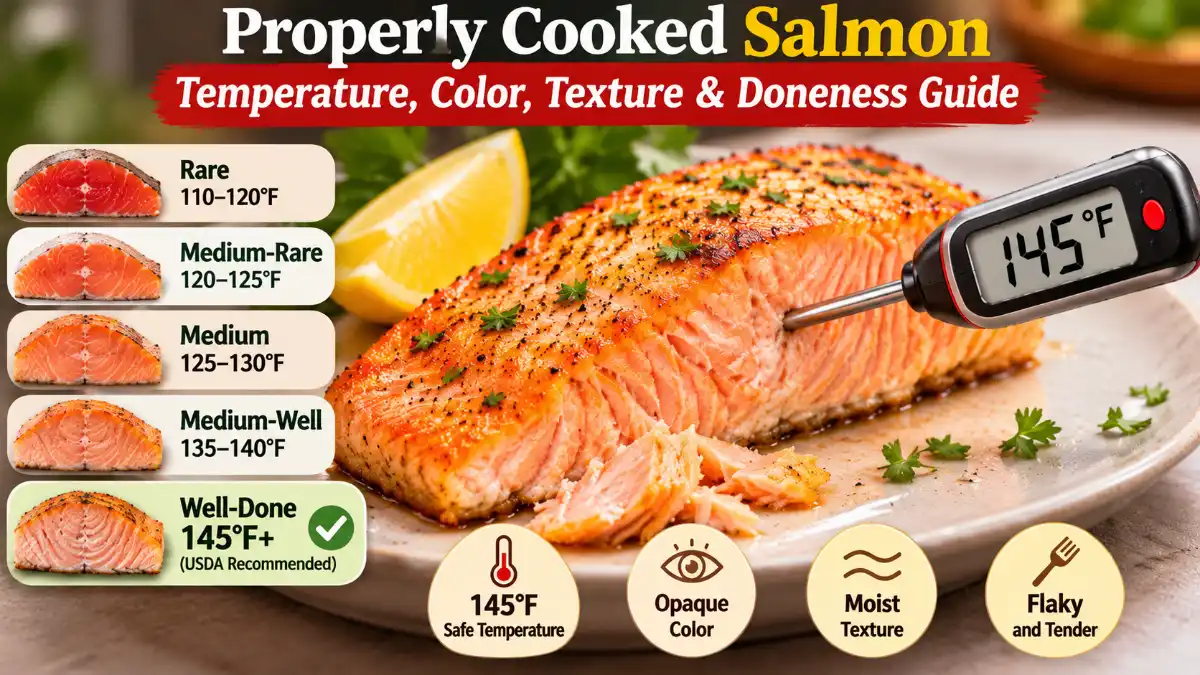

Medium rare salmon typically reaches an internal temperature of about 120–125°F (49–52°C), giving it moist, tender flesh with a slightly translucent center. Culinary definitions vary, and this range is below the US recommended cooking temperature of 145°F (63°C) for fish. Cooking salmon medium rare carries a foodborne-illness risk; its color alone cannot establish safety.
To achieve a particular doneness, check the thickest center with an instant-read thermometer. Pan-searing and oven-baking both work, but fillet thickness, starting temperature, and cooking heat affect how quickly the center warms.
Medium Rare vs. Medium Salmon
Medium rare salmon has a soft, silky center, while medium salmon is firmer and more opaque. The difference is gradual, and cooks do not use universally agreed temperature boundaries.
The comparison below separates approximate culinary preferences from the recommended safe cooking endpoint.
| Doneness or endpoint | Internal temperature | Typical texture |
| Medium rare | About 120–125°F (49–52°C) | Moist and tender, with a slightly translucent center |
| Medium | About 125–135°F (52–57°C) | Firmer and increasingly opaque |
| Recommended safe cooking endpoint | 145°F (63°C) | More firmly set flesh that separates easily with a fork |
The overlapping culinary ranges reflect differences in terminology, salmon varieties, and personal preference. They do not represent different safety standards for wild and farmed fish.
Pink flesh is not automatically raw: salmon can retain its pink or orange color after cooking. Translucency describes how much light passes through the flesh and helps describe doneness, but neither appearance nor flaking replaces a temperature reading.
Is Medium Rare Salmon Safe?
Medium rare salmon does not meet the recommended 145°F cooking endpoint. Raw or undercooked fish can contain harmful bacteria or parasites, and careful sourcing and handling cannot eliminate every risk.
Pregnant people, children, older adults, and people with weakened immune systems should avoid undercooked salmon. For these groups, cook it thoroughly and verify the center temperature.
Previously frozen salmon is not automatically safe to serve medium rare. Appropriate freezing treatments can control parasites, but freezing does not kill all harmful germs. Likewise, farmed origin, “sushi-grade” labeling, or restaurant preparation should not be treated as a safety guarantee.
Read Also: Dorado Fish: 7 Amazing Health Benefits, Nutrition Facts, and Risks
How to Cook Salmon Medium Rare
The methods below describe an undercooked culinary preference. To follow standard US consumer food-safety guidance, continue cooking until the center reaches 145°F.
Start with thawed fillets of similar thickness so they cook more evenly. Pat the surface dry, check for pin bones, and season with salt and pepper. Keep raw salmon refrigerated until preparation, and wash hands, utensils, and surfaces after handling it.
Pan-Seared Salmon
Pan-searing suits skin-on fillets when you want a browned exterior and crisp skin.
- Preheat the pan. Heat a skillet over medium-high heat, then add a thin coating of cooking oil.
- Start skin-side down. Lower the salmon into the pan carefully. Press gently with a spatula at first if the skin curls.
- Control the heat. Reduce the heat if the skin darkens too quickly. Allow the salmon to release from the pan rather than forcing it loose.
- Turn to finish. Carefully flip the fillet to cook the flesh side. Begin checking the center temperature before it appears fully cooked.
- Remove and recheck. For a straightforward approach, transfer the fillet to a plate when the center first reaches the lower end of the medium rare range, about 120°F (49°C). Recheck after a brief rest: carryover heat may move it toward—or beyond—125°F (52°C).
Here, 120–125°F describes the intended temperature when served, rather than a guaranteed removal range. There is no universal temperature offset that ensures an exact result.
Avoid relying on a fixed number of minutes per side. A thin tail portion can cook much faster than a thick center-cut fillet, even when both weigh the same.
Oven-Baked Salmon
A low oven provides a gentler approach and makes it easier to monitor the center as it approaches your chosen temperature.
- Preheat to 275°F (135°C). Line a baking tray and lightly oil the surface.
- Arrange the fillets. Place them skin-side down, leaving space between portions. Brush lightly with oil and season.
- Bake and check. Measure the thickest center during cooking, checking smaller or thinner pieces sooner.
- Remove and recheck. For the same approach used above, transfer the salmon off the hot tray when the center first reaches about 120°F (49°C). Rest briefly and measure again to assess the serving temperature.
Oven temperature is not the same as internal temperature. Baking at 275°F does not tell you how warm the center has become.
Measure the Center and Account for Carryover
Place the thermometer’s sensing area in the center of the thickest part, avoiding the skin, bones, and hot pan. For a thin fillet, inserting the probe horizontally from the side can make accurate placement easier. Check individual portions rather than assuming they all match.
Salmon may continue warming after removal from the heat. This carryover cooking varies with thickness, cooking method, and exterior temperature. Do not assume every fillet will rise by a fixed 5 or 10 degrees, or that resting will bring undercooked fish to 145°F.
Frequently Asked Questions
Can I cook salmon medium rare straight from frozen?
Cooking from frozen makes a narrow doneness range harder to control because the exterior heats before the center thaws. For these methods, thaw the salmon in the refrigerator first.
Is medium rare salmon the same as raw salmon?
No. Medium rare salmon has been heated, with a more cooked exterior and a lightly set center. It remains undercooked relative to the recommended safe endpoint.
Can I make medium rare salmon without a thermometer?
You can estimate texture by appearance and touch, but neither reliably identifies a narrow internal temperature range. Use an instant-read thermometer for a meaningful doneness check.
Does white protein on salmon mean it is overcooked?
Not necessarily. The white substance is albumin, a protein that can emerge as salmon cooks. Its presence does not establish the center temperature or prove that the fish is overcooked.
Should I leave salmon in the hot skillet while it rests?
For the methods above, transfer it to a plate. A hot skillet continues applying heat and can push the center beyond your intended doneness more quickly.