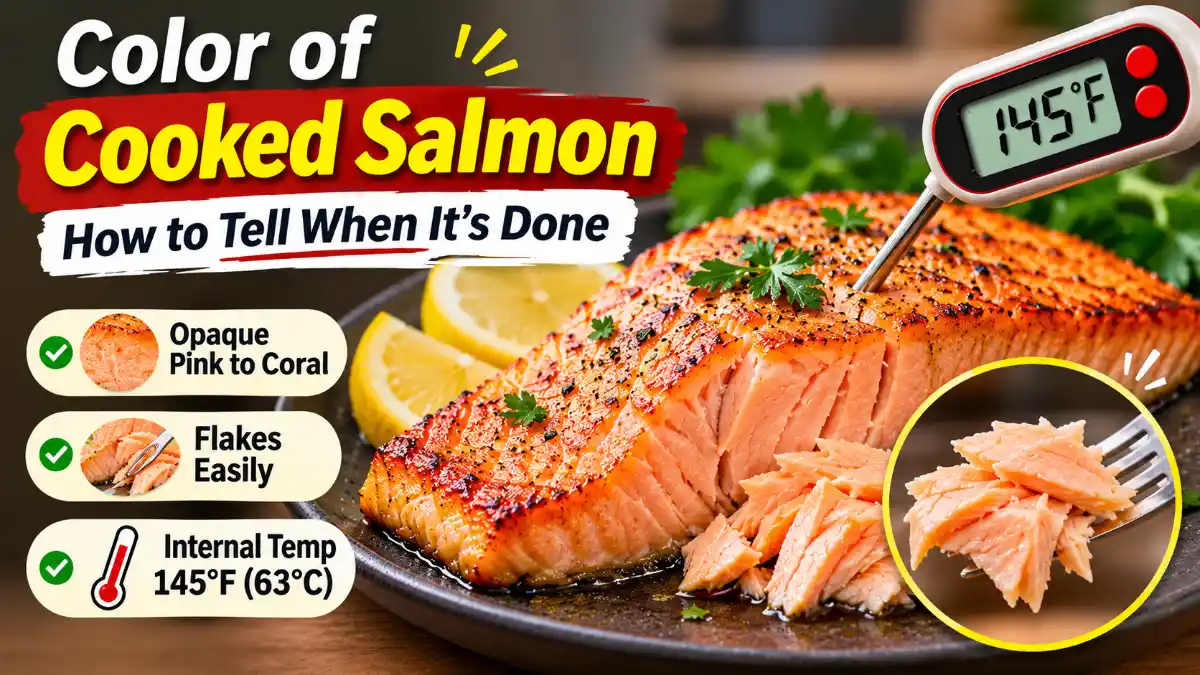

What Does Salmon Look Like When It’s Done How do you know if your salmon is fully cooked? Generally, once the salmon has reached the stage of being fully cooked, its flesh will have become opaque and pinkish-orange in appearance, possibly reddish, and it will flake apart easily with a gentle press of a fork. At this point, the center of the fish should no longer appear raw or semi-translucent. It is important to remember that the specific shade of pink will depend upon the variety of salmon used. Therefore,
if the flesh appears darker pink than usual, this does not automatically indicate that the fish was undercooked. To ensure the safety of the product for consumption, the internal temperature of the salmon must be brought to at least 145 degrees Fahrenheit (63 degrees Celsius).
The thickest area of the fillet is where you should take your temperature reading. It will take longer than other parts of the fish to cook. You want the flesh to feel firm yet moist. It should not be mushy, rubbery, or dry. When in doubt regarding the appearance of the fillet, use a food thermometer to determine if the internal temperature has met the manufacturer’s recommendation.
What Does Salmon Look Like When It’s Done?
Generally speaking, when cooked, salmon looks opaque pink or orange-pink. The color of salmon can vary greatly depending upon what type of fish you are eating.
The Atlantic salmon usually has a softer pink-orange hue to its skin and flesh than the sockeye salmon. Sockeye salmon will also have a darker, more intense red hue to its skin and flesh, which may stay red even after cooking. Therefore, there is not one specific shade of pink or red that indicates when all types of salmon fillets are properly cooked.
What is important is how opaque the meat appears to be, not whether it is a specific color of pink. Uncooked raw salmon has a smooth surface that appears to be somewhat translucent. When raw salmon is subjected to cooking processes that change the protein structure within the fish, the meat will become firmer and lose some of its transparency.
Gently separate the most substantial part of the fillet to inspect its degree of doneness. The center of the fillet will appear done, not raw, even though there can be a slightly pinkish or reddish tint.
When the center of the piece of meat appears glossy, translucent, and significantly softer than the surrounding meat, then it is likely that the meat requires further cooking. On the contrary, if the center of the meat has a deeper shade of pink, this does not automatically indicate that the meat is fully cooked.
Raw vs. Undercooked vs. Fully Cooked vs. Overcooked Salmon
When salmon is cooked, its appearance will change, which can help you identify the various levels of doneness.
Doneness Stage
Color and Appearance
Texture
Raw salmon
Glossy, translucent pink, orange, or red
Soft and doesn’t separate into cooked flakes
Undercooked salmon
Opaque outside with a more translucent center
Softer in the middle and may resist flaking
Fully cooked salmon
Opaque throughout, usually pink, orange-pink, or reddish
Moist, tender, and separates easily into flakes
Overcooked salmon
Opaque, sometimes pale or dry-looking
Firm, dry, and may crumble easily
You can use these differences to determine if your salmon requires additional cooking time. However, the visual signs will not give you an accurate reading on how hot the inside of your salmon is.
While a thick cut of meat may appear cooked on the exterior, it may still be raw inside. Therefore, only assessing the appearance of the exterior can lead to errors.
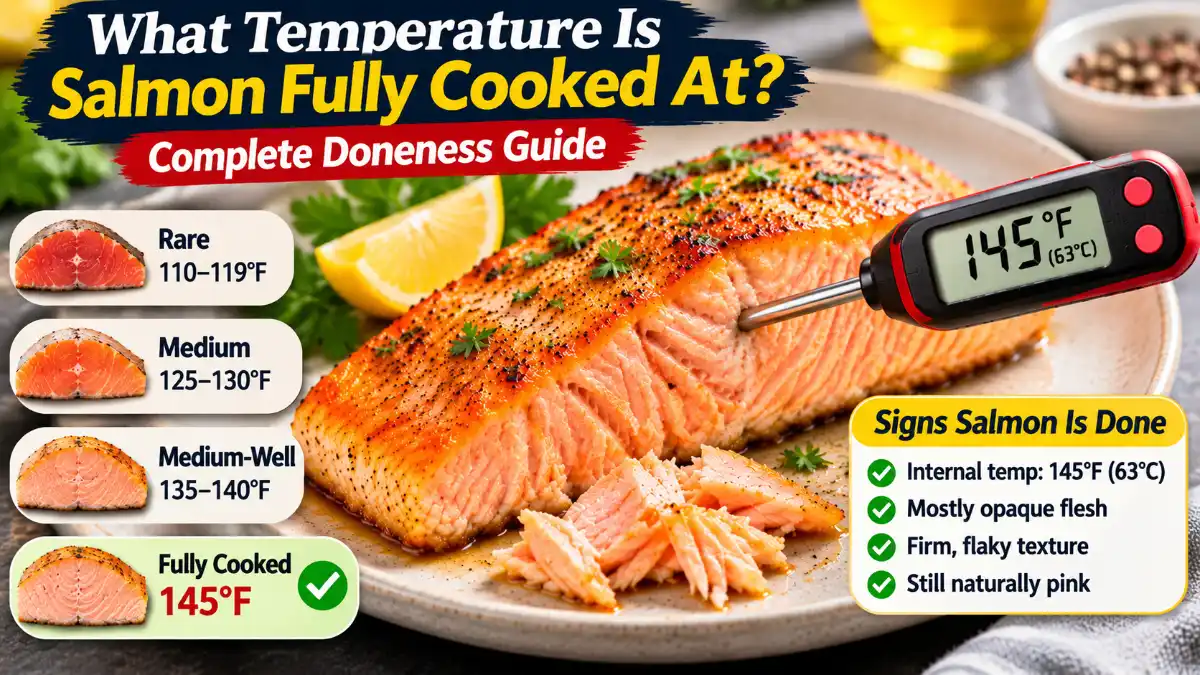
In contrast, when salmon is overcooked it will lose moisture and become very dry, chewy, or crumbly rather than flaky and tender. For a better understanding of what an ideally cooked piece of salmon should look like at the end of the cooking process, see our guide on “Fully Cooked Salmon” for visual examples and suggested cooking temperatures.
How to Tell When Salmon Is Done Without a Thermometer
When you don’t have access to a food thermometer, you can use a fork to test if your salmon is done. To determine how well-done the fish is, look at the fish’s consistency (texture) and appearance. It’s especially important to observe these characteristics in the thickest part of the fish.
Follow these steps:
Find the thickest section. This area generally takes the longest to cook.
Press lightly on the top of each piece of cooked salmon using a fork. When you apply gentle pressure, the cooked salmon should naturally break apart into separate layers.
Inspect the center. Check for opaque flesh as opposed to a shiny, raw looking inside.
Test the consistency of the center. It should be tender and firm, but not excessively soft or mushy.
Check the middle of your piece of salmon against the outside. If you can still see through the center after checking, then you should probably cook it longer.
It isn’t necessary to separate the whole fillet. A simple opening of a small portion will typically allow for inspection of the center.
The official food-safety guidelines for the United States state that if fish has lost its transparency and can be pulled apart with a fork, it will meet the stated alternate visual doneness criterion.
Both of these signs are important for determining when the fish is done. Flaking on its own will not tell you if the fish has reached 145 degrees Fahrenheit, therefore, it is best to use a thermometer to get a much more accurate reading.
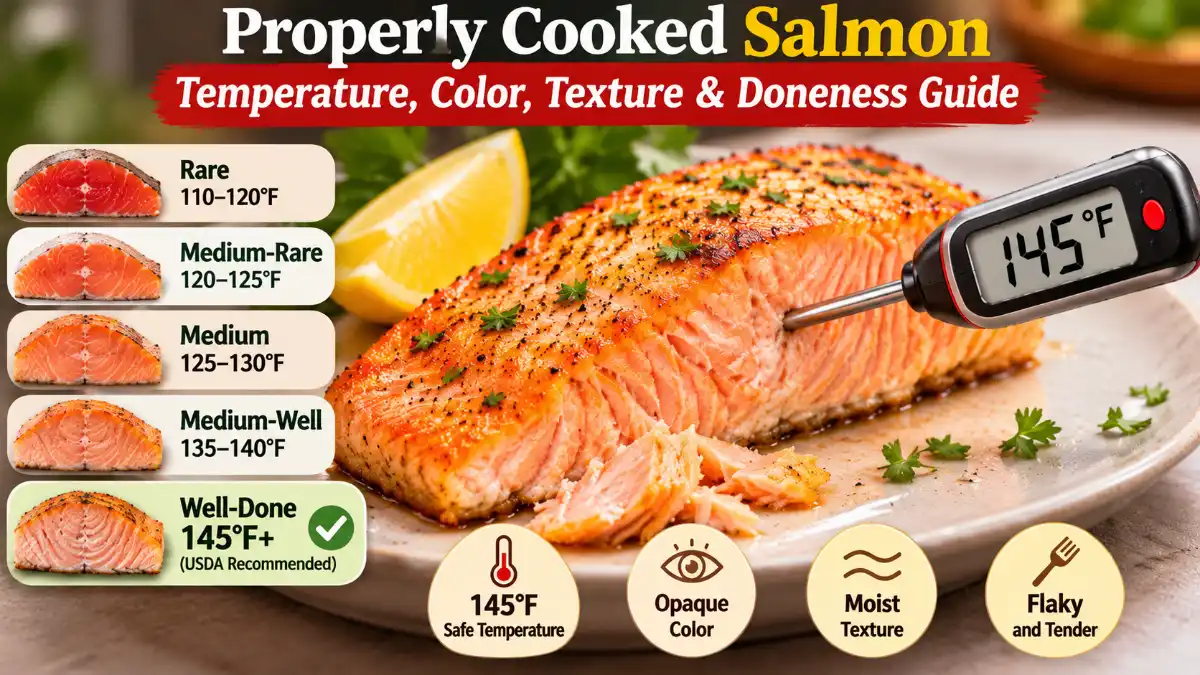
Read Also: Properly Cooked Salmon: Temperature, Color, Texture, and Doneness Guide
What Internal Temperature Should Salmon Reach?
The recommended safe minimum internal temperature for salmon is 145°F (63°C).
Measure the temperature by inserting an instant-read thermometer into the thickest area of the fillet. Ensure that you place the tip of the thermometer so that it is positioned in the middle of the fillet and not touching either the pan or any bones.
The FDA’s Safe Food Handling Guidelines suggest that the minimum internal temperature of all finfish, such as salmon, should reach at least 145 degrees Fahrenheit. If the internal temperature of the fish does not meet the specified minimum, continue to cook the fish until it reaches the desired internal temperature.
A culinary preference is to cook salmon at a lower temperature so that it will remain soft and moist in its center; however, this is not a substitute for the standard food-safety recommendations of the United States.
As with its appearance, the way that you prepare your salmon will impact what it looks like. For example, if you pan-sear your salmon, it may develop a crispy, golden-brown skin. If you bake or steam your salmon, it is likely to have a smoother, less textured surface.
No matter the way you cook the meat, measuring the inside temperature of the meat will be a better indicator of whether or not the meat has been cooked through than looking at the outside appearance of the meat.
Can Salmon Be Pink or Medium-Rare in the Middle?
Yes, salmon can still have a pink center even after being completely cooked. The amount of natural pigmentation depends on which type of salmon is used. Also, cooking will not cause all salmon to be light pink in color.
The important distinction is whether the center looks opaque or translucent.
A medium-rare or medium cooked salmon typically features a center with less opacity and greater flexibility when compared to a salmon prepared at 145 degrees Fahrenheit. While many consumers find this preparation style preferable, such techniques typically do not meet the safety requirements set forth by the United States Department of Agriculture (USDA) for food preparation.
The safety of eating salmon that has been cooked to a “medium-rare” state is questionable. Cooking salmon to less than the recommended internal temperature will increase the probability of getting sick from food-borne illness. While freezing and/or properly storing and handling the fish may help to mitigate some of the risk of contracting food-borne illness from under-cooked fish, there are other potential health threats that cannot be avoided by merely freezing or storing/handling the fish properly.
The U.S. Food and Drug Administration (FDA) has issued safety guidelines for seafood consumption. These guidelines are intended for pregnant women, infants and toddlers, older adults, and people whose immune systems have been compromised. They recommend avoiding raw or undercooked seafood.
If you are most concerned about the safety of the food you eat, then you should use a meat thermometer and check the temperature of the salmon as opposed to using only the pinkness of the fish to determine if it is cooked through.
Why Does Cooked Salmon Sometimes Look White or Dry?
You may find a white substance on the outside of your cooked salmon, or in-between the layers of the fish. This is most likely albumin, which is a naturally-occurring protein. It will appear when the fish has been heated.
In addition to contracting while being cooked, there are times when the muscle fibers within the fish move moisture (protein) towards the outer surface where it will then solidify. When this occurs, you will often find a white substance on either side of your fillet or on top of the fillet itself.
Albumin can be eaten without harm. Just because you see albumin on your fish doesn’t mean that the fish was overcooked, or that the center of the fish has cooked enough to kill harmful bacteria.
The quantity of albumin may vary. According to the University of Wyoming Extension’s instructions on how to cook salmon, cooking the salmon more gently will decrease the loss of moisture and the quantity of visible white protein.
Another thing to watch for is how dry the fish is. A well-done piece of salmon will be able to flake apart into separate pieces without being too dry. When the fish becomes extremely hard, chalky, or crumbly, this means that you may have overcooked the fish.
When reheating your left over food you may find that the food is drying out as well. If you are going to be eating this salmon at another time, then a very slow way of reheating will help to keep the fish moist. The following are ways to reheat your salmon so that it does not become dry.
When you have just finished cooking your salmon, you will know it is done when the meat turns from pink to opaque, the flakes fall apart easily, and the center is still somewhat wet. You should always use a meat thermometer to make sure that the thickest part of the salmon has reached 145 degrees Fahrenheit (63 degrees Celsius) to ensure that it was cooked safely.
Frequently Asked Questions
1. Should salmon be completely opaque when done?
Salmon cooked to the standard fully cooked stage should generally be opaque throughout, including the thickest section. Its flesh may still appear pink or reddish, depending on the species. If the center looks noticeably translucent, it may need more cooking. A thermometer provides a more reliable way to check whether the fish has reached 145°F (63°C).
2. Can salmon be cooked even if it looks dark pink inside?
Yes. Some salmon varieties, especially sockeye, retain a deep pink or reddish color after cooking. That color is natural and doesn’t necessarily indicate undercooking. Check whether the flesh is opaque and flakes easily, and use a thermometer to confirm the recommended internal temperature.
3. What does slightly undercooked salmon look like?
Slightly undercooked salmon often looks opaque around the edges but remains glossy or translucent in the center. The middle may also feel softer and resist flaking compared with the cooked outer portions. Since appearance cannot tell you the exact temperature, checking the thickest section with a thermometer is the safest approach.
4. Is it normal for cooked salmon to have white stuff on top?
Yes. The white substance is usually albumin, a natural protein that becomes visible during cooking. It’s harmless and safe to eat. Although more albumin may appear when salmon is cooked over high heat or loses moisture, its presence doesn’t necessarily mean the fish is overcooked.
5. Can salmon look cooked on the outside but still be raw inside?
Yes. Salmon can develop an opaque or browned exterior while the center remains undercooked, especially when cooking thick fillets over high heat. The outside may look ready before heat has fully reached the middle. Check the thickest section and use a thermometer to confirm that the fish has reached 145°F (63°C).