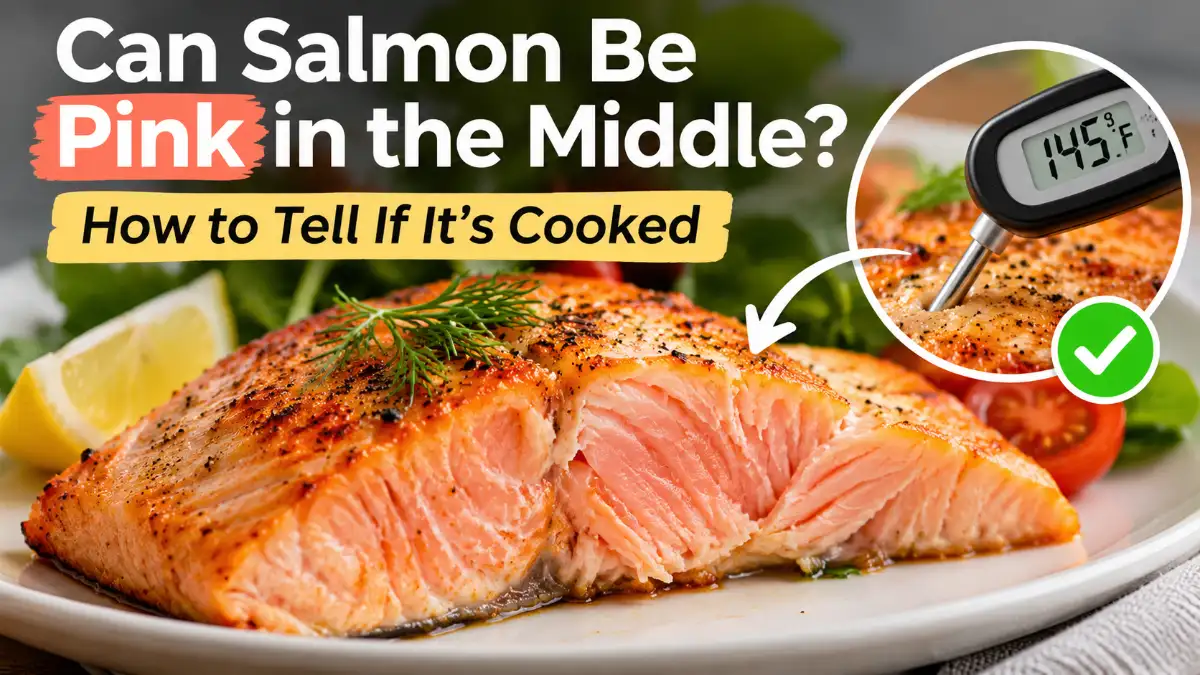
Can Salmon Be Pink in the Middle and still be fully cooked and safe to eat. Salmon naturally has pink or orange flesh, so it doesn’t need to turn white when cooked. The important difference is whether the center looks opaque and cooked or translucent and raw. For the most reliable safety check, salmon should reach an internal temperature of 145°F (63°C).
A slightly pink center is normal, especially in thicker fillets. However, color alone cannot tell you whether salmon is safe to eat. If you’re unsure about doneness, checking the thickest part with a food thermometer is more dependable than relying on appearance or cooking time.
Can Salmon Be Pink in the Middle?
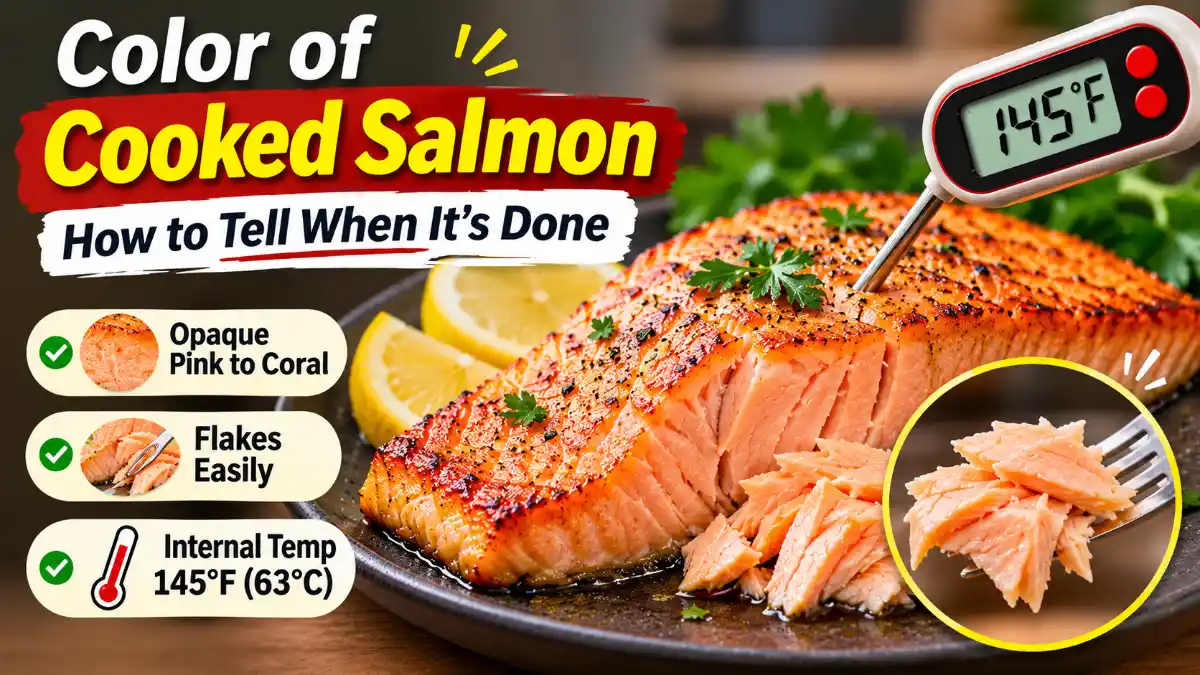
Properly cooked salmon generally has an opaque pink, coral, or orange-pink center. Its flesh becomes firmer as it cooks and separates into flakes when gently pressed with a fork.
Several characteristics can help you recognize cooked salmon:
- Color: The inside may remain light pink, coral, or orange rather than turning white.
- Appearance: The flesh should look opaque instead of shiny, glassy, or translucent.
- Texture: Cooked salmon is tender but more set than raw salmon.
- Flaking: The flesh should separate relatively easily along its natural layers.
The exact color depends partly on the type of salmon. Sockeye salmon often retains a deeper reddish-pink appearance, while Atlantic salmon commonly has a lighter orange-pink color.
A dark pink center doesn’t automatically mean the salmon is undercooked. What matters more is its appearance, texture, and internal temperature.
Cooked vs. Undercooked Salmon: Key Differences
If you’re wondering how to tell if salmon is cooked, comparing the center’s appearance and texture can help.
| Feature | Cooked Salmon | Potentially Undercooked Salmon |
| Center color | Pink, coral, or orange-pink | May be pink, orange, or dark pink |
| Appearance | Opaque | Translucent or glassy |
| Texture | Tender but set | May feel soft, slippery, or raw |
| Flaking | Separates relatively easily | May resist flaking |
| Internal temperature | 145°F (63°C) meets the recommended safety standard | Below 145°F (63°C) does not meet the recommended safety standard, even if partly cooked |
The most noticeable difference between cooked and uncooked salmon is often translucency rather than color.
Raw salmon typically has a glossy, somewhat transparent appearance. As it cooks, the flesh becomes increasingly opaque. However, these visual differences are not absolute. Salmon can appear cooked before reaching the recommended safe temperature, so a food thermometer remains the better choice.
Read Also: what temperature is salmon fully cooked at ? 9 Essential Facts About Salmon Doneness
What Internal Temperature Should Salmon Reach?
The recommended safe internal temperature for salmon is 145°F (63°C). At this temperature, salmon meets the standard US food-safety recommendation for cooked fish.
To check the salmon accurately:
- Insert a food thermometer into the thickest part of the fillet.
- For thin fillets, insert the probe sideways toward the center.
- Avoid touching the baking tray, pan, or any bones.
- Wait for the reading to stabilize.
- If it hasn’t reached 145°F (63°C), continue cooking and check again.
Salmon is sometimes served at lower temperatures in restaurants or home cooking because some people prefer a softer, more translucent center. However, cooking salmon below 145°F does not meet the standard recommended temperature.
Baking, grilling, pan-searing, and air frying can all produce properly cooked salmon. Cooking time varies with thickness, starting temperature, and heat intensity, so temperature is a better guide than a fixed number of minutes.
What If Salmon Is Still Pink or Translucent Inside?
If your salmon looks pink but opaque in the middle, that can be completely normal. Check its internal temperature before deciding whether it needs more cooking.
If the center looks glassy, translucent, or noticeably raw, take these steps:
- Return the salmon to the oven, skillet, grill, or air fryer.
- Continue cooking gently to avoid excessively drying the outside.
- Check the thickest portion with a food thermometer.
- Serve once it reaches the recommended 145°F (63°C).
A fillet can cook unevenly, particularly when one end is much thicker than the other. The thinner portion may look fully cooked while the thick center still needs additional heat.
Also, don’t confuse the white substance that sometimes appears on cooked salmon with raw flesh. This substance is albumin, a protein that becomes visible as salmon cooks. Its presence alone doesn’t establish whether the fish has reached a safe temperature.
Is Slightly Undercooked Salmon Safe to Eat?
Eating salmon below the recommended cooking temperature carries some food-safety risk. Raw or undercooked fish may contain harmful bacteria or parasites, even when it looks fresh and smells normal.
Some people intentionally eat rare salmon or raw salmon prepared for dishes such as sushi and sashimi. However, these preparations involve different handling considerations, and freezing used for parasite control does not eliminate every food-safety risk.
Certain people should avoid raw or undercooked salmon, including:
- Pregnant people
- Young children
- Older adults
- People with weakened immune systems
For home cooking, reaching 145°F (63°C) provides a straightforward safety target. If you’re uncertain whether a pink center is adequately cooked, checking its temperature is safer than guessing based on color.
Frequently Asked Questions
1. Is salmon safe to eat if it’s slightly pink in the middle?
Yes, provided it has been cooked safely. Salmon naturally retains pink coloring, so a pink center is not automatically a problem. A thermometer reading of 145°F (63°C) confirms that it has reached the recommended cooking temperature.
2. Can salmon be dark pink in the middle when cooked?
Yes. Sockeye salmon, for example, naturally has deeper reddish flesh than some other varieties. This color can remain visible after cooking and doesn’t necessarily indicate a raw center.
3. Does salmon have to be completely opaque to be cooked?
Salmon can begin cooking before becoming fully opaque. However, the standard visual guidance for safely cooked fish is flesh that is no longer translucent and flakes easily. Temperature measurement is more reliable than visual inspection.
4. What happens if you accidentally eat undercooked salmon?
You may experience no symptoms, but undercooked salmon can expose you to foodborne bacteria or parasites. Possible symptoms include nausea, vomiting, diarrhea, and abdominal discomfort. Seek medical advice if symptoms are severe, persistent, or occur in someone at higher risk.
5. Can salmon look cooked on the outside but be raw inside?
Yes. Thick salmon fillets can brown or become opaque on the outside while remaining undercooked in the center, particularly when cooked over high heat. Check the thickest portion with a thermometer rather than judging doneness from the surface.