
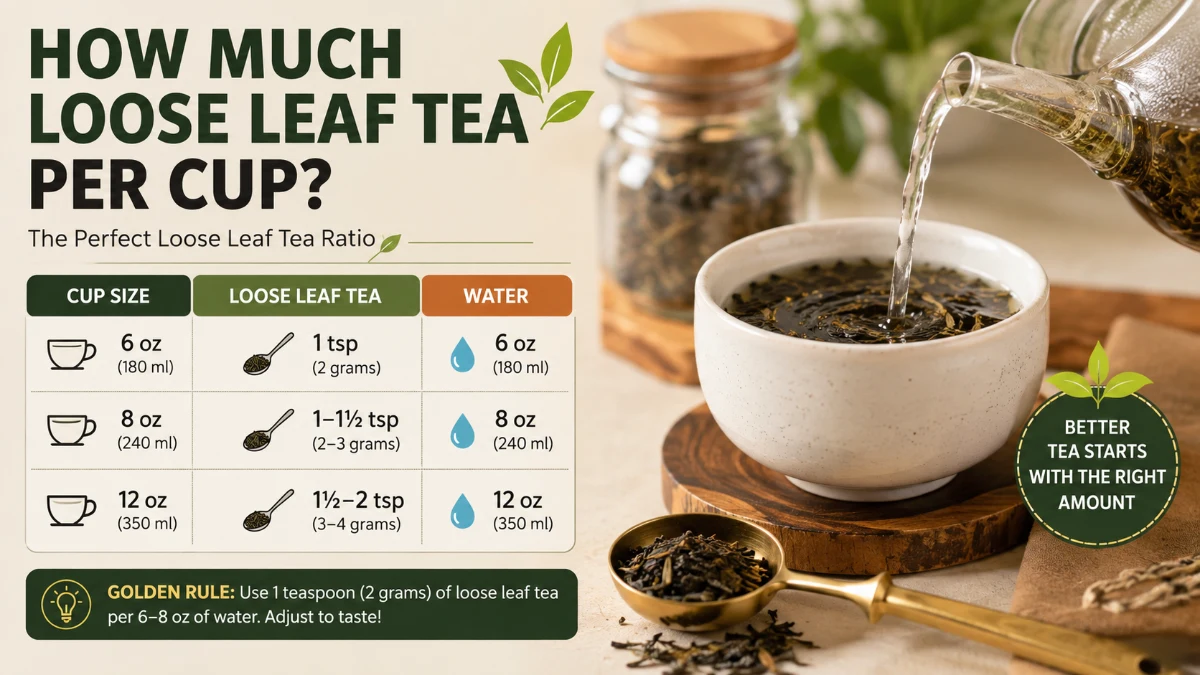
If you’re wondering how much loose leaf tea per cup to use, a simple starting point is about 2 grams of loose leaf tea for every 8 oz (240 ml) of water.
For many compact teas, that’s roughly 1 level teaspoon. Large, fluffy leaves may require a heaped teaspoon or more because they take up more space without necessarily weighing more.
Quick Answer: How Much Loose Leaf Tea Per Cup?
For Western-style brewing, use this simple starting guide:
| Water | Loose Leaf Tea |
| 6 oz / 180 ml | About 1.5 g |
| 8 oz / 240 ml | About 2 g |
| 12 oz / 355 ml | About 3 g |
| 16 oz / 475 ml | About 4 g |
| 24 oz / 710 ml | About 6 g |
| 32 oz / 950 ml | About 8 g |
Think of these measurements as starting points rather than strict rules.
The ideal amount can vary according to the tea, leaf size, brewing method, manufacturer’s instructions, and how strong you prefer your tea.
If your tea comes with brewing instructions, follow those first.
Grams vs Teaspoons: Which Measurement Is Better?
A kitchen scale is the most consistent way to measure loose leaf tea.
That’s because a teaspoon measures volume, while grams measure weight.
Different tea leaves can occupy dramatically different amounts of space.
For example:
- Broken black tea can pack tightly into a teaspoon.
- Rolled oolong looks compact before its leaves expand.
- Large white tea leaves can occupy a lot of space while weighing relatively little.
- Chamomile, mint, flowers, and fruit blends can be particularly bulky.
So two teaspoons of different teas won’t necessarily contain the same weight.
If you regularly brew loose leaf tea, weigh your normal spoonful once. Once you know how many grams it contains, you can continue using your spoon for convenient everyday brewing.
How Many Teaspoons of Loose Leaf Tea Per Cup?
If you don’t have a kitchen scale, about 1 teaspoon per cup is a useful starting point for many teas.
However, adjust the spoon measurement according to the leaves.
Small or Dense Tea Leaves
For fine black tea, broken leaves, and other relatively dense teas, start with approximately:
1 level teaspoon per 8 oz cup
Then adjust according to taste and the tea producer’s instructions.
Large or Fluffy Tea Leaves
Large-leaf white tea, some green teas, open-leaf oolongs, mint, chamomile, and herbal blends may require considerably more volume.
You may need:
1 heaped teaspoon or more per 8 oz cup
The goal isn’t to make every tea fit the same teaspoon measurement. It’s to use an appropriate amount of leaf for the amount of water you’re brewing.
Tightly Rolled Tea Leaves
Rolled oolong and other tightly shaped teas can look deceptively small before brewing.
They expand substantially when hydrated, so avoid filling a small infuser tightly with dry leaves.
Measure the tea according to weight or the manufacturer’s instructions and give the leaves plenty of room to open.
How Much Loose Leaf Tea for an 8 oz Cup?
For an 8 oz (240 ml) cup, start with approximately:
2 grams of loose leaf tea
For many compact or medium-density teas, this may be close to one teaspoon.
If the tea is especially bulky or fluffy, you’ll probably need more spoon volume to reach approximately the same weight.
Taste the first cup before making adjustments.
If it’s too light, increase the amount of tea slightly the next time.
How Much Loose Leaf Tea for a 12 oz Mug?
For a 12 oz (355 ml) mug, start with approximately:
3 grams of loose leaf tea
This is important because many everyday mugs are considerably larger than a traditional teacup.
Using one small teaspoon simply because you’re making “one cup” can result in weak tea when your mug actually holds 12 or 16 ounces.
Measure your favorite mug’s capacity once so you know how much water you’re actually brewing.
How Much Loose Leaf Tea for a 16 oz Mug?
For a 16 oz (475 ml) mug, start with approximately:
4 grams of loose leaf tea
If you’re measuring with teaspoons rather than a scale, the exact number of spoonfuls will depend heavily on leaf density.
Use the tea producer’s instructions when available and adjust after tasting.
Read More: Best Bread for Avocado Toast
How Much Loose Leaf Tea for a Teapot?
Measure the amount of water in your teapot, rather than simply counting the number of people drinking.
Using the 2 g-per-8 oz starting ratio:
| Teapot Capacity | Starting Amount |
| 16 oz / 475 ml | About 4 g |
| 24 oz / 710 ml | About 6 g |
| 32 oz / 950 ml | About 8 g |
| 40 oz / 1.18 L | About 10 g |
For example, if your teapot holds 32 oz of water, start with approximately 8 grams of loose leaf tea.
This is more reliable than using “one spoonful per person” because cup and mug sizes vary.
Why One Teaspoon Doesn’t Work for Every Tea
Imagine filling one cup with rice and another with popcorn.
Although both containers have the same volume, their contents don’t have the same weight.
Loose tea works similarly.
Small leaves pack closely together, while large leaves leave considerable empty space between them.
That’s why grams are generally more repeatable than teaspoons.
You don’t need to abandon teaspoons completely. Just remember that a teaspoon is an approximate shortcut rather than a universal measurement.
How to Brew a Test Cup
When opening a new loose leaf tea, make one controlled test cup.
Step 1: Measure Your Water
Start with 8 oz (240 ml) of water.
If you’re using your regular mug, measure its actual capacity once. You may discover that your “cup” actually holds 10, 12, or 16 ounces.
Step 2: Measure the Tea
Start with approximately:
2 grams of loose leaf tea
If you don’t have a scale, use the tea producer’s recommended spoon measurement or approximately one teaspoon for a typical compact tea.
Step 3: Use a Roomy Infuser
Place the leaves in a basket infuser or another brewing vessel that gives them room to expand.
Large tea leaves shouldn’t be packed tightly into a small tea ball.
Step 4: Use an Appropriate Water Temperature
Different teas perform best under different brewing conditions.
Follow the temperature listed on the tea package whenever possible.
Green and white teas commonly use cooler water than black tea and many herbal infusions.
Step 5: Steep for the Recommended Time
Use the tea producer’s recommended steeping time.
Adding several extra minutes isn’t always the best way to make weak tea stronger. Excessive steeping can increase bitterness or astringency.
Step 6: Remove the Leaves
Remove the infuser or strain the tea when the infusion is complete.
Leaving the leaves in hot water means extraction continues, potentially making the drink stronger or more bitter than intended.
Step 7: Taste Before Adding Anything
Taste your tea before adding milk, sugar, honey, or lemon.
This helps you decide whether the leaf amount itself needs adjustment.
What to Do If Your Loose Leaf Tea Is Too Weak
Weak tea doesn’t automatically mean you need to steep it much longer.
First check:
- Tea quantity — Did you use enough leaves?
- Water volume — Is your mug larger than you thought?
- Infuser size — Do the leaves have room to expand?
- Water temperature — Was it appropriate for the tea?
- Tea freshness — Has the tea been stored properly?
If everything else appears correct, increase the amount of tea slightly on your next brew.
For example, move from 2 grams to around 2.5 grams rather than making a dramatic change.
What If My Tea Is Too Strong?
If your tea tastes strong but isn’t unpleasantly bitter, reduce the amount of tea slightly while keeping the other brewing variables similar.
This lets you isolate the variable that caused the difference.
If the tea tastes strong and bitter or excessively drying, review the steeping time and water temperature too.
Too-hot water or excessive steeping can produce an unpleasant cup even when the amount of tea is reasonable.
How Leaf Shape Changes the Measurement
Tea category isn’t the only thing that matters. Leaf shape can be equally important when you’re measuring with spoons.
Broken and Fine Leaves
These pack densely into a teaspoon.
A level teaspoon may contain a relatively substantial amount of tea.
Whole Leaves
Whole-leaf teas occupy more space and can require a larger spoon measurement.
Rolled Oolong
Rolled leaves appear small when dry but can expand dramatically during steeping.
Give them sufficient room in the brewing vessel.
Herbal and Fruit Blends
Flowers, herbs, spices, dried fruit, and other ingredients can make blends extremely bulky.
A teaspoon of an herbal blend may therefore weigh much less than a teaspoon of fine black tea.
Does the Tea Infuser Size Matter?
Yes—but not because it changes the amount of dry tea you need.
The infuser affects how easily water circulates around the leaves.
A roomy basket-style infuser is useful for loose tea because it allows whole leaves to expand.
A small tea ball may work with fine or compact leaves but can restrict larger white tea, oolong, whole-leaf black tea, and bulky herbal ingredients.
If you’re using a reasonable amount of tea but the brew still tastes unexpectedly thin, check whether the leaves are crowded.
Western-Style vs Gongfu Brewing
The 2 grams per 8 oz guideline in this article is intended primarily as a simple starting point for Western-style brewing.
Gongfu brewing works differently.
Western-Style Brewing
Typically uses:
- A mug, teapot, or basket infuser
- More water
- A lower concentration of leaves
- Longer infusions
Gongfu Brewing
Typically uses:
- A gaiwan or small teapot
- Much less water
- A higher leaf-to-water ratio
- Multiple short infusions
Because the brewing methods are fundamentally different, don’t take a gongfu tea quantity and use it unchanged in a normal mug.
How Much Tea Should I Use for Stronger Tea?
If you prefer stronger tea, try increasing the amount of leaf modestly rather than automatically extending the steeping time.
For example:
2 g → 2.5 g per 8 oz
Keep the recommended water temperature and steeping time similar for your first adjustment.
This allows you to increase the concentration while reducing the risk of extracting excessive bitterness.
How Much Loose Leaf Tea for Milk Tea?
Milk dilutes the brewed tea and changes how strongly its flavor comes through.
If you plan to add milk, you may prefer a somewhat stronger initial brew.
Rather than steeping black tea for an excessively long time, start by modestly increasing the leaf quantity.
The ideal amount depends on:
- The tea
- Amount of milk
- Mug size
- Sweetener
- Personal taste
Strong black teas and chai-style blends are commonly chosen when milk will be added.
How Much Loose Leaf Tea for Iced Tea?
Iced tea may require a different approach because melting ice dilutes the drink.
One common method is to brew tea at a stronger concentration and then pour it over ice.
Don’t assume your normal hot-tea recipe will produce the ideal iced tea without adjustment.
Follow the tea producer’s iced-tea instructions when available.
Can You Use the Same Ratio for Cold-Brew Tea?
Not necessarily.
Cold brewing uses cool water and a much longer extraction period than ordinary hot brewing.
For that reason, treat cold-brew tea as a separate recipe rather than automatically using the same quantity, temperature, and steeping-time combination as hot tea.
Start with the producer’s cold-brew instructions when provided and adjust according to taste.
Loose Leaf Tea Measurement Troubleshooting Chart
| Problem | Check First | Possible Adjustment |
| Tea tastes weak | Tea amount and water volume | Add slightly more tea |
| Green tea tastes bitter | Temperature and steep time | Use cooler water or shorten steep |
| Black tea tastes overly drying | Steep time | Shorten infusion |
| Tea lacks aroma | Freshness and water | Try fresher tea or better water |
| Cups vary in strength | Measurement | Weigh the tea |
| Large leaves brew weakly | Infuser space | Use a larger basket |
| Large mug tastes watery | Mug capacity | Increase tea proportionally |
Change one variable at a time whenever possible. That makes it much easier to identify what improves the cup.
Do You Need a Scale for Loose Leaf Tea?
No.
You can make excellent loose leaf tea using teaspoons.
A digital kitchen scale simply improves consistency, especially when you regularly switch between very different leaf styles.
A useful compromise is to weigh your favorite tea once.
For example, if your normal level teaspoon weighs 2.2 grams and produces the cup you enjoy, record that measurement. You can then use the same spoon in everyday brewing without weighing every serving.
When Should You Ignore the 2-Gram Starting Point?
The 2 g-per-8 oz ratio is a convenient baseline-not a universal brewing law.
Use a different amount when:
- The tea producer recommends a different dose.
- You’re following a specific tea recipe.
- You’re brewing gongfu style.
- You’re preparing iced-tea concentrate.
- You’re cold brewing.
- The tea is unusually bulky or compressed.
- You’re making milk tea or chai.
- Your personal taste favors a noticeably stronger or lighter cup.
The instructions supplied with the tea should generally take priority over a generic ratio.
The Simplest Loose Leaf Tea Ratio to Remember
If you don’t want to memorize several charts, remember this:
Start with about 2 grams of loose leaf tea per 8 oz (240 ml) of water.
Use approximately one teaspoon as a convenient shortcut for many compact teas, but expect larger or fluffier leaves to require more spoon volume.
Then taste your tea and adjust.
That’s more useful than trying to find one teaspoon measurement that works perfectly for every tea.
Frequently Asked Questions
How much loose leaf tea per cup should I use?
Start with approximately 2 grams of loose leaf tea per 8 oz (240 ml) cup of water for Western-style brewing. Depending on the tea, this may be around one teaspoon. Adjust according to the tea producer’s instructions and your preferred strength.
Is 1 teaspoon of loose leaf tea enough for one cup?
It can be. One teaspoon is a reasonable starting point for many compact teas, but large or fluffy leaves may require more volume. Measuring by weight is more consistent.
How much loose leaf tea should I use for a 12 oz mug?
Start with approximately 3 grams for a 12 oz (355 ml) mug, then adjust according to taste and the tea’s brewing instructions.
How much loose leaf tea should I use for a 16 oz mug?
Start with approximately 4 grams for 16 oz (475 ml) of water.
How many grams of loose leaf tea are in a teaspoon?
There isn’t one reliable conversion because different teas have different densities. A teaspoon of fine black tea can weigh considerably more than the same spoonful of large white tea or a fluffy herbal blend.
Is one teaspoon of loose leaf tea the same as one tea bag?
Not necessarily. Tea bags vary by manufacturer and product, while a teaspoon measures volume rather than weight. When replacing a tea bag with loose tea, use the loose tea’s brewing directions when available.
Can I put loose leaf tea directly into a mug?
Yes. Add the leaves directly to the mug, pour in the water, allow them to steep, and then strain the tea into another cup. An infuser is more convenient but isn’t essential.
Should I fill my tea infuser completely?
No. Leave enough room for the leaves to expand and for water to circulate around them. This is particularly important for whole-leaf tea and rolled oolong.
Does hard water mean I should use more tea?
Not automatically. Water quality can affect tea’s flavor. Before substantially increasing the tea quantity, compare the brew using suitable fresh or filtered water.
Can loose leaf tea be steeped more than once?
Some teas can be infused multiple times, particularly certain oolongs and whole-leaf teas. The appropriate number and length of infusions depend on the tea and brewing method.