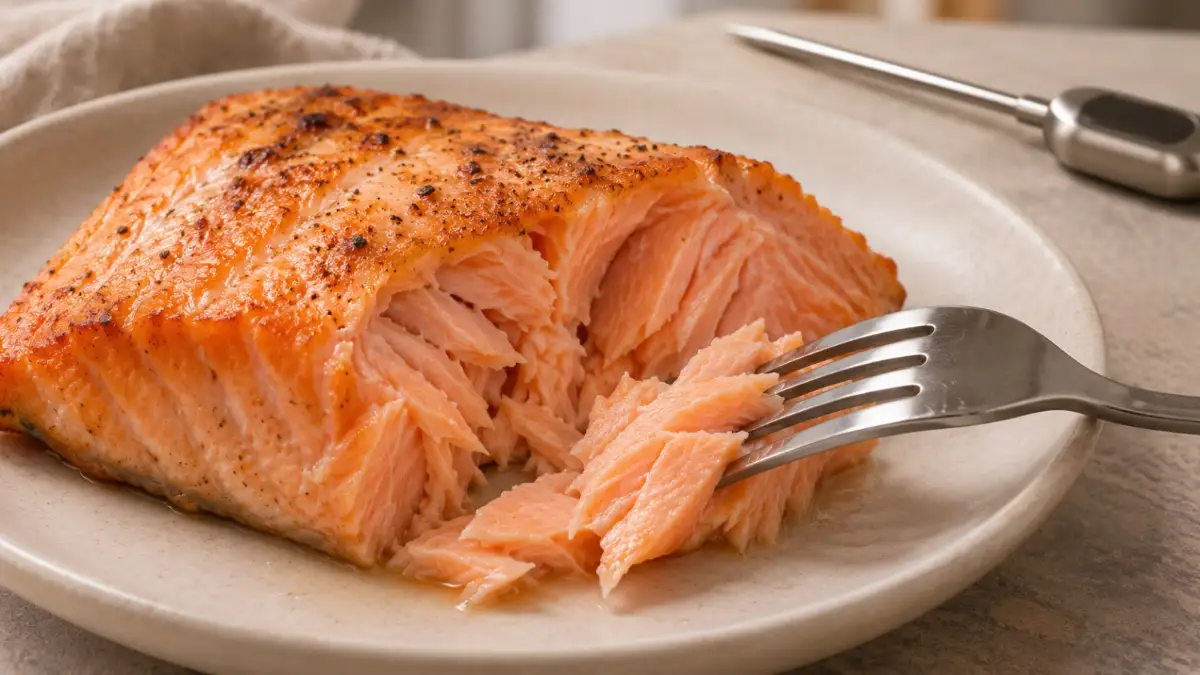
What Does Cooked Salmon Look Like generally has opaque pink-to-orange flesh that separates into flakes with gentle fork pressure. The interior can remain pink and moist, so pinkness alone does not mean it is raw. Check the thickest part of the fillet, where a glassy, translucent center suggests it needs more cooking. To confirm doneness, use a food thermometer: the recommended internal temperature for salmon is 145°F (63°C).
Color and texture help you recognize changes as salmon cooks, but neither provides the certainty of a temperature reading. A browned surface can hide an undercooked middle, while a fully cooked fillet may retain a rich pink color.
What Cooked Salmon Looks Like Inside and Outside
As salmon cooks, its flesh changes from translucent to increasingly opaque. Translucent flesh looks somewhat glassy or see-through; opaque flesh looks solid rather than transparent. You can check this change by gently opening the thickest section with a fork or the tip of a knife.
Inside, cooked salmon is usually pink, peach, or orange, sometimes noticeably lighter than before cooking. There is no single shade every fillet must reach. Its natural coloring and the cooking method affect the final appearance.
Look at the structure as well as the color. Cooked flesh separates along its natural layers into recognizable flakes. It can still look moist between those layers. Moisture alone is not a sign of undercooking, and you should not keep cooking solely to eliminate every trace of shine.
The outside varies more widely. Roasted or pan-seared salmon may develop browned edges, while gently poached salmon can remain pale. Crisp skin and a golden surface tell you about the exterior, not whether the center has reached the recommended temperature.
Undercooked vs. Cooked vs. Overcooked Salmon
The most useful comparison is at the thickest part of the fillet. Thin edges may cook through while the middle remains underdone.
| Cooking state | Interior appearance | Flaking and texture |
| Undercooked | Often glassy or translucent in the center, sometimes with a deeper pink or orange color | Center may resist separating into flakes and feel soft or slippery |
| Cooked through | Generally opaque, with pink-to-orange coloring that can remain moist | Separates into flakes under gentle pressure |
| Overcooked | Opaque and often dry-looking; color alone may resemble cooked-through salmon | Can become tough, dry, or crumbly |
These are general observations, not a safety test. A fillet does not become overcooked simply because it turns opaque, and darker coloring does not automatically mean it is raw.
Read Also: Cooked Salmon Color Chart: Raw, Cooked, and Overcooked
How to Tell If Salmon Is Cooked
A thermometer gives you the clearest answer, especially when the surface and center look different.
- Find the thickest section. Check the substantial middle portion rather than a thin edge or tail.
- Position the probe correctly. Place its sensing area in the center of the flesh, avoiding bone and the cooking surface. For a thin fillet, inserting the probe from the side can help you reach the center. Follow your thermometer’s insertion instructions.
- Read the temperature. Salmon should reach 145°F (63°C). If the reading is lower, continue cooking and check again.
- Observe the flesh. Gently separate a small section. Look for opacity and layers that release into flakes.
Without a thermometer, opaque flesh that separates easily with a fork offers useful doneness cues. However, appearance cannot reliably confirm the internal temperature.
If the middle remains glassy and does not flake readily, continue cooking and reassess. Avoid relying on a fixed number of extra minutes: a thick fillet and a thin portion will not finish at the same rate.
What Does Cooked Salmon Look Like Be Pink in the Middle?
Yes. Cooked salmon can still be pink in the middle because pink is part of its natural flesh color. You do not need to cook it until all pink disappears.
The more useful distinction is pink and opaque versus pink and translucent. An opaque pink center can be cooked through. A glassy center suggests less cooking, although appearance alone cannot tell you its exact temperature.
Some cooks prefer a translucent center for its softer texture. That preference differs from the recommended temperature for home cooking; use a thermometer to resolve uncertainty.
What Is the White Stuff on Cooked Salmon?
The white material that sometimes collects on salmon during cooking is albumin, a naturally occurring protein. As the flesh heats and its muscle fibers contract, protein is pushed toward the surface and forms white streaks or patches.
Albumin itself is edible. Its presence does not mean the salmon has spoiled, and it does not confirm that the center is done.
A greater amount of albumin may accompany overcooking, but some can appear during normal cooking too. Judge doneness by the center’s temperature rather than the amount of white coating.
Frequently Asked Questions
Does cooked salmon need to turn white throughout?
No. The flesh generally becomes more opaque, but it can retain pink, peach, or orange coloring. Cooking until the entire fillet turns white can unnecessarily dry it out.
Can salmon be overcooked and still look pink?
Yes. Pink coloring can remain even after salmon becomes dry or tough. Texture is more useful than color for recognizing overcooking.
Should every salmon fillet be checked separately?
Yes, especially when portions differ in thickness. A temperature reading from one fillet does not establish that another has reached the same temperature.
What if the salmon flakes at the edges but not in the middle?
The thinner edges may have cooked faster than the center. Check the thickest part with a thermometer and continue cooking if it is below 145°F (63°C).
Can a photograph tell me whether salmon is safely cooked?
No. A photograph may show color and texture, but lighting can alter their appearance, and it cannot establish an internal temperature. Use a thermometer when checking your own salmon.