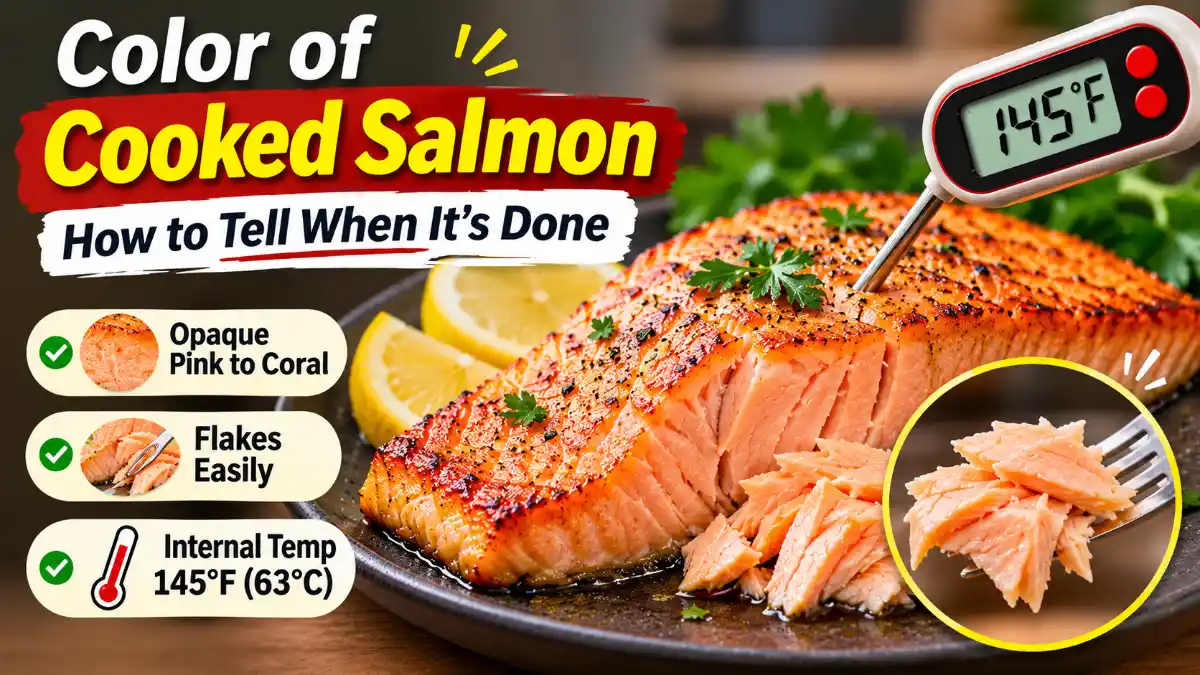
what temperature is salmon fully cooked at Yes, salmon is supposed to be pink inside, even when fully cooked. Properly cooked salmon usually has an opaque pink or coral-colored interior, a moist texture, and flesh that separates easily into flakes. However, pink color alone cannot determine whether salmon is safe to eat.
According to the U.S. Food and Drug Administration (FDA), salmon should reach an internal temperature of 145°F (63°C) to meet the recommended food-safety standard.
Some restaurants serve salmon at lower temperatures for a softer texture, but these preparations do not meet the FDA’s recommended cooking temperature.
Understanding the difference between raw, medium, and fully cooked salmon can help you avoid undercooking while preserving its natural flavor and moisture.
1. Is Salmon Supposed to Be Pink Inside?
Yes. Salmon naturally contains pink and orange pigments called carotenoids, particularly astaxanthin, which contribute to its distinctive color.
These pigments remain visible after cooking. Therefore, fully cooked salmon does not need to turn white.
The interior color depends on several factors, including the species, diet, and cooking method.
For example, sockeye salmon generally has a deeper reddish color, while Atlantic salmon often appears lighter pink or orange.
A cooked fillet may have a pink center while still meeting the recommended internal temperature.
However, a dark, glossy, or translucent center may indicate a lower degree of doneness. Because appearance is not a reliable safety test, always check the thickest part with a food thermometer.
2. When Is Salmon Done?
If you’re wondering when is salmon done, the most reliable answer is when its internal temperature reaches 145°F (63°C).
Several physical changes occur during cooking. The flesh gradually becomes opaque, its texture becomes firmer, and the muscle segments begin separating into flakes.
Common signs include:
- Flesh that appears mostly opaque rather than translucent.
- A firmer texture compared with raw salmon.
- Muscle segments that separate easily with gentle pressure.
- An internal temperature of 145°F.
Although these visual indicators are helpful, they cannot confirm food safety independently.
Insert an instant-read thermometer into the thickest portion of the fish. For thin fillets, inserting the thermometer sideways helps position the probe correctly.
Avoid touching the pan or baking tray with the thermometer tip, as this can produce an inaccurate reading.
3.what temperature is salmon fully cooked at?
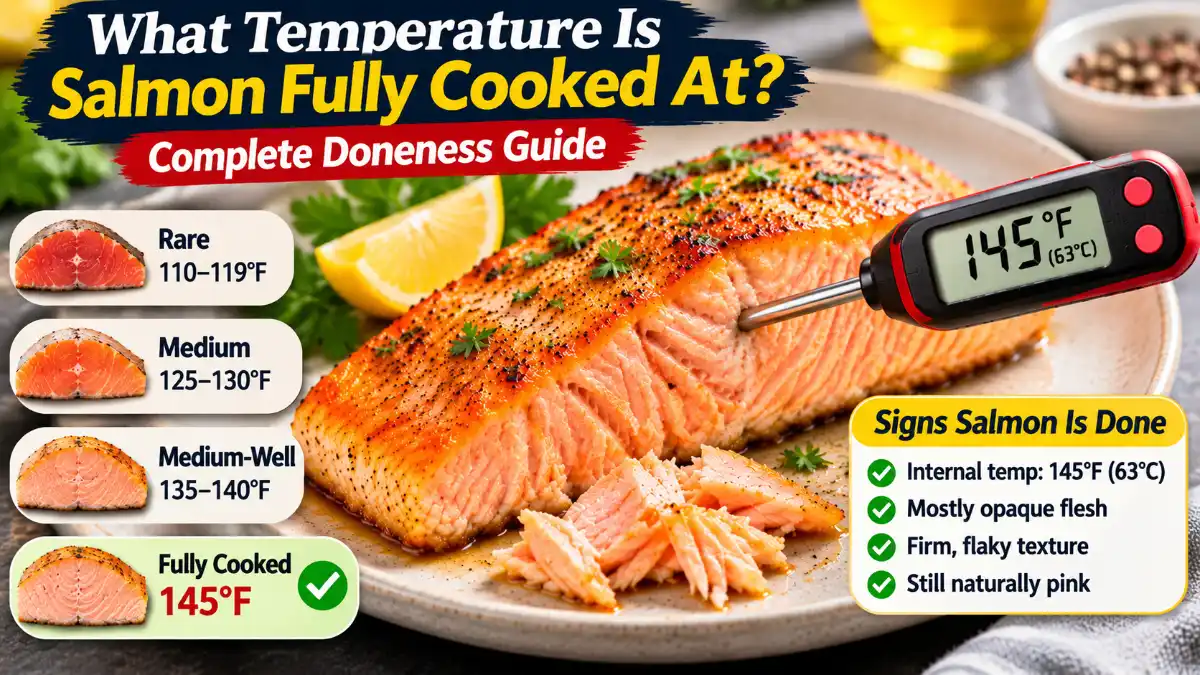
The answer to what temperature is salmon fully cooked at is 145°F (63°C), according to FDA food-safety guidance.
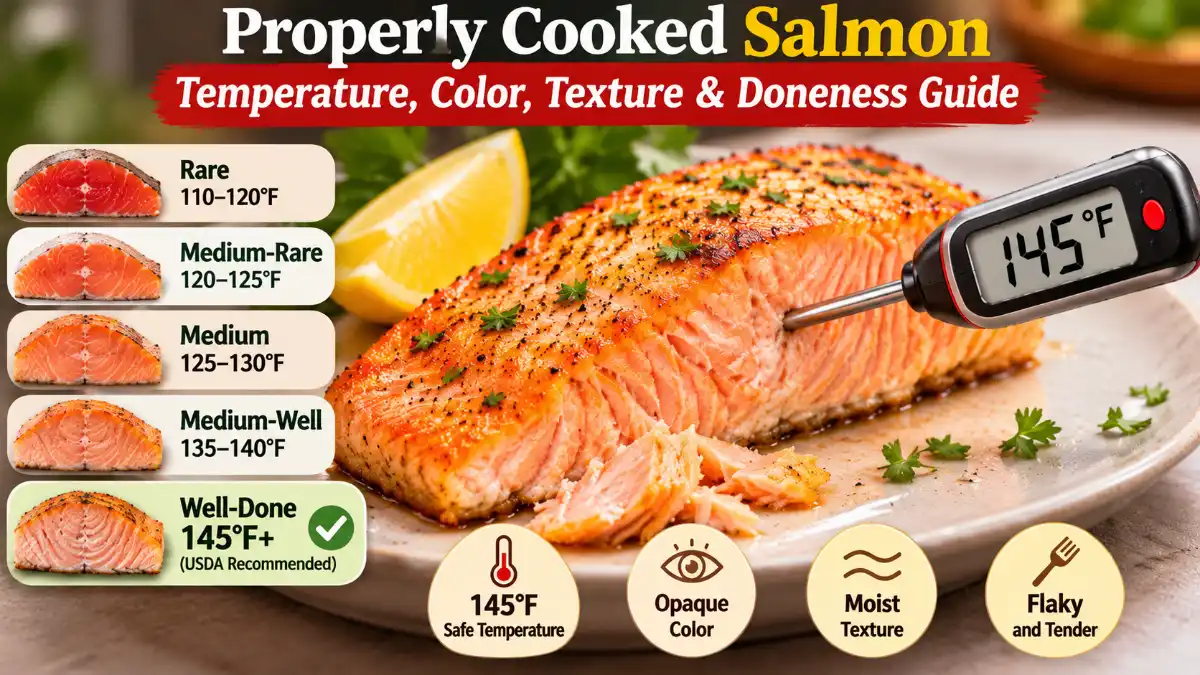
Different temperatures produce different textures, but lower cooking temperatures should not be confused with the recommended safe minimum.
| Internal temperature | Typical doneness | Appearance |
| 110–119°F | Very rare | Soft and translucent |
| 120–124°F | Rare | Moist, translucent center |
| 125–130°F | Medium | Tender, partly opaque |
| 135–140°F | Medium-well | Firmer, mostly opaque |
| 145°F | Fully cooked to FDA guidance | Generally opaque and flaky |
Note: These culinary categories are approximate, not standardized food-safety classifications. All temperatures below 145°F are below the FDA recommendation.
Cooking salmon to the recommended temperature is particularly important for pregnant people, young children, older adults, and individuals with weakened immune systems.
A properly cooked fillet can still remain moist and flavorful when temperature is monitored carefully.
4. Is Salmon Pink When Cooked?
Yes, is salmon pink when cooked is a common question because many people expect fish to become white when heated.
Unlike some white-fleshed fish, salmon retains its natural pink or orange pigmentation.
Cooking changes the structure of its proteins, causing the flesh to become more opaque and firm. However, these changes do not completely eliminate its natural color.
The final appearance varies by species:
- Atlantic salmon: Usually light pink or orange.
- Sockeye salmon: Often deeper red or coral.
- Coho salmon: Commonly medium pink to reddish-orange.
- Chinook salmon: Usually pink to orange, although some varieties have naturally white flesh.
These differences are normal and do not independently indicate whether the fish is safe to eat.
5. Is Salmon Supposed to Be Pink When Cooked?
The answer to is salmon supposed to be pink when cooked is yes. Pink flesh is a natural characteristic of salmon and does not automatically indicate undercooking.
A fillet can remain visibly pink after reaching 145°F.
Cooking methods can also change its appearance. Pan-seared salmon develops a browned exterior, grilled salmon may have darker marks, and steamed salmon generally retains a more uniform color.
You may also notice a white substance appearing on the surface.
This is albumin, a naturally occurring protein that coagulates during cooking. It is harmless and safe to eat.
Do not use the amount of albumin, exterior browning, or pink color as your primary indicator of food safety.
6. Salmon Medium Temp: What Does Medium Salmon Mean?
The phrase salmon medium temp commonly refers to an internal temperature of approximately 125–130°F (52–54°C).
At this temperature, salmon generally develops a tender texture while retaining a moist, slightly translucent center.
Some chefs prefer medium-cooked salmon because the proteins have not firmed as much as they do at higher temperatures.
However, these temperatures represent culinary preferences rather than FDA-recommended safe cooking temperatures.
Salmon cooked to 125–130°F may still contain harmful microorganisms or parasites.
For home preparation, particularly when serving vulnerable individuals, the FDA recommends cooking salmon to 145°F.
7. Medium Well Salmon Temp: How Is It Different?
A typical medium well salmon temp is approximately 135–140°F (57–60°C).
At this stage, the salmon is generally firmer and more opaque than medium-cooked fish.
The muscle segments separate more easily, and the center usually has less translucency.
The main differences are texture and appearance. Medium salmon tends to be softer, while medium-well salmon has a firmer structure.
However, medium-well salmon remains below the FDA-recommended internal temperature.
To meet the recommended food-safety standard, continue cooking until the thickest portion reaches 145°F.
Read Also: Fully Cooked Salmon: 7 Easy Signs, Safe Temperature & Health Tips
8. Raw vs Cooked Salmon: Key Differences
Understanding raw vs cooked salmon helps identify changes in texture, appearance, and protein structure.
Raw salmon typically has a glossy surface, soft texture, and translucent flesh.
As salmon cooks, its proteins coagulate, creating a firmer and more opaque appearance.
| Feature | Raw salmon | Fully cooked salmon |
| Color | Pink, orange, or red | Often lighter pink or coral |
| Texture | Soft and smooth | Firmer and flaky |
| Appearance | Glossy and translucent | Generally opaque |
| Muscle separation | Less pronounced | Separates more easily |
| Internal temperature | Not cooked | 145°F meets FDA guidance |
Raw or undercooked salmon may contain parasites or harmful microorganisms.
The CDC’s food safety guidance emphasizes safe food handling and appropriate cooking temperatures to reduce foodborne illness.
Freezing fish under specific controlled conditions can reduce certain parasite risks, but freezing does not eliminate every food-safety hazard.
9. How Does Cooked Salmon Look?
If you are wondering how does cooked salmon look, a fully cooked fillet generally has an opaque pink interior, a firm but moist texture, and flesh that separates into flakes.
The exterior appearance depends on the cooking method.
Baked salmon may have a uniform pink surface, while pan-seared salmon often develops a golden-brown crust.
Grilled salmon may display darker grill marks without being overcooked.
Overcooked salmon often becomes dry, tough, and crumbly. Its muscle segments may separate excessively, making the fish less pleasant to eat.
Proper temperature monitoring helps prevent unnecessary overcooking.
How to Cook Salmon Safely Without Drying It Out
Cooking salmon safely does not require leaving it in the oven until it becomes dry.
Begin with fillets of similar thickness so they cook evenly. If frozen, thaw salmon in the refrigerator rather than at room temperature.
Preheat the cooking equipment and use an appropriate temperature for the chosen method.
As the fish approaches doneness, check its internal temperature with a clean instant-read thermometer.
Remove the salmon from the heat once the thickest portion reaches 145°F.
Avoid repeatedly cutting the fish open to inspect its center, as this can release moisture without providing a reliable temperature measurement.
For additional guidance, read the FDA’s recommendations for selecting and serving seafood safely.
Health Risks of Eating Undercooked Salmon
Undercooked salmon can expose consumers to foodborne pathogens and parasites.
Potential symptoms of foodborne illness include nausea, vomiting, diarrhea, and abdominal discomfort.
The risk may be more serious for pregnant people, older adults, young children, and individuals with weakened immune systems.
Safe preparation also requires proper storage and handling.
Keep raw salmon separate from ready-to-eat foods, clean utensils and preparation surfaces, and refrigerate perishable seafood promptly.
Discard salmon that develops a sour, rancid, or ammonia-like smell. Cooking does not reliably make spoiled fish safe.
For broader prevention advice, consult the CDC’s food poisoning prevention resources.
Frequently Asked Questions
1. Can salmon be fully cooked and still pink in the middle?
Yes. Fully cooked salmon can remain pink or coral-colored because of its natural pigments. The important safety indicator is its internal temperature, which should reach 145°F (63°C) under FDA guidance.
2. Is salmon safe to eat at 125°F?
Salmon cooked to 125°F is below the FDA-recommended temperature. Although some culinary preparations use this temperature, it carries additional food-safety risks, especially for vulnerable individuals.
3. Why is my salmon pink but not flaky?
Salmon may remain soft and resist flaking if it has not cooked sufficiently. However, texture varies depending on thickness, species, and cooking method. Check the internal temperature to determine whether it has reached 145°F.
4. Can undercooked salmon cause food poisoning?
Yes. Raw or undercooked salmon may contain harmful microorganisms or parasites that cause foodborne illness. Symptoms can include nausea, vomiting, diarrhea, and stomach pain. Proper cooking and handling help reduce these risks.
5. What is the safest internal temperature for salmon?
The FDA recommends cooking salmon to 145°F (63°C). Measure the thickest portion with a food thermometer rather than relying solely on color, texture, or cooking time.