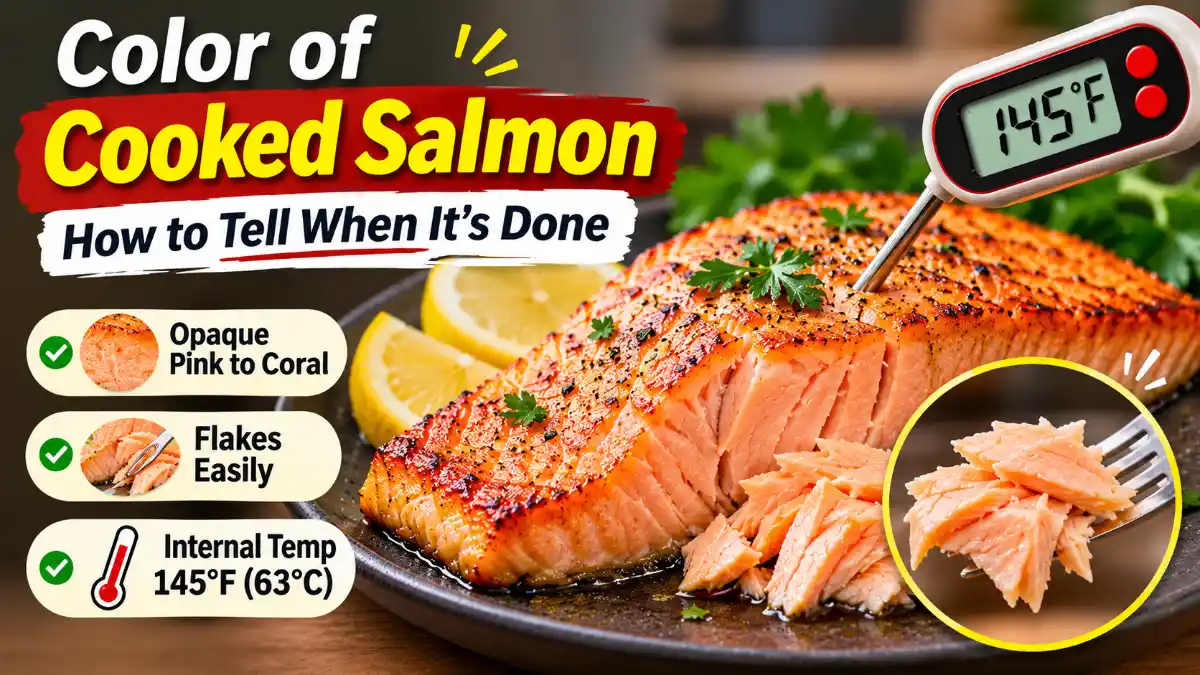
Properly cooked salmon should reach an internal temperature of 145°F (63°C), according to USDA food safety guidelines. At this temperature, the fish is typically opaque, moist, and easy to separate into flakes with a fork. Its flesh may remain pink or orange because salmon naturally contains pigments that do not disappear completely during cooking.
The safest way to check salmon is with a food thermometer inserted into the thickest part of the fillet. Color, texture, and flaking can help you judge doneness, but they cannot reliably confirm food safety on their own.
Salmon can be prepared rare, medium, or well-done, depending on culinary preferences. However, lower cooking temperatures do not meet the USDA’s recommended safety standard. Understanding these differences helps you avoid undercooking while preserving as much moisture and flavor as possible.
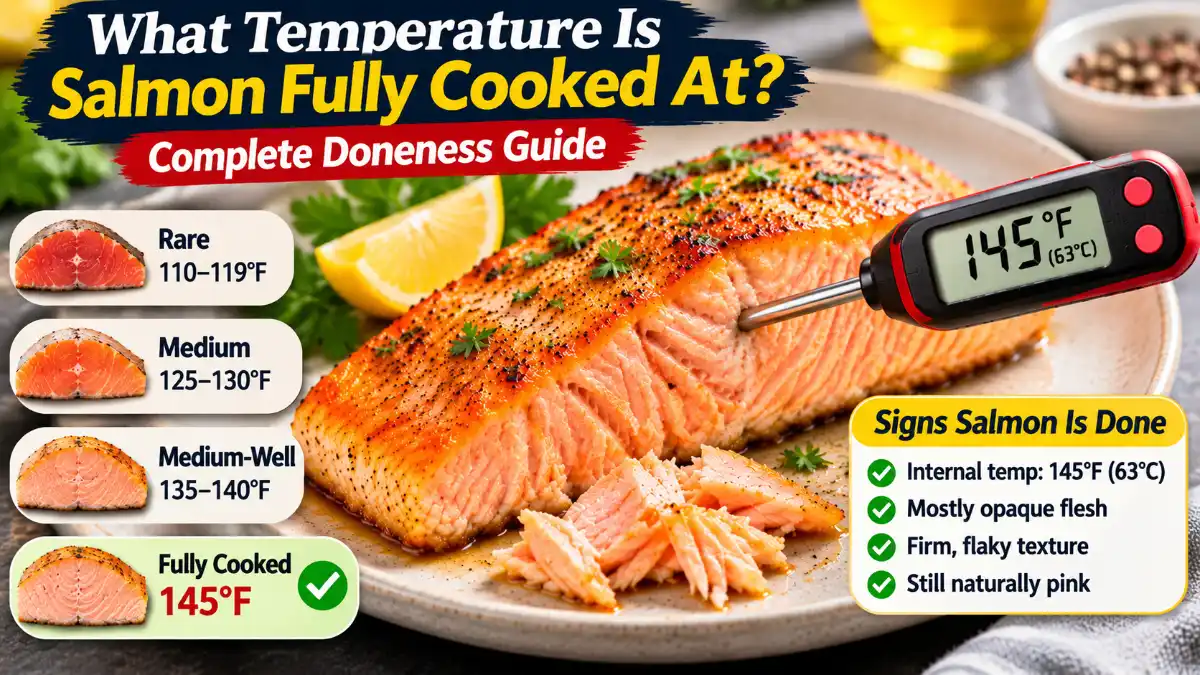
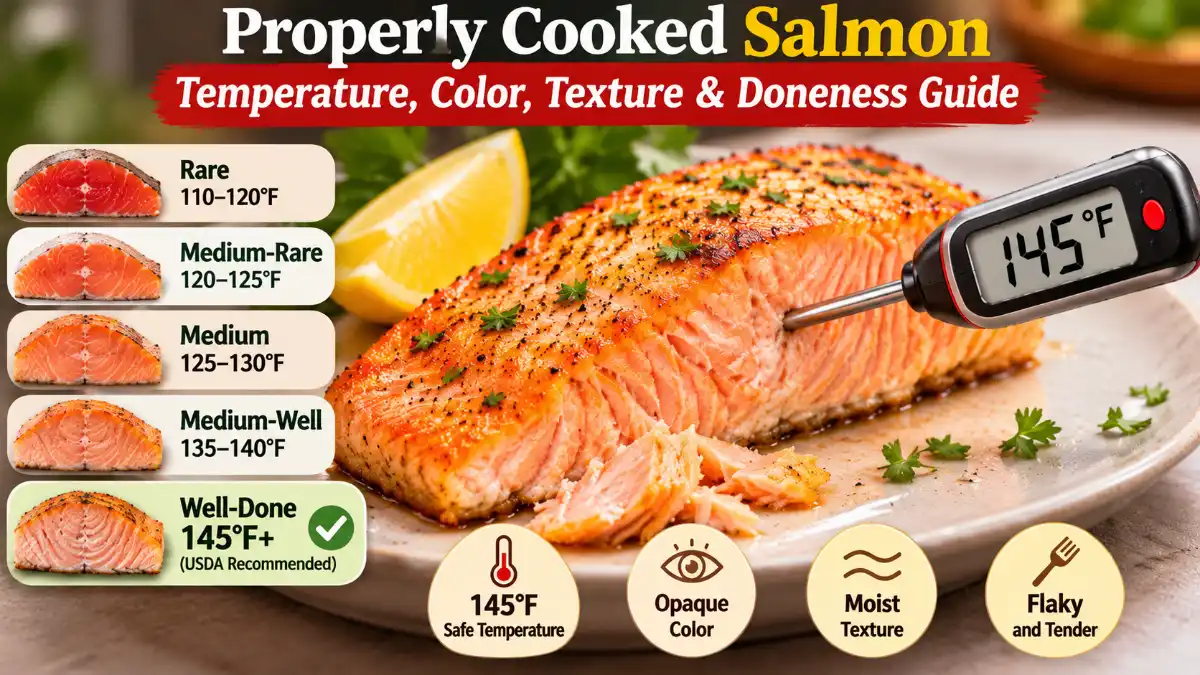
Salmon Doneness Temperature Chart
Different cooking temperatures change salmon’s texture, appearance, and moisture content.
| Doneness | Approximate temperature | Appearance | Food safety |
| Rare | 110–120°F | Translucent, soft center | Below USDA recommendation |
| Medium-rare | 120–125°F | Tender, partly translucent | Below USDA recommendation |
| Medium | 125–130°F | Pink, moist center | Below USDA recommendation |
| Medium-well | 135–140°F | Mostly opaque, firmer texture | Below USDA recommendation |
| Well-done | 145°F or higher | Opaque, flaky, firm | Meets USDA recommendation |
These culinary temperature ranges are approximate and may vary between chefs. Only the 145°F threshold represents the USDA’s recommended minimum internal temperature for fish.
1. Medium Salmon: Temperature and Texture
Medium salmon generally reaches an internal temperature of approximately 125–130°F (52–54°C). The exterior appears cooked and opaque, while the center remains pink, soft, and moist.
At this stage, the flesh separates into delicate layers without feeling excessively firm. Its natural fat contributes to the tender texture.
Some restaurants offer salmon at this doneness because customers prefer a softer center. However, this temperature remains below the USDA’s recommended minimum.
People who are pregnant, older adults, young children, and individuals with weakened immune systems should avoid undercooked fish because they face a greater risk of serious foodborne illness.
For safer home preparation, cook salmon until its thickest section reaches 145°F.
2. How Should Salmon Look When Cooked?
If you’re wondering how should salmon look when cooked, examine its color, texture, and moisture.
Raw salmon usually has a glossy, translucent appearance. As it cooks, the flesh becomes lighter and more opaque. Depending on the species, finished salmon may appear pale pink, peach, coral, or light orange.
The muscle layers should separate when gently pressed with a fork. Salmon that has reached the recommended temperature can still remain moist rather than dry or chalky.
You might notice white material on the surface. This is albumin, a natural protein that becomes visible when heated. It is harmless and safe to eat.
However, the fish’s appearance cannot prove that it has reached a safe temperature. A thermometer remains the most dependable method.
3. Medium Cooked Salmon: Is It Safe?
Medium cooked salmon is usually associated with a moist center and an internal temperature around 125–130°F.
Although some culinary preparations intentionally use this temperature, it does not meet standard USDA guidance.
Salmon can contain harmful microorganisms, including certain bacteria and parasites. Proper freezing procedures can reduce parasite risks in fish intended for raw consumption, but freezing does not reliably eliminate every foodborne hazard.
Even high-quality, fresh-looking salmon may carry microorganisms that cannot be detected through smell, color, or texture.
For home cooks, reaching 145°F is the recommended approach. This is particularly important when preparing meals for people at greater risk of foodborne illness.
4. Rare Salmon: Appearance and Health Risks
Rare salmon typically has a lightly cooked exterior and a translucent, soft center. Its internal temperature may be approximately 110–120°F.
Because the center receives relatively little heat, rare preparation does not meet the recommended cooking temperature for fish.
Eating raw or undercooked seafood increases exposure to potential foodborne hazards. Depending on the organism involved, illness may cause nausea, abdominal pain, vomiting, or diarrhea.
Some fish served raw undergo specialized freezing procedures designed to control parasites. However, these procedures do not guarantee protection against all harmful bacteria.
Anyone choosing rare fish should understand these limitations. Thorough cooking remains the safer general recommendation.
5. Salmon Well Done: How to Keep It Moist
Salmon well done is generally opaque, firm, and flaky. At 145°F, it meets the USDA’s recommended minimum temperature, although cooking substantially beyond that point can reduce moisture.
As salmon heats, muscle proteins tighten and release liquid. Excessive cooking can therefore create a dry or chalky texture.
To reduce overcooking, use moderate heat and check the internal temperature as the fish approaches doneness.
A little olive oil or a suitable marinade may improve flavor and mouthfeel. However, neither oil nor marinade makes undercooked fish safe.
Remove the salmon from the heat once the thickest section reaches 145°F. Avoid leaving it in a hot pan unnecessarily after cooking.
6. What Should Salmon Be Cooked To?
The answer to what should salmon be cooked to is 145°F (63°C) at the thickest part, according to the USDA.
This recommendation applies whether you bake, grill, pan-sear, or air-fry salmon.
For an accurate reading, insert an instant-read thermometer into the thickest section. If the fillet is thin, insert the probe sideways toward its center.
Avoid touching the cooking pan, tray, or grill surface with the probe, since contact can affect the reading.
For example, if a fillet measures 138°F in the center, continue cooking and check again shortly. Once it reaches 145°F, remove it from the heat.
Do not rely on a fixed cooking time alone. Thickness, starting temperature, equipment, and heat intensity can all change how quickly salmon cooks.
7. How Do You Know If Salmon Is Cooked?
To answer how do you know if salmon is cooked, start with the internal temperature and use visible changes as supporting clues.
Signs commonly associated with cooked salmon include:
- An internal temperature of 145°F.
- Flesh that appears more opaque than raw fish.
- Layers that separate easily with a fork.
- A firm but moist center.
- Small amounts of white albumin on the surface.
A salmon fillet may brown on the outside while remaining undercooked in the middle, particularly when cooked over high heat.
Similarly, a pink center does not automatically mean the fish is raw. Different salmon species retain different shades after cooking.
A thermometer is therefore more dependable than judging doneness by appearance alone.
8. How Is Cooked Salmon Supposed to Look?
Understanding how is cooked salmon supposed to look helps distinguish normal cooking changes from excessive cooking.
As salmon heats, its proteins change structure, causing the flesh to become increasingly opaque and firm.
A finished fillet generally has visible layers that separate easily. The interior may remain pink or orange, depending on the salmon variety.
Ideally, the fish retains moisture and does not crumble into dry, tough pieces. A chalky texture can indicate prolonged cooking.
White albumin is also normal. Its presence does not mean the fish has spoiled.
Nevertheless, texture and appearance should support—not replace—a proper temperature measurement.
Read Also: Is Salmon Supposed to Be Pink Inside? Cooking Temperature and Safety Guide
Best Cooking Methods for Moist and Safe Salmon
The cooking method affects how evenly salmon heats and how much moisture it retains.
| Cooking method | Practical technique | Main advantage |
| Oven baking | Use moderate oven heat and check the center | Even cooking |
| Pan-searing | Brown the surface, then reduce heat if necessary | Crisp exterior |
| Grilling | Use controlled heat and avoid excessive charring | Smoky flavor |
| Air frying | Check early, especially with thin fillets | Convenient cooking |
Cooking time varies with fillet thickness and appliance performance. Regardless of the method, use 145°F as the recommended internal temperature.
How to Check Salmon With a Food Thermometer
For accurate results, follow these steps:
- Insert the thermometer probe into the thickest part of the fillet, aiming for the center.
- Wait until the temperature reading stabilizes.
- If the temperature is below 145°F, continue cooking.
- Check another thick section if the fillet has an uneven shape.
- Once the relevant sections reach 145°F, remove the salmon from the heat.
For a thin fillet, insert the probe horizontally from the side rather than straight down. This helps position the sensor in the center without touching the cooking surface.
A thermometer provides a clearer measurement than cutting into the fish repeatedly.
Properly Cooked Salmon Mistakes to Avoid
Several simple mistakes can affect salmon’s texture or food safety.
Relying only on color: Pink flesh does not necessarily mean salmon is raw, and a browned exterior does not prove the center is fully cooked.
Using excessive heat: High temperatures may dry the outside before the thickest section finishes cooking.
Skipping the thermometer: Cooking times are estimates, particularly when fillets vary in thickness.
Thawing on the counter: Leaving frozen salmon at room temperature can allow harmful bacteria to multiply.
Cross-contamination: Using the same unwashed utensils or cutting board for raw and cooked salmon can transfer microorganisms.
The FDA recommends refrigerating seafood at 40°F (4°C) or below, thawing it safely, and keeping raw seafood separate from ready-to-eat foods.
FDA+1
Salmon Food Safety: Storage and Leftovers
Safe cooking is only one part of preparing seafood. Proper storage matters before and after cooking.
Fresh salmon should be refrigerated promptly and generally used within two days of purchase or frozen for later use.
After cooking, refrigerate leftovers within two hours, or within one hour if the surrounding temperature exceeds 90°F (32°C).
Store cooked salmon in shallow, covered containers to help it cool promptly. Reheat leftovers to 165°F (74°C), the recommended temperature for leftovers.
These practices help reduce the risk of foodborne illness.
Frequently Asked Questions
1. Can salmon be fully cooked and still pink inside?
Yes. Salmon may retain a pink or orange color after cooking because of its natural pigments. The most reliable way to confirm doneness is to measure the thickest section with a thermometer and ensure it reaches 145°F.
2. Is salmon safe to eat at 125°F?
Salmon cooked to 125°F does not meet the USDA’s recommended minimum temperature. Some culinary preparations use this temperature for a softer texture, but eating undercooked fish carries additional food safety risks.
3. Why does cooked salmon have white stuff on top?
The white substance is usually albumin, a naturally occurring protein that becomes visible as salmon heats. It is harmless and safe to eat. Its presence alone does not indicate spoilage or establish whether the fish is fully cooked.
4. Can salmon be slightly translucent in the middle?
A translucent center may indicate incomplete cooking. For safer preparation, cook salmon to 145°F or follow official guidance for opaque flesh that separates easily with a fork. Using a thermometer is the preferred method.
5. What happens if you accidentally eat undercooked salmon?
Undercooked salmon may expose you to harmful bacteria or parasites. Possible symptoms include nausea, vomiting, diarrhea, and abdominal pain. Seek medical attention for severe symptoms, dehydration, persistent illness, or symptoms affecting someone at higher risk.