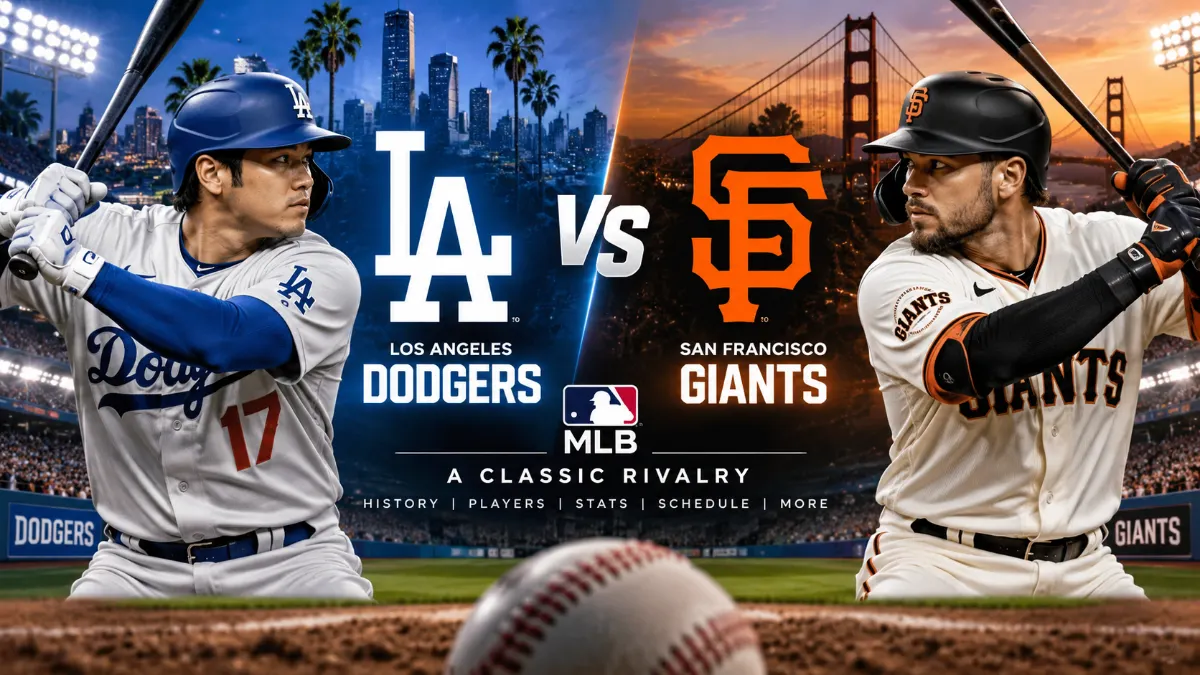
Few baseball matchups carry the historical weight of Dodgers vs Giants. The Los Angeles Dodgers and San Francisco Giants are now identified with California, but their rivalry began thousands of miles away in New York. That unusual journey-from Brooklyn and Manhattan to Los Angeles and San Francisco-helped create a competition spanning generations, ballparks, legendary players, pennant races, and unforgettable games.
What separates this matchup from a typical divisional rivalry is continuity. The uniforms, cities, stadiums, and stars have changed, yet the two franchises have remained connected as opponents. From Bobby Thomson’s famous 1951 home run to the dramatic 2021 National League Division Series, the rivalry has repeatedly produced meaningful baseball when the stakes were highest.
Why Are the Dodgers and Giants Such Big Rivals?
The Dodgers and Giants are rivals because they spent decades competing against each other in New York before both franchises moved to California for the 1958 season. Their new homes created another natural geographic divide: Southern California against Northern California.
Three ingredients have kept the rivalry strong:
- More than a century of shared history
- Direct competition within the National League
- Repeated games with pennant, division, or postseason consequences
Today, both franchises compete in the National League West, keeping the matchup relevant even when one club is having a stronger season than the other.
Dodgers vs Giants: Quick Comparison
| Feature | Dodgers | Giants |
| Current identity | Los Angeles Dodgers | San Francisco Giants |
| Former identity | Brooklyn Dodgers | New York Giants |
| Current division | NL West | NL West |
| California era started | 1958 | 1958 |
| Current home | Dodger Stadium | Oracle Park |
| First official postseason meeting | 2021 NLDS | 2021 NLDS |
| 2021 NLDS outcome | Won 3–2 | Lost 3–2 |
The simultaneous relocation of both franchises is especially important. Instead of destroying an existing rivalry, the moves allowed it to develop a second identity.
1. New York Created the Rivalry Before California Inherited It
Modern fans associate the matchup with Los Angeles and San Francisco, but its foundation was established in New York.
The Giants represented New York while the Dodgers became closely identified with Brooklyn. Their proximity meant that games could carry local significance in addition to their importance in the National League standings.
The competition eventually became embedded in the identities of both franchises.
This background explains why calling it merely a “California rivalry” misses much of the story. California inherited an established baseball feud rather than creating one from scratch.
2. Bobby Thomson Changed the Rivalry Forever in 1951
October 3, 1951 produced the rivalry’s most famous early moment.
Brooklyn and the New York Giants had reached a three-game tiebreaker to determine the National League pennant. After splitting the first two games, the entire race came down to Game 3.
Brooklyn led 4–1 entering the bottom of the ninth inning.
The Giants rallied.
With New York trailing 4–2, Bobby Thomson faced Dodgers pitcher Ralph Branca and hit a three-run home run that gave the Giants a 5–4 victory.
The home run became known as the “Shot Heard ’Round the World.”
Its significance extended beyond one spectacular play. The Giants had completed a dramatic pennant-race comeback and eliminated their biggest rival in the deciding game.
For generations of baseball fans, Thomson’s homer became shorthand for the emotional stakes surrounding this matchup.
3. The Rivalry Traveled Across America in 1958
A major sports rivalry normally depends heavily on geography.
That makes what happened after the 1957 season particularly unusual.
The Dodgers left Brooklyn for Los Angeles.
The Giants left New York for San Francisco.
Beginning in 1958, both franchises were playing on the West Coast.
The moves transformed the rivalry without erasing it.
Instead of competing for New York baseball attention, the teams became representatives of two major California regions. Los Angeles and San Francisco provided a new geographic foundation for an old competition.
That continuity remains one of the rivalry’s most distinctive characteristics.
4. The 1962 Pennant Race Repeated History
If 1951 seemed impossible to repeat, the teams came remarkably close just 11 years later.
The Dodgers and Giants finished the scheduled 1962 season tied, requiring another three-game tiebreaker to determine the National League pennant.
San Francisco won Game 1.
Los Angeles answered in Game 2.
Once again, the rivals reached a decisive third game.
The Dodgers carried a 4–2 lead into the ninth inning, but the Giants scored four runs and won 6–4.
San Francisco advanced to the World Series.
The parallels with 1951 were extraordinary: another tied race, another three-game showdown, and another Giants comeback in the deciding contest.
An important statistical detail often causes confusion here. The 1951 and 1962 tiebreakers determined pennants, but historically they are counted as extensions of the regular season rather than official postseason series.
That distinction would become important decades later.
5. The 1965 Marichal-Roseboro Incident Showed the Rivalry’s Darker Side
Rivalries can create excitement, but extreme emotions can also cross acceptable boundaries.
That happened at Candlestick Park on August 22, 1965.
Giants pitcher Juan Marichal and Dodgers catcher John Roseboro became involved in a confrontation after tensions had escalated during the game. Marichal struck Roseboro with a bat, resulting in an ugly benches-clearing incident.
Marichal was subsequently suspended.
The episode remains one of the rivalry’s most notorious moments and should not be treated as something admirable. It demonstrates how intense competitive hostility can become dangerous when players lose control.
There was, however, an important later chapter: Marichal and Roseboro eventually reconciled and developed a friendship.
6. Spoiling the Other Team’s Season Became Part of the Story
A rivalry is not defined only by championships.
Sometimes preventing the opponent from succeeding becomes a memorable chapter of its own.
The Dodgers and Giants have experienced both sides of that dynamic.
Giants Hurt the Dodgers in 1982
Late in the 1982 season, both teams were involved in the NL West picture.
By the final day, San Francisco’s own path had disappeared, but the Giants could still damage Los Angeles.
Joe Morgan hit a crucial three-run home run as San Francisco defeated Los Angeles 5–3.
The loss eliminated the Dodgers from the division race.
Dodgers Answer in 1993
The situation was reversed in 1993.
San Francisco had produced an outstanding season and entered the final day still fighting Atlanta for the NL West.
Los Angeles defeated the Giants 12–1.
San Francisco finished with 103 wins yet missed the postseason after Atlanta finished one game ahead.
These two seasons help explain the psychology of the rivalry. Success is important, but games can remain meaningful simply because the opponent has something important to lose.
7. Legendary Players Gave Every Era Its Own Identity
A rivalry lasting this long cannot depend on a single generation.
The Giants have featured iconic players such as:
- Willie Mays
- Willie McCovey
- Juan Marichal
- Barry Bonds
- Buster Posey
- Madison Bumgarner
The Dodgers have countered with generations of stars including:
- Jackie Robinson
- Duke Snider
- Sandy Koufax
- Don Drysdale
- Fernando Valenzuela
- Clayton Kershaw
These names also illustrate how much baseball changed while the rivalry endured.
The game played by Jackie Robinson and Willie Mays belonged to a different baseball environment from the one experienced by Clayton Kershaw, Buster Posey, and later generations.
The opponent, however, remained familiar.
8. The 2021 Season Created a Modern Classic
For younger fans, 2021 may be the clearest example of what this rivalry can become when both clubs are elite simultaneously.
San Francisco finished the regular season with 107 wins.
Los Angeles finished with 106.
The Giants captured the NL West by a single game, despite the Dodgers recording a win total that would ordinarily be more than enough to dominate a division.
San Francisco also narrowly won the regular-season series between the clubs, 10–9.
The numbers demonstrate how little separated the teams.
Then came October.
Read More: Dodgers vs Giants Rivalry: 9 Defining Moments Behind Baseball’s Epic West Coast Battle
9. Dodgers vs Giants Finally Became a Postseason Series
Despite more than a century of shared history, the teams had never met in an official postseason series before 2021.
That changed in the National League Division Series.
The matchup immediately lived up to expectations.
| Game | Result |
| Game 1 | Giants won 4–0 |
| Game 2 | Dodgers won 9–2 |
| Game 3 | Giants won 1–0 |
| Game 4 | Dodgers won 7–2 |
| Game 5 | Dodgers won 2–1 |
San Francisco took a 2–1 series lead after three games.
Los Angeles responded in Game 4, sending the series back to San Francisco for a winner-take-all Game 5.
The deciding contest was tied 1–1 before Cody Bellinger drove in the go-ahead run in the ninth inning.
Los Angeles held on for a 2–1 victory and won the series 3–2.
The outcome gave the Dodgers the first official postseason-series victory in the history of the rivalry.
Dodgers vs Giants Head-to-Head: Why the Cutoff Date Matters
Fans frequently want to know which franchise leads the Dodgers vs Giants head-to-head record.
The answer must include a date.
Because the franchises continue playing each other every season, their lifetime win-loss totals change whenever they meet.
One particularly remarkable snapshot came entering their first regular-season matchup of 2026: MLB listed the historical series at 1,288 Dodgers wins, 1,288 Giants wins, and 17 ties.
That exact balance after generations of competition illustrates why the rivalry cannot easily be reduced to one franchise dominating the other.
Different measurements also answer different questions.
All-Time Regular Season
This includes the rivalry’s New York and California eras and is the broadest historical comparison.
California Era
This isolates games played since both franchises relocated for the 1958 season.
Individual Season Series
This tells readers which team performed better against the other in a specific year.
For example, San Francisco won the 2021 regular-season series 10–9.
Postseason
The sample is dramatically smaller.
Their first official postseason series was the 2021 NLDS, which Los Angeles won 3–2.
These categories should not be mixed together when evaluating head-to-head performance.
What Makes Dodger Stadium and Oracle Park Different?
The rivalry’s California chapter is also shaped by two distinctive home environments.
Dodger Stadium
Opened in 1962, Dodger Stadium has hosted generations of games between Los Angeles and San Francisco.
Its longevity gives it unusual continuity. A modern rivalry game takes place in the same stadium where Giants and Dodgers teams competed decades earlier.
Oracle Park
Oracle Park gives San Francisco home games a dramatically different visual identity.
Its waterfront location and McCovey Cove beyond right field are among the ballpark’s defining features.
The contrasting venues reinforce the geographic character of the modern rivalry: one series takes place in Southern California, the next may shift north to San Francisco.
Dodgers vs Giants Rivalry Timeline
| Year | What Happened |
| Late 1800s | Rivalry develops while both franchises are based in New York |
| 1951 | Bobby Thomson hits the “Shot Heard ’Round the World” |
| 1958 | Both franchises begin playing in California |
| 1962 | Giants win a three-game pennant tiebreaker |
| 1965 | Marichal-Roseboro confrontation occurs |
| 1982 | Giants help eliminate Dodgers from NL West race |
| 1993 | Dodgers defeat Giants on final day of San Francisco’s 103-win season |
| 2021 | Giants win 107 games; Dodgers win 106 |
| 2021 | Dodgers win first official postseason meeting, 3–2 in NLDS |
| 2026 | All-time series enters first regular-season meeting tied at 1,288 wins each |
Looking at the rivalry as a timeline reveals its real strength: meaningful moments are distributed across completely different generations.
Is Dodgers vs Giants Bigger Than a Normal Division Rivalry?
Yes, primarily because the relationship predates the NL West itself.
Modern divisional competition gives the teams a practical reason to care about each meeting. But division standings alone do not explain why games between them attract unusual attention.
The deeper reasons are historical:
Continuity: The rivalry survived both franchises changing cities.
Competitive balance: Neither side has permanently controlled every era.
Consequential games: Pennants and postseason advancement have been decided through direct competition.
Generational connection: Fans can associate different eras with different stars while following the same matchup.
Geographic identity: New York provided the original foundation; California created the modern version.
That combination gives the rivalry dimensions that newer divisional matchups cannot easily replicate.
Frequently Asked Questions
1. Why are the Dodgers and Giants rivals?
The rivalry originated when both franchises played in New York. The Dodgers were associated with Brooklyn, while the Giants represented New York. Both moved to California for the 1958 season, transforming the matchup into Los Angeles versus San Francisco. Decades of pennant races, division battles and memorable head-to-head games have kept the competition relevant.
2. How old is the Dodgers vs Giants rivalry?
Its roots extend to the late 19th century, making it one of professional baseball’s longest-running franchise rivalries. The competition existed decades before either club moved to California. This longevity is important because today’s NL West games continue a relationship that began in an entirely different era of American baseball.
3. What was the biggest Dodgers-Giants game ever?
There is no universally correct choice, but Game 3 of the 1951 National League tiebreaker is the most historically famous candidate. Bobby Thomson’s ninth-inning three-run home run gave the Giants a 5–4 victory over Brooklyn and the NL pennant. The play became known as the “Shot Heard ’Round the World.”
4. Did the Dodgers and Giants both move to California at the same time?
Yes. Both relocated after the 1957 season and began playing in California in 1958. The Dodgers moved from Brooklyn to Los Angeles, while the Giants moved from New York to San Francisco. Their simultaneous relocation was crucial because it allowed an established New York rivalry to continue on the West Coast.
5. Who won the 1962 Dodgers-Giants tiebreaker?
The Giants won the three-game tiebreaker two games to one. In the deciding game, Los Angeles led 4–2 entering the ninth inning before San Francisco scored four runs and won 6–4. The victory sent the Giants to the World Series and created another dramatic parallel with their 1951 pennant victory over Brooklyn.
6. When did the Dodgers and Giants first meet in the playoffs?
Their first official postseason series came in the 2021 NLDS. Los Angeles won the best-of-five series 3–2. The famous 1951 and 1962 tiebreakers are historically counted as regular-season games, even though they determined National League pennants, which explains the surprisingly late date of their first official postseason matchup.
7. Who won the 2021 Dodgers vs Giants rivalry?
It depends on the competition being measured. San Francisco won the regular-season series 10–9 and captured the NL West with 107 victories compared with Los Angeles’ 106. The Dodgers, however, defeated the Giants 3–2 in the NLDS and eliminated them from the postseason.
8. Are the Dodgers and Giants in the same division?
Yes. Both teams compete in the National League West. Sharing a division ensures regular head-to-head meetings and means those games can directly affect divisional standings. This modern competitive structure reinforces a rivalry that existed long before MLB adopted its current divisional system.
9. Where do Dodgers-Giants games take place?
Los Angeles hosts its home games at Dodger Stadium, while San Francisco plays at Oracle Park. Both ballparks are strongly associated with the California version of the rivalry. Before the franchises moved west, earlier chapters were played at New York venues associated with Brooklyn and the New York Giants.
10. Is the Dodgers-Giants rivalry still important today?
Yes, although its competitive intensity varies by season. Both clubs remain NL West opponents, so their games continue to affect the same divisional landscape. The 2021 season demonstrated the rivalry’s modern potential particularly well: San Francisco won 107 games, Los Angeles won 106, and the teams then played a five-game NLDS.