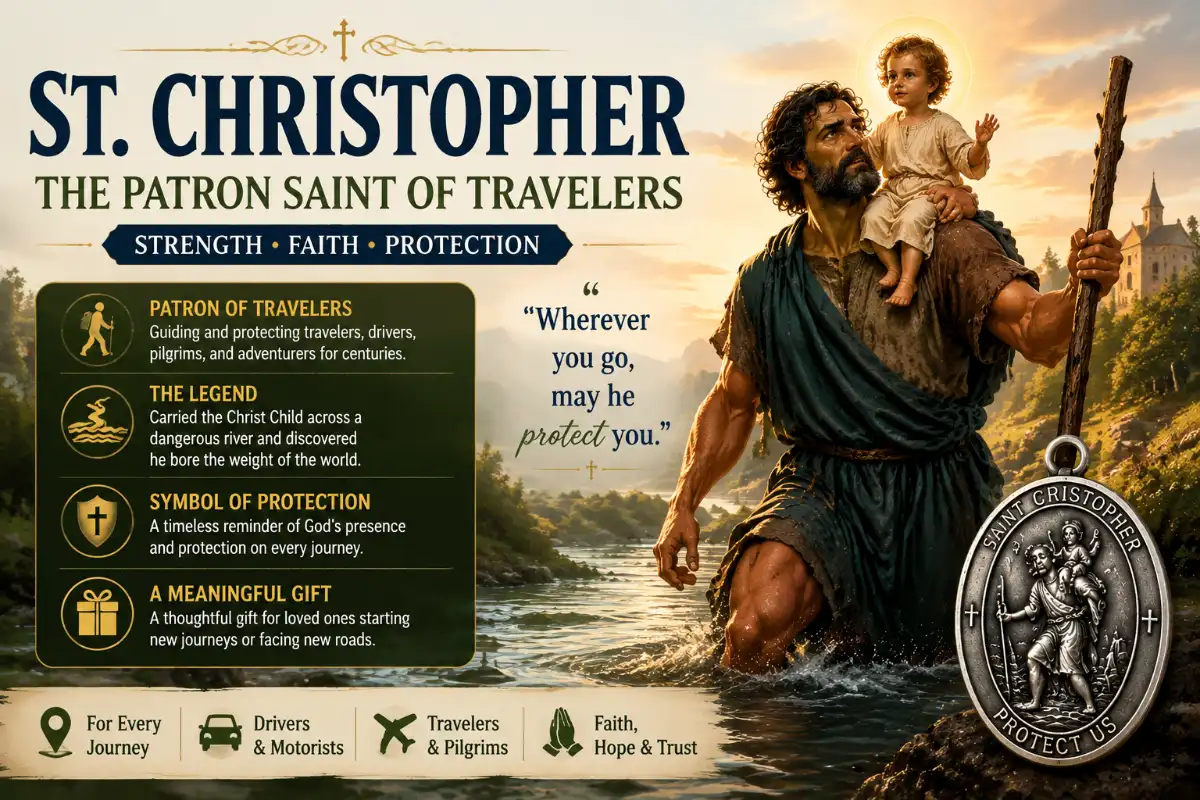
st. christopher A small silver medal, a bearded giant wading through water, a child perched on his shoulder. This image has traveled from the walls of medieval churches into glove compartments, backpacks, and jewelry boxes across the world. At the center of it is St. Christopher, a figure whose story has outlived empires, survived a liturgical controversy, and still shapes how millions of people think about safe travel.
This piece takes a different route into that story. Rather than starting with a dry biography, it starts where most people actually encounter St. Christopher today: on a medal around someone’s neck or clipped to a car mirror, and works backward to the legend, the theology, and the unresolved historical questions that make his cult one of the most enduring in Christianity.
The Medal Comes First for Most People
For the average person today, St. Christopher rarely begins with a history book. He begins with a gift: a grandmother’s necklace, a small charm tucked into a new driver’s glovebox, a pendant bought before a long flight. The medal typically shows the saint carrying a child across water, often with an inscription asking for his protection.
That object carries centuries of accumulated meaning even when the wearer knows little about the man behind it. Understanding what the medal represents requires going back to a single legend that has barely changed in its essentials since it was first written down.
The Story Behind the Image
A Giant Looking for the Greatest Master
Christian tradition holds that St. Christopher was originally called Offerus, a man of unusual size and strength. Restless and proud of his physical power, he resolved to serve only the mightiest ruler alive. He attached himself first to a king, then abandoned that king upon learning the ruler feared the devil, reasoning that the devil must be stronger still.
Serving the devil next, Offerus eventually noticed his new master avoiding a roadside cross, and when told this was out of fear of Christ, he concluded that Christ must outrank even the devil. A hermit then instructed him in the Christian faith and set him to a peculiar form of service suited to his size: ferrying travelers across a swollen, dangerous river with no bridge.
The Weight That Changed Everything
Offerus built a hut on the riverbank and spent his days carrying pilgrims and merchants safely to the other side, using a long staff to steady himself against the current. One night, a child asked to cross. Partway through the water, the child’s weight became so extreme that Offerus feared they would both drown, comparing the burden afterward to carrying the entire world on his back.
Once safely across, the child identified himself as Christ and explained that Offerus had, in fact, been carrying the weight of the world and its Creator. The staff Offerus had used, according to the legend, was later planted in the ground and grew into a living tree. From that encounter came a new name: Christopher, built from the Greek Christos and phero, together meaning one who bears Christ.
Fact, Faith, and the Limits of History
It is worth being direct about what can and cannot be verified. No surviving document from the third century confirms a historical St. Christopher, and the narrative familiar today took shape gradually through medieval hagiography rather than eyewitness testimony. The most influential written version appears in Jacobus de Voragine’s thirteenth-century compilation, The Golden Legend, which shaped how artists and preachers portrayed him for generations afterward.
This gap between legend and documented history is not unusual for saints from the early centuries of Christianity, when oral tradition and devotional storytelling often preceded formal record-keeping by hundreds of years. Scholars generally treat Christopher’s biography as pious legend layered onto a martyr cult that likely did have some historical basis, even if the specific details cannot be confirmed. The Catholic Church has acknowledged this uncertainty openly rather than asserting the legend as literal fact, while still maintaining that veneration of Christopher rests on a long, legitimate tradition rather than a fabrication.
A Saint for Every Kind of Journey
St. Christopher’s patronage did not stay fixed to river crossings. It expanded steadily as travel itself changed, adapting to whatever mode of transport dominated a given era.
Land, Sea, and Sky
Pilgrims walking to shrines invoked him first, followed by sailors navigating open water, both natural extensions of the river-crossing legend. When automobiles arrived in the twentieth century, motorists adopted the same protective medal almost immediately, and the custom later extended informally to aviation as air travel became common.
Beyond Transportation
His protective role widened further to include bachelors, gardeners, and those suffering from epilepsy, storms, or toothache, reflecting his place among the Fourteen Holy Helpers, a group of saints invoked for specific afflictions in medieval devotion. The U.S. Army Transportation Corps formalized its own connection to Christopher in 1998 through the Honorable Order of Saint Christopher, an award recognizing distinguished service, which shows how his patronage can still gain new, modern expressions centuries after the original legend was written.
Read More: Baseball in Spanish
Reading the Symbolism
Every visual detail attached to St. Christopher carries a specific meaning rather than existing for decoration.
| Element | What It Represents |
| The river | The unpredictable dangers and trials of any journey, physical or spiritual |
| The Christ Child | The increasing weight of faith and responsibility as one draws closer to God |
| The staff | Steadiness, support, and reliance on something beyond one’s own strength |
| Christopher’s size | The scale of the burden a person may be asked to carry in service to others |
| The medal itself | A portable reminder of protection, carried rather than displayed on a wall |
One Feast Day, Several Calendars
St. Christopher’s commemoration is not fixed across all of Christianity, and the differences reveal how separately Eastern and Western traditions developed their liturgical calendars.
| Tradition | Feast Date | Status |
| Roman Catholic (most dioceses) | July 25 | Optional local memorial |
| Some German-speaking dioceses | July 24 | Local observance |
| Eastern Orthodox Church | May 9 | Commemorated feast |
| Coptic Church | 2 Parmouti | Commemorated feast |
The 1969 Calendar Reform, Explained Plainly
The Second Vatican Council’s liturgical reforms led to a 1969 revision of the General Roman Calendar, during which several saints with thin historical documentation, Christopher included, were moved off the universal, mandatory calendar. This step is frequently misunderstood as the Church declaring Christopher fictional or stripping him of sainthood. Neither is accurate.
Christopher remains a canonized saint. What changed was purely administrative: his feast became optional and local rather than obligatory worldwide, freeing up July 25 primarily for the Feast of St. James the Greater on the universal calendar. Parishes, dioceses, and individual Catholics remain free to honor him on that date, and many still do.
Carrying the Devotion Forward Today
Devotion to St. Christopher did not stay confined to churches. It moved into everyday objects and personal rituals that people use without necessarily thinking of it as formal religious practice.
- A short prayer asking St. Christopher to watch over a journey remains common before long drives or flights, with no fixed wording required by the Church
- Pendants and necklaces bearing his image are given as gifts to new drivers, students moving away, and frequent travelers
- Surfers in 1960s California adopted the St. Christopher necklace as a personal talisman, a trend that helped popularize the medal outside strictly religious circles
- Tattoos depicting the saint appear among sailors and long-distance travelers as a permanent, personal mark of protection
- Military transportation units, following the U.S. Army’s 1998 example, have built modern honors around his name
None of these modern uses require deep theological knowledge. They rely on the same basic idea that shaped the original legend: that carrying someone, or something, safely to the other side is an act worth protecting and remembering.
Common Questions Readers Ask
Was St. Christopher a real person or purely a myth?
Neither label fits cleanly. There is no contemporary historical record confirming a specific individual matching the legend, but he is generally believed to represent a real early martyr whose actual biography became overlaid with legendary detail over centuries. Treat the detailed river-crossing story as devotional legend rather than documented biography.
If the Church removed his feast, is it wrong to still ask for his intercession?
No. The 1969 calendar revision removed his feast from the mandatory universal calendar due to limited historical verification, not because the Church rejected devotion to him. Catholics remain free to pray to St. Christopher and observe his optional local memorial, and this practice continues in many parishes today.
Does the St. Christopher medal need to be blessed to work?
Catholic teaching does not treat the medal as possessing power on its own; it functions as a devotional aid and reminder of faith rather than a protective charm. Many Catholics do have such medals blessed by a priest as an act of piety, though an unblessed medal carries the same symbolic meaning for personal devotion.
Why do some people wear a St. Christopher medal without being religious?
The medal has taken on a secular meaning tied to safe travel and good luck, separate from its Catholic origins, particularly through its adoption in surf culture, motoring, and general gift-giving. Many wearers value it as a sentimental or cultural symbol rather than a strictly religious one.
How is St. Christopher different from other travel-related saints?
While other saints are occasionally invoked for specific forms of travel, Christopher’s patronage is uniquely broad, covering pilgrims, sailors, motorists, and even military transportation units, largely because the original legend itself is about the act of physically carrying someone across danger. This breadth is unusual compared to more narrowly defined patron saints.
What does it mean that his staff grew into a tree in the legend?
This detail, found in some versions of the story, symbolizes new life and blessing growing out of an act of faith and service. It functions similarly to other transformation motifs in medieval hagiography, where an ordinary object becomes miraculous evidence of a saint’s encounter with the divine.
Is the Eastern Orthodox version of his story the same as the Catholic one?
The core outline is similar, but Eastern Christian tradition includes some variations in detail and commemorates him on a different date, May 9, reflecting the separate development of Eastern and Western hagiographical traditions rather than a single unified account.
Can a St. Christopher medal be worn alongside other religious jewelry?
There is no religious restriction against combining a St. Christopher medal with other devotional items such as a crucifix or a medal of another saint; many Catholics wear multiple religious items together as an expression of broader devotion.
What should someone say if giving a St. Christopher medal as a gift?
There is no required script, but the gesture is traditionally framed around wishing the recipient safety and protection on their travels, whether a literal journey or a broader life transition such as moving away or starting a new chapter.
Did St. Christopher’s legend influence any famous artworks?
Yes. His image appears in medieval church murals, stained glass, and later in Renaissance-era paintings, often placed prominently near church entrances due to a popular belief that seeing his image would protect a person for the day. This made him one of the most frequently depicted saints in medieval Christian art.