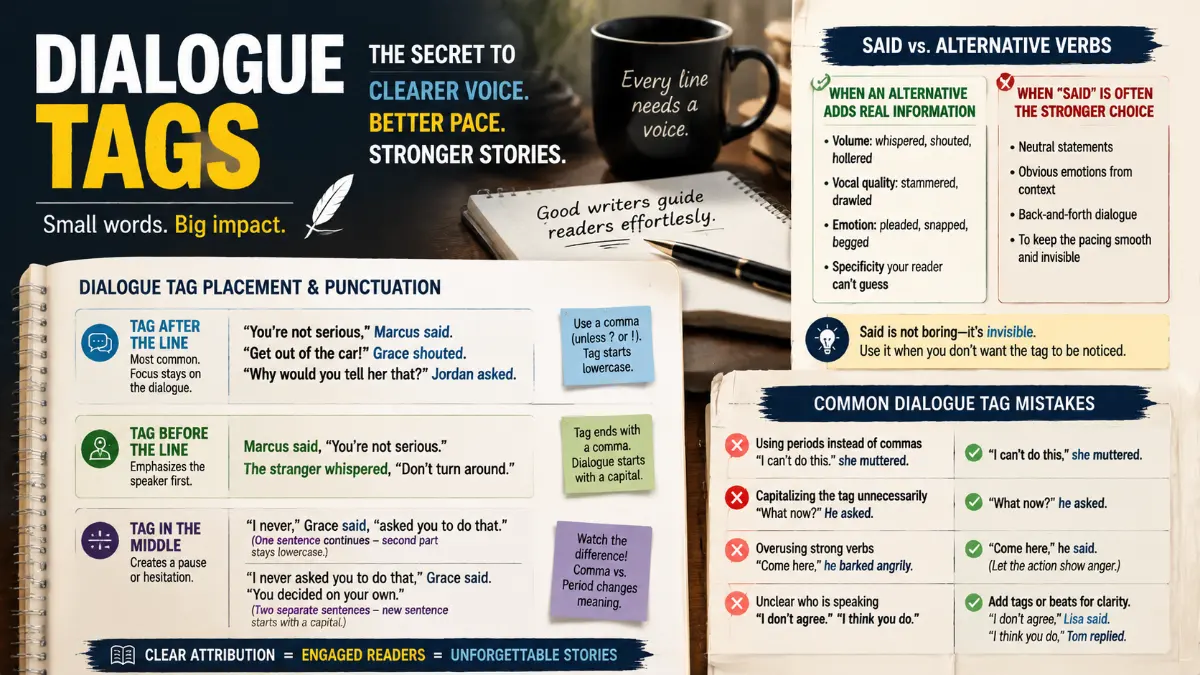
dialogue tags Every conversation on the page depends on one quiet mechanic: the reader needs to know, instantly and without friction, who just spoke. That mechanic is dialogue attribution, and the tool writers reach for most often is the dialogue tag. Handled well, it disappears into the background of the reading experience. Handled poorly, it either confuses the reader or drags their attention away from the story itself.
This guide treats dialogue tags as a craft decision rather than a fixed set of rules to memorize. You’ll see how tag placement affects pacing, when “said” earns its reputation as the safest choice, how to build a working vocabulary of alternatives without overusing them, and how writers catch attribution errors during revision.
Why Dialogue Tags Matter in Fiction
Readers process dialogue almost instantly when attribution is clean, but they stumble the moment they have to backtrack and figure out who’s talking. This is the entire reason dialogue tags exist-not as a grammatical formality, but as a tool for maintaining reading flow.
Consider a short exchange without any attribution at all:
“You’re leaving tonight?”
“I have to.”
“You said you’d wait until spring.”
Two people are clearly talking, but a reader dropped into this exchange mid-scene has no reliable way to sort out who opens the conversation or who responds. Attribution-through a tag, an action, or both-solves that problem before it becomes a distraction.
What Is a Dialogue Tag?
A dialogue tag pairs a speaking verb with a subject to identify who’s talking: Elena said, Marcus asked, the detective muttered. That’s the core function. Everything else-tone, emotion, volume-is optional information layered on top.
It helps to separate three distinct tools writers use for attribution, since they’re often lumped together incorrectly:
- The dialogue tag: “I’m not signing this,” Elena said.
- The action beat: “I’m not signing this.” Elena pushed the folder across the table.
- The internal beat: “I’m not signing this.” She’d rehearsed the line all morning.
Each does a different job. The tag is fast and nearly invisible. The action beat adds movement and visual grounding. The internal beat adds interiority. A scene that relies exclusively on one of these three tools for pages at a time usually starts to feel flat or repetitive.
Dialogue Tag Placement and Punctuation
Where you place a tag relative to the dialogue changes both rhythm and emphasis. English fiction generally supports three placements, each with its own punctuation pattern.
Tag Following the Line
This is the most common placement, and it holds the dialogue itself in the spotlight since the reader absorbs the line before learning who said it.
- “You’re not serious,” Marcus said.
- “Get out of the car!” Grace shouted.
- “Why would you tell her that?” Jordan asked.
The line inside the quotation marks ends in a comma unless it’s a question or exclamation, and the tag that follows begins lowercase.
Tag Preceding the Line
Placing the tag first shifts emphasis toward the speaker before the reader hears the line-useful when the speaker’s identity matters more than the content, such as introducing an unexpected voice.
- Marcus said, “You’re not serious.”
- The stranger whispered, “Don’t turn around.”
The tag ends with a comma, and the quoted line that follows starts with a capital letter.
Tag Splitting the Line
A tag can also sit inside a single sentence of dialogue, which slows the pace and creates a deliberate pause-often used for hesitation or emphasis.
- “I never,” Grace said, “asked you to do that.”
Because the sentence continues after the interruption, the second half stays lowercase. This differs from a tag sitting between two separate sentences, where the second sentence restarts with a capital letter:
- “I never asked you to do that,” Grace said. “You decided on your own.”
Writers frequently mix these two constructions up, either capitalizing a continuation that shouldn’t be capitalized, or leaving a new sentence lowercase when it should start fresh.
Said Versus Alternative Attribution Verbs
There’s a long-running discussion among writers about whether said is a crutch or a strength. The practical answer: said carries very little interpretive weight, so it tends to register with the reader as a functional marker rather than a word that demands attention in its own right. That’s part of why several fiction-writing guides treat it as the reliable default rather than something to minimize.
The real question isn’t whether to use said-it’s when a different verb genuinely adds information the reader needs, versus when it’s just decoration.
When an Alternative Verb Adds Real Information
- Volume the reader can’t infer from context: whispered, shouted, hollered.
- A vocal quality that changes meaning: stammered (halting delivery), drawled (slow, deliberate delivery).
When an Alternative Verb Becomes Decoration
If the line itself already reads as a question, tagging it with questions adds nothing. If the surrounding scene already shows a character is furious, tagging their line with snarled on top of an adverb-heavy description becomes redundant layering.
Choosing Tags by Scene Type
Rather than memorizing a long list of said-synonyms, it’s often more useful to think about which verbs suit which kind of scene. Different moods call for different attribution registers.
| Scene Type | Useful Tags | Why They Fit |
| Tense confrontation | snapped, demanded, growled | Signal escalating conflict without extra adverbs |
| Quiet, intimate scene | murmured, breathed, said softly | Match the reduced volume of the moment |
| Fast-paced action | called out, shouted, said (kept brief) | Speed matters more than nuance here |
| Comedic dialogue | said, deadpanned, quipped | Overly dramatic verbs can undercut comedic timing |
| Formal or professional setting | said, stated, replied | Neutral tags suit measured, controlled speech |
| Uncertain or nervous character | stammered, hesitated, trailing off | Reflects disrupted speech patterns realistically |
This kind of scene-based thinking tends to produce more natural results than reaching for a thesaurus mid-draft, since it starts from what the moment needs rather than which synonym hasn’t been used yet.
Read More: Allstate Renters Insurance
Attribution Errors That Break Immersion
Certain attribution habits pull readers out of a scene more than others. It helps to sort them by type when revising.
Punctuation Errors
Writing “I’m done here.” Jordan said treats the tag as a separate sentence, when it should carry forward with a comma: “I’m done here,” Jordan said. Similarly, “Sit down,” He said incorrectly capitalizes a pronoun that isn’t a proper noun, it should read “Sit down,” he said.
Word-Choice Errors
Forcing a non-speech verb into tag position without adjustment can read oddly. A sentence like “That’s absurd,” Marcus laughed treats laughed exactly like said. Splitting it into a separate beat often reads more cleanly: “That’s absurd.” Marcus laughed. – or combining tag and beat: “That’s absurd,” Marcus said, laughing.
Overuse Errors
Layering an adverb onto a tag that already implies tone, as in “Get away from me,” Grace snapped angrily, doubles up on information the verb snapped already communicates. Tagging every single line in a two-person scene also slows the pace unnecessarily once readers already know who’s speaking, a tag every few lines, supplemented by beats, usually reads better than constant attribution.
Tagging Dialogue in Group Scenes
Attribution becomes more demanding once a scene involves three or more speakers, because readers can no longer rely on simple alternation to track who’s talking. Compare a poorly tagged version with a clearer one.
Confusing version: “We need an answer by Friday.” “That’s not enough time.” “It never is.” “Then we start without her.”
Four lines, zero attribution-a reader has no reliable way to sort out who said what.
Clearer version:
“We need an answer by Friday,” Lena said.
Marcus shook his head. “That’s not enough time.”
“It never is,” Grace muttered.
“Then we start without her.” Lena was already reaching for her coat.
Here, tags and beats alternate to keep every speaker distinct, without over-tagging every single line.
A Revision Workflow for Dialogue Tags
Instead of checking attribution line by line while drafting, many writers find it more efficient to review it as a dedicated revision pass once a full scene exists. A practical workflow looks like this:
- Read the scene aloud and mark any line where you had to pause to figure out who was speaking.
- Check tags placed mid-sentence for correct capitalization based on whether they split one sentence or sit between two.
- Flag any non-speech verb (laughed, smiled, nodded, sighed) used as a tag and decide whether it should become a separate action beat.
- Search for adverbs attached to tags and test whether the line still works without them.
- Count consecutive tagged lines in two-person exchanges and remove tags once the pattern is established.
- In scenes with three or more speakers, confirm every speaker change is marked by a tag or an unmistakable beat.
This kind of targeted pass catches most attribution problems faster than trying to perfect tags during the first draft, when attention is better spent on the content of the dialogue itself.
Frequently Asked Questions
Why do some editors treat “said” as the safest default tag?
Because said carries very little connotation beyond identifying the speaker, it tends to register quickly with readers without demanding much conscious attention, unlike a more distinctive verb. This lets the dialogue itself hold the reader’s focus rather than the narration around it. That’s part of why said is a common recommendation in fiction-writing guidance, even though it looks plain on the page.
Is it ever appropriate to invent a unique attribution verb for stylistic effect?
Occasionally, in literary or experimental fiction, writers use unconventional verbs deliberately for stylistic voice, but this is a calculated risk rather than standard practice. In most genre fiction, unusual attribution verbs risk drawing attention to the writing mechanics instead of the story. If you’re experimenting this way, it helps to test the effect on readers unfamiliar with the manuscript before committing to it throughout a full project.
How do screenplays or stage plays handle dialogue attribution differently from prose fiction?
Screenplays and stage plays generally use a character’s name in a fixed format above each line rather than embedded tags within a sentence, since the format itself establishes who’s speaking. Prose fiction lacks that visual structure, which is part of why tags and beats carry more weight in novels and short stories. Writers moving between mediums often need to unlearn script-formatting habits when writing prose dialogue.
Can dialogue tags be used to control pacing in an action scene?
Yes. Short, minimal tags like said or shouted tend to preserve momentum during fast-paced sequences, while longer or more descriptive attribution slows the read down. If a chase scene needs urgency, stacking elaborate tags or lengthy action beats between lines can undercut that urgency regardless of how exciting the dialogue itself is.
What does it mean when a verb like “sighed” or “laughed” is used to describe dialogue delivery?
Verbs like these aren’t a formally defined grammatical category-they’re simply action-oriented verbs that some writers borrow for tag position because the action and the speech happen at nearly the same moment. Whether this reads naturally is a matter of editorial preference rather than an established rule, and many editors still prefer separating the action from the dialogue with a period rather than joining it with a comma.
Should dialogue tags change based on a character’s native language or dialect?
The tag itself typically stays consistent regardless of a character’s background, since its job is attribution, not dialect representation. Dialect and speech patterns are usually conveyed through the dialogue’s actual word choice, rhythm, and phrasing rather than through unusual attribution verbs, which risk feeling like a shortcut rather than authentic characterization.
Is it acceptable to skip attribution entirely in a two-line exchange?
Yes, when only two speakers are established and the context makes clear who begins the exchange, brief back-and-forth dialogue can run without any tag or beat at all. This technique works especially well in tense, rapid exchanges where attribution would slow things down. It becomes risky only if the exchange runs long enough that a reader could lose track of the alternating pattern.
Do present-tense and past-tense narratives handle dialogue tags differently?
The punctuation conventions stay the same regardless of narrative tense, only the tag’s verb form changes to match the surrounding prose-Elena says in present tense versus Elena said in past tense. Writers switching between tenses mid-project should double-check dialogue tags specifically, since inconsistent verb tense in attribution is an easy detail to miss during revision.
Does dialogue attribution work differently in first-person versus third-person narration?
There can be some difference in practice: first-person narrators sometimes add commentary about tone or delivery as part of their own voice, which can reduce reliance on descriptive tags in certain passages. This isn’t a strict rule, though, and plenty of first-person narratives still use tags and beats extensively, just as some third-person narration stays close enough to a character’s perspective to color dialogue similarly. Treat this as a tendency rather than a fixed difference between the two narrative modes.
Can overusing action beats create the same fatigue as overusing dialogue tags?
Yes. Just as repeatedly writing “she said” becomes monotonous, constantly inserting an action beat after every line-someone always nodding, sighing, or crossing their arms-creates its own repetitive pattern. Effective dialogue scenes usually mix bare exchanges, tags, and beats rather than leaning on any single tool throughout an entire conversation.