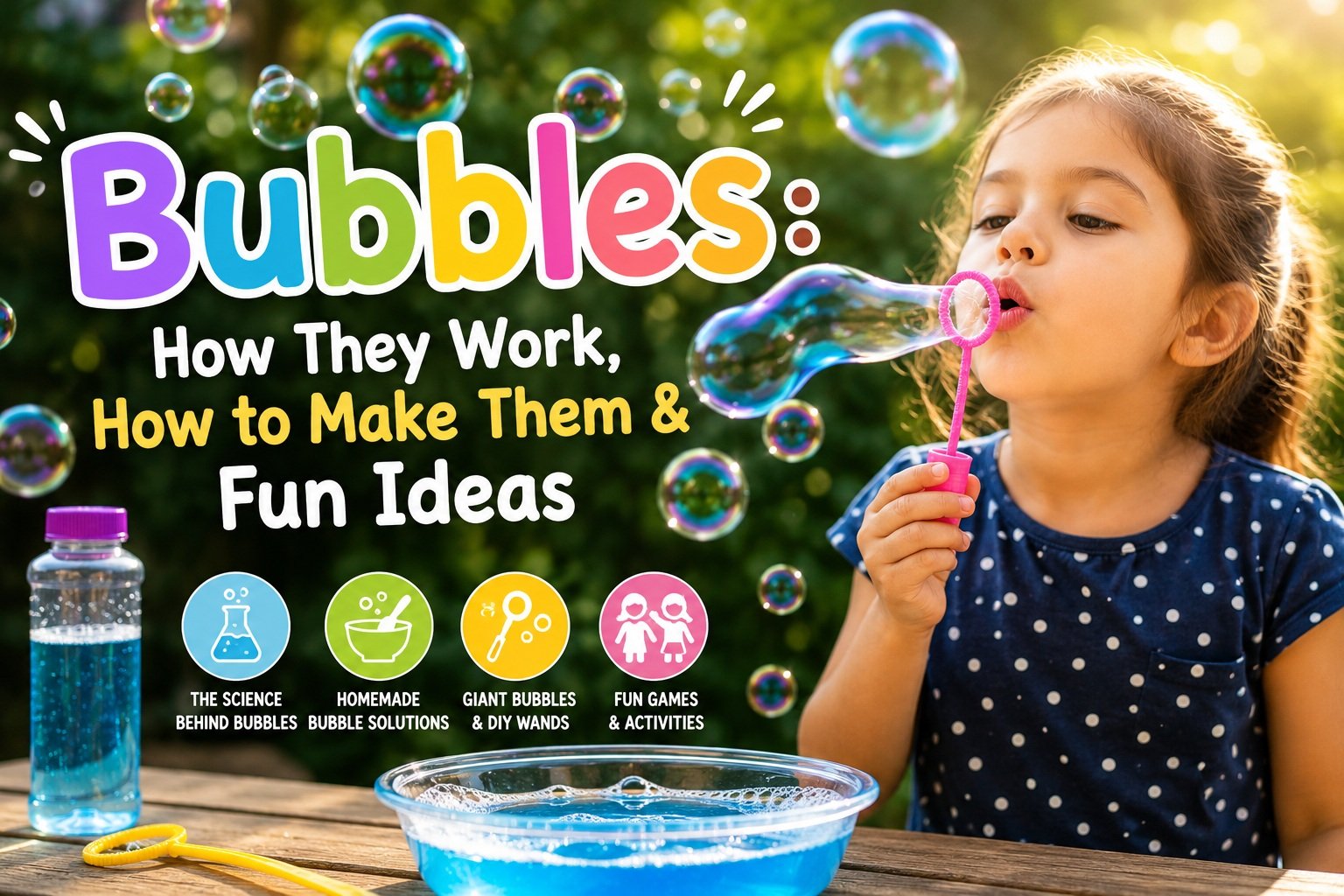
Bubbles are thin pockets of air surrounded by a liquid film. A familiar soap bubble forms when water, soap and air combine to create a flexible film that can float through the air before eventually popping.
This guide focuses on soap bubbles—how they form, why they become round, what makes them pop, and how to make stronger bubbles at home. You’ll also find homemade bubble solution recipes, giant bubble ideas, simple science experiments, DIY bubble wands, outdoor games and safety tips for children.
Whether you’re making bubbles for backyard play, a classroom activity, a party or a simple science experiment, understanding how the bubble film works can help you get better results.
Quick Answer: What Are Bubbles?
A soap bubble is a thin film of soapy water surrounding air. Soap contains surfactants that help the liquid form and stabilize a thin film. Surface tension then pulls the free-floating film toward a shape with minimal surface area, which is why a bubble naturally becomes approximately spherical.
Bubbles eventually pop when the film becomes too thin, loses water through evaporation, drains under gravity, or is disturbed by contact with another surface.
What Are Soap Bubbles Made Of?
A typical soap bubble has three basic components:
- Water: Forms most of the liquid film.
- Soap or detergent: Contains surfactants that help the film form and remain stable.
- Air: Becomes trapped inside the film.
The exact performance of bubble solution depends on the ingredients, their proportions, the water used and environmental conditions.
A stronger bubble solution does not simply mean adding more soap. The goal is to create a film that can stretch and remain intact long enough to form a stable bubble.
Why Are Bubbles Round?
One of the most interesting things about bubbles is that they naturally become round.
Surface tension pulls the liquid film inward. For a given amount of enclosed air, a sphere has the smallest surface area of any three-dimensional shape. The film therefore naturally moves toward a spherical shape.
This explains why a free-floating bubble doesn’t remain square, triangular or star-shaped.
You can use a square or star-shaped wand, but once the bubble separates from the wand, surface tension causes the film to relax toward a spherical shape.
Try This Simple Experiment
Use several wands with different openings:
- Circle
- Square
- Triangle
- Star
Ask children to predict what shape the bubble will become.
Then release the bubbles and compare the results.
This is an easy way to introduce surface tension, prediction and observation.
Why Do Bubbles Pop?
Bubbles are delicate because their liquid film is extremely thin.
A bubble can pop for several reasons.
1. Water Evaporates
Water gradually leaves the bubble film through evaporation. As the film becomes thinner, it becomes harder for the bubble to remain intact.
Hot and dry conditions can speed up this process.
2. The Film Is Punctured
A bubble can burst when its film touches:
- Dust
- Dry fingers
- Grass
- Rough surfaces
- Another object
The thin film can break almost instantly after contact.
3. Liquid Drains Downward
Gravity causes liquid in the film to move downward over time. This can leave some parts of the bubble thinner than others.
Eventually, the weakened area may no longer support the bubble.
4. Wind Disturbs the Bubble
Strong airflow can stretch and distort the film until it breaks.
This is one reason calm outdoor conditions are usually better for making larger, longer-lasting bubbles.
How to Make Bubble Solution at Home
You can make a simple bubble solution with ingredients commonly found at home.
Easy Homemade Bubble Solution
Ingredients
- 1 cup water
- 2 tablespoons liquid dish soap
- 1 teaspoon granulated sugar, optional
Instructions
- Pour the water into a clean container.
- Add the dish soap slowly.
- Add the sugar if you want to experiment with a slightly stronger solution.
- Stir gently.
- Avoid vigorous mixing because it creates excess foam.
- Let the solution settle before using it.
The solution should contain as little surface foam as possible before you begin making bubbles.
Tip
Don’t assume that more soap automatically creates better bubbles. Bubble performance depends on the overall mixture, the type of soap, the water and the surrounding conditions.
How to Make Longer-Lasting Bubbles
Glycerin is commonly added to homemade bubble solutions to help improve the performance of the bubble film.
Long-Lasting Bubble Solution
Ingredients
- 4 cups warm water
- ½ cup liquid dish soap
- 1–3 tablespoons glycerin
Instructions
- Add the water to a clean container.
- Add the dish soap slowly.
- Add the glycerin.
- Stir gently.
- Avoid creating excessive foam.
- Let the mixture rest for several hours before using it.
You can experiment with different amounts of glycerin to see how the results change.
Why Let Bubble Solution Rest?
Allowing the solution to rest gives the ingredients time to settle and reduces excess foam created during mixing.
For stronger bubbles, some people leave the mixture for several hours or overnight.
Can You Use Tap Water for Bubble Solution?
Yes. Tap water can work well for ordinary bubble play.
Some specialized recipes use distilled water because minerals in water can affect the behavior of a bubble solution. For casual backyard bubbles, however, tap water is generally convenient and practical.
If you’re experimenting with giant bubbles, you can compare tap water and distilled water yourself to see whether your local water makes a noticeable difference.
How to Make Giant Bubbles
Giant bubbles require more than simply using a larger wand.
You need:
- A solution that can produce a strong film
- A large wand
- Gentle, controlled movement
- Suitable weather conditions
Glycerin is commonly used in stronger bubble solutions because it can help improve the flexibility and longevity of the film.
Giant Bubble Solution
A simple starting point is:
- ½ gallon distilled water
- 2 cups dish soap
- 4–5 tablespoons glycerin
Method
- Add the dish soap and glycerin to a clean container.
- Slowly add the water.
- Stir gently to avoid creating excessive foam.
- Allow the mixture to rest before using it.
- Dip the giant wand completely into the solution.
- Lift it slowly.
- Pull the wand apart gradually to create a large film.
Results can vary depending on the ingredients, wand design and weather.
For the biggest bubbles, humid and relatively calm conditions are generally more favorable than hot, dry or windy weather.
How to Make a DIY Giant Bubble Wand
You can make a simple giant bubble wand with two wooden sticks and cotton cord.
Materials
- 2 wooden dowels or sturdy sticks
- Cotton cord
- 1–2 small washers or another suitable weight
- Bubble solution
Steps
- Attach the cord to one dowel.
- Connect the other end to the second dowel.
- Add a small weight to the lower section of the cord.
- Dip the entire cord into the bubble solution.
- Lift the cord slowly.
- Separate the dowels to stretch the liquid film.
- Move slowly to create the bubble.
Avoid sudden movements because a large bubble film can break easily.
No-Tools Alternative
For a simpler activity, a clean wire coat hanger can be shaped into a loop. Wrap the handle area with duct tape to reduce the risk of sharp edges.
An adult should prepare homemade wire wands for young children.
What Makes Some Bubbles Last Longer?
Several factors can affect how long a bubble survives.
Bubble Solution
The ingredients and their proportions influence the strength and flexibility of the liquid film.
Humidity
Humid conditions can slow the loss of water from the film.
Wind
Strong wind can stretch and break a bubble quickly.
Temperature
Temperature affects evaporation and the behavior of the liquid film.
Clean Equipment
Dust, oil and other contaminants can interfere with the bubble film.
This is why the same recipe can produce different results on different days.
Bubble Science Activities for Kids
Bubbles are an easy way to introduce children to basic physics and chemistry.
1. Bubble Shape Experiment
Use wands with different shapes and ask:
Will the bubble have the same shape as the wand?
Make the bubbles and compare the results.
This demonstrates the effect of surface tension.
2. Bubble Durability Experiment
Prepare two solutions:
Solution A: Water + dish soap
Solution B: Water + dish soap + glycerin
Make bubbles with the same wand and compare how long they survive.
For a more scientific experiment, repeat the test several times and record the results.
Children can calculate:
- Average bubble life
- Largest bubble
- Number of bubbles produced
- Difference between the two solutions
3. Bubble Snake Experiment
You’ll need:
- A clean plastic bottle
- An old sock
- A rubber band
- Bubble solution
Steps:
- Cut the bottom from the bottle.
- Place the sock over the opening.
- Secure it with a rubber band.
- Dip the sock into bubble solution.
- Gently blow through the bottle opening.
A long chain of connected bubbles can emerge from the sock.
Never inhale the bubble solution.
4. Catch a Bubble
Try catching a bubble with:
- A dry hand
- A wet hand
- A hand coated with bubble solution
Compare what happens.
A dry surface can disrupt the delicate bubble film quickly. A wet or solution-coated surface can make it easier to touch the bubble without immediately breaking it.
5. Freezing Bubble Experiment
In temperatures well below freezing, bubbles can develop visible ice crystals across their surface.
This can be a striking demonstration of how temperature affects a thin liquid film.
Because freezing weather creates additional safety concerns, this experiment should be supervised by an adult.
What Do Kids Learn From Bubble Activities?
Bubble play can introduce several basic scientific skills.
Children can practice:
- Observation
- Prediction
- Measurement
- Cause-and-effect reasoning
- Comparing results
- Following ratios
- Recording experimental results
For example, changing one ingredient in a bubble solution gives children an opportunity to observe whether the change affects bubble size or durability.
Fun Bubble Games for Kids
Once the solution is ready, you can turn bubble-making into simple games.
Bubble-Popping Race
Blow a batch of bubbles into the air and see who can pop the most within a set amount of time.
Bubble Catch Challenge
Try to catch a bubble without popping it.
Older children can experiment with wet hands or bubble-solution-coated gloves.
Giant Bubble Challenge
Divide children into teams and see which team can create the largest bubble.
An adult can supervise the activity and judge the results.
Bubble Target Game
Draw a target on pavement or place a safe hoop outdoors.
Challenge children to guide bubbles toward the target before they pop.
Bubble Parade
Give children different bubble wands and let them create bubbles while walking through a safe outdoor area.
These games require very little equipment and can work well for:
- Birthday parties
- Backyard play
- School activities
- Field days
- Summer activities
DIY Bubble Wand Ideas
Store-bought bubble wands work well, but you can also create simple alternatives.
Pipe Cleaner Wands
Twist a pipe cleaner into a loop, heart or another shape and use it as a small wand.
Cookie Cutter Wand
Attach a clean cookie cutter to a stick or dowel to create a simple wand.
Slotted Spoon
A clean kitchen slotted spoon can create many small bubbles at once.
Bubble Snake Bottle
The bottle-and-sock method can create long chains of connected bubbles.
Giant Cord Wand
Use two sticks and cotton cord to create large bubbles.
Safety Tip
Homemade wands should not have sharp edges, exposed wire ends or loose small parts that could create a hazard for young children.
How to Make Bubbles Last Longer Outdoors
If your bubbles are popping too quickly, try these steps:
- Use a stronger solution with glycerin.
- Stir the solution gently.
- Let the solution rest before use.
- Remove excess foam.
- Choose a humid day when possible.
- Avoid strong wind.
- Keep the wand clean.
- Avoid touching bubbles with dry surfaces.
Weather can make a major difference, so don’t assume a recipe has failed simply because it performs poorly on a hot, windy day.
Bubble Safety for Children
Bubble solution is intended for play, not for drinking or eating.
Keep these safety points in mind:
- Keep bubble solution away from children’s eyes.
- Do not allow children to drink the solution.
- Supervise toddlers closely.
- Be careful with homemade wands.
- Keep scissors and drills away from young children.
- Watch for small parts such as washers on giant wands.
- Stop using the solution if it causes skin irritation.
- Clean slippery residue from floors and outdoor surfaces.
- Wash hands after extended bubble play if skin becomes irritated.
Children with particularly sensitive skin may react to some dish-soap formulas, so a small test area can be useful before prolonged contact.
How Long Does Homemade Bubble Solution Last?
Storage life depends on the ingredients, container and storage conditions.
Keep leftover solution in a clean, sealed container and inspect it before reuse.
Discard it if you notice:
- An unusual smell
- Visible contamination
- Unexpected color changes
- A significant change in performance
If you’re unsure about the condition of an old mixture, making a fresh batch is the safer choice.
Why Does My Bubble Solution Make Foam Instead of Bubbles?
Too much foam usually means the solution was mixed too aggressively.
Try:
- Stirring slowly.
- Avoiding vigorous shaking.
- Letting the mixture rest.
- Skimming foam from the surface.
- Using a clean container and wand.
A container full of foam isn’t necessarily a sign of a stronger bubble solution.
Why Are My Homemade Bubbles Popping Too Quickly?
Several things can cause bubbles to pop quickly.
The most common possibilities are:
- Weak solution
- Too much foam
- Dry weather
- Strong wind
- Dirty wand
- Dry surfaces
- Excessive handling
Try a glycerin-based solution, let it rest and choose a humid, relatively calm day.
Do Bubbles Work in Cold Weather?
Yes, bubbles can still form in cold weather.
In temperatures well below freezing, you may even see ice crystals develop across a bubble before it freezes or breaks.
The effect is most noticeable in very cold conditions rather than simply cool weather.
Because freezing temperatures can create risks of cold exposure and slippery surfaces, children should be supervised closely.
Why Do Bubbles Have Rainbow Colors?
Soap bubbles can display shifting rainbow colors because light interacts with their extremely thin liquid film.
As the thickness of the film changes, different wavelengths of light can interfere with one another differently. This produces the changing colors often seen across a bubble’s surface.
The colors can change quickly because the film is constantly moving and becoming thinner.
Are Bubbles Only for Kids?
No.
Soap bubbles can be used for:
- Children’s play
- Classroom demonstrations
- Science experiments
- Parties
- Photography
- Art projects
- Performances
- Outdoor recreation
Their simple ingredients and interesting physics make them useful for both entertainment and learning.
Frequently Asked Questions About Bubbles
What are bubbles?
Soap bubbles are thin liquid films surrounding air. In a typical bubble solution, water and surfactants work together to create the flexible film.
Why are bubbles round?
Surface tension pulls the film toward a shape with minimal surface area around the trapped air. A free-floating bubble therefore becomes approximately spherical.
Why do bubbles pop?
Bubbles can pop when their liquid film becomes too thin, water evaporates, liquid drains downward, wind disturbs the film or another object punctures it.
How do you make bubbles at home?
A basic homemade bubble solution can be made with water and liquid dish soap. Adding a small amount of sugar or glycerin can be used for experimentation with stronger bubble films.
What is the best ingredient for stronger bubbles?
Glycerin is commonly used in stronger homemade bubble solutions. However, results depend on the entire recipe and environmental conditions.
Can I use tap water for bubble solution?
Yes. Tap water works well for ordinary bubble play. Distilled water can be useful for some specialized recipes, particularly when experimenting with giant bubbles.
How do you make giant bubbles?
Use a large wand, a suitable bubble solution and slow movements. Glycerin is commonly included in giant-bubble recipes. Humid, calm weather can also improve results.
Why do my bubbles pop immediately?
A weak solution, excessive foam, dry weather, strong wind, contaminated equipment or a dry surface can all cause bubbles to burst quickly.
Can bubbles be different shapes?
A bubble can temporarily follow the shape of a wand while it is attached to the frame. Once it becomes a free-floating bubble, surface tension pulls it toward a spherical shape.
What can I use instead of glycerin?
Some homemade recipes use granulated sugar or corn syrup as alternatives. Results can vary depending on the ingredients and proportions.
What age is appropriate for bubble activities?
Simple popping and supervised bubble activities can be suitable for young children who can safely handle a wand. More complicated activities involving tools or small parts should be reserved for older children and supervised by an adult.
Can children play with bubble solution?
Yes, with appropriate supervision. Bubble solution should not be consumed and should be kept away from children’s eyes and mouths.
How can I stop bubble solution from making outdoor surfaces slippery?
Use only the amount needed for the activity and rinse outdoor surfaces with water after extended bubble play. Pay particular attention to smooth pavement and other surfaces where soap residue can create a slipping hazard.
Final Takeaway
Bubbles are simple enough for everyday play but complex enough to demonstrate real principles of physics and chemistry.
A basic bubble is made from a thin film of soapy water surrounding air. Surface tension gives free-floating bubbles their familiar round shape, while evaporation, gravity, contact and environmental conditions eventually cause the film to break.
With a simple homemade solution, you can make ordinary bubbles, experiment with stronger formulas, build giant bubble wands, explore surface tension and create activities that combine play with science.
For the best results, focus on gentle mixing, a suitable bubble solution, clean equipment and humid, relatively calm conditions.