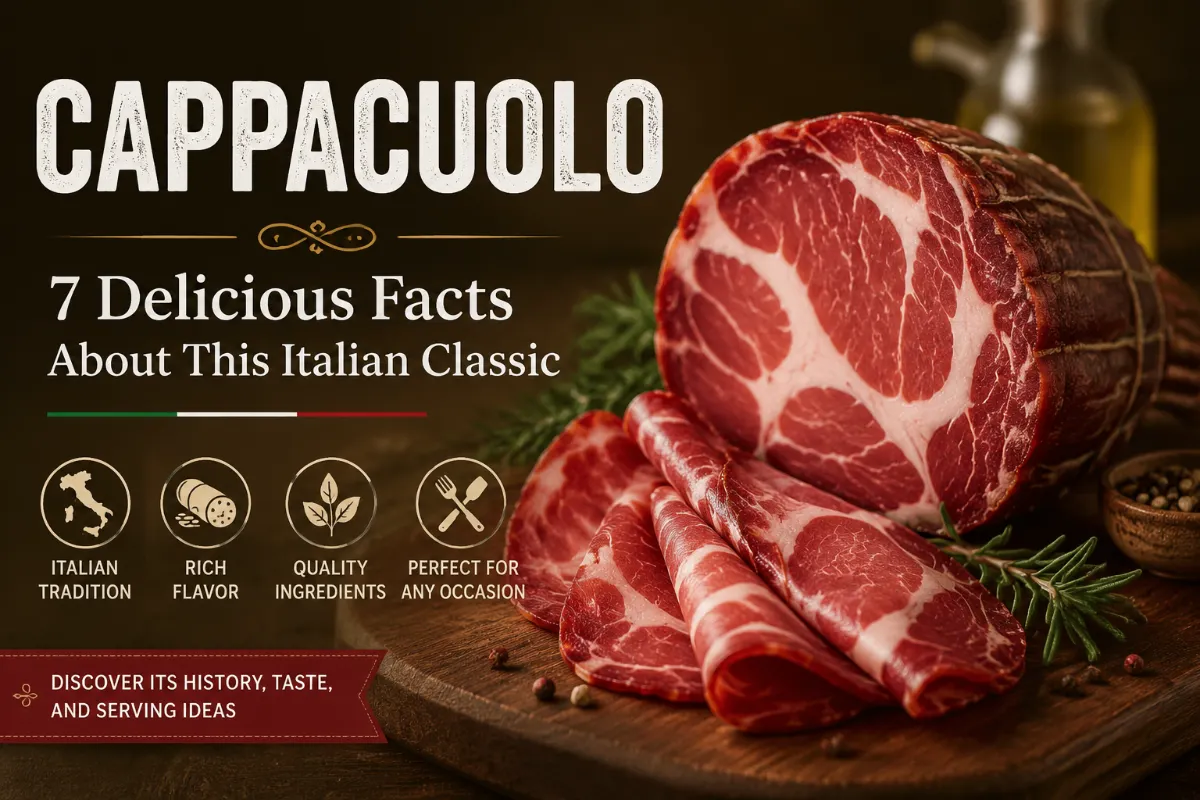
If you have seen Cappacuolo on an Italian-American deli menu, you may be wondering what it actually is. In most U.S. deli settings, the name refers to a seasoned, cured whole-muscle pork product closely associated with capicola and capocollo. It is generally made from the neck or upper-shoulder area of the pig, cured until firm, and sliced thinly for sandwiches, antipasto, and charcuterie.
The name can vary by region, producer, and Italian-American tradition, which is why you may also see spellings such as capicola and capocollo. Everyday deli terminology does not always map perfectly onto the specifications of regional Italian protected products.
What Is Cappacuolo?
Cappacuolo is a seasoned, cured whole-muscle pork product rather than a ground meat. In North American usage, it is commonly associated with capicola; capocollo is the traditional Italian term for the same broad family of cured pork, while coppa is a closely related term used in parts of Italy and international food markets
The cut generally comes from the neck or upper-shoulder region, where natural marbling contributes to rich flavor and a soft texture. The meat is salted and seasoned, placed in a casing, and matured under controlled conditions until it reaches the intended firmness and flavor concentration.
There is no single universal recipe. Seasonings, curing methods, smoking, maturation time, and the exact cut can vary by producer and tradition.
Cappacuolo vs. Capicola vs. Capocollo vs. Coppa
Much of the confusion comes from overlapping Italian, Italian-American, and English-language terminology. These names can refer to closely related cured pork products, but should not automatically be treated as identical in every regional or protected-product context.
| Term | Common context | What it generally refers to | Important distinction |
| Cappacuolo | Italian-American and U.S. deli usage | Alternative name/spelling associated with capicola and capocollo | Usually the same broad cured-pork style in everyday deli use |
| Capicola | U.S. and Italian-American usage | Cured pork associated with the neck or upper shoulder | Common American deli name |
| Capocollo | Italian usage, especially central and southern traditions | Traditional Italian name for cured neck/upper-shoulder pork | Specific regional versions can have protected requirements |
| Coppa | Northern/central Italian usage and international food markets | Closely related cured pork product | Regional coppa products may have distinct cuts, recipes, and PDO specifications |
For everyday deli shopping, the first three names may describe the same general style. In traditional Italian and protected-product contexts, however, the names can refer to products with specific identities.
For example, Coppa Piacentina PDO is a protected product made from cervical pork muscles and aged for at least six months. Capocollo di Calabria PDO has its own defined specification: it uses the upper part of the pork loin and must mature for at least 100 days. These protected products should not automatically be treated as interchangeable with every deli item labeled Cappacuolo or capicola.
Read More: Long John Silver’s
Why Is It on American Deli Menus?
The spelling Cappacuolo is particularly familiar in Italian-American food culture and U.S. delis. One deli may use Cappacuolo, another capicola, and another capocollo even when the products are broadly similar.
Italian-American food terminology often reflects regional speech patterns, inherited family vocabulary, and adaptations of Italian words rather than one universal spelling. The result is that the same general cured meat can be recognized under multiple names.
Where Does the Name Come From?
The Italian word capocollo is commonly explained through capo and collo, referring to the head and neck. The American term capicola developed from Italian forms, while additional Italian-American spellings and pronunciations reflect regional speech and dialect influence.
This is why a specialty producer, Italian recipe, U.S. deli, and Italian-American speaker may use different words for a closely related product.
How Do You Pronounce Cappacuolo?
Pronunciation varies because the term has been adapted through Italian-American speech. In everyday U.S. deli use, it may sound very different from the traditional Italian spelling.
The well-known Italian-American pronunciation “gabagool” is associated with capicola or capocollo. It is not a separate meat or a different cut of pork; it is a colloquial pronunciation associated with the same broad cured-pork family.
What Part of the Pig Is Used?
Cappacuolo is generally made from a whole-muscle cut from the neck and upper-shoulder region of the pig. The exact anatomical cut varies by tradition and product specification.
Natural marbling contributes to tenderness, rich mouthfeel, and the characteristic look of thinly sliced meat. This lean-and-fat structure also distinguishes it from many cured meats made from finely ground pork.
Protected products illustrate why wording matters. Coppa Piacentina PDO is defined from cervical muscles, while Capocollo di Calabria PDO uses the upper part of the pork loin. A generic U.S. deli label should therefore not be assumed to match either specification exactly.
How Is It Cured?
This is a whole-muscle cured meat, not a ground-and-stuffed sausage. The meat is salted and seasoned, placed in a casing, and matured under controlled conditions while gradually losing moisture.
Depending on the style, seasonings can include:
- Black pepper
- Red pepper or chili
- Herbs
- Wine
- Garlic
- Other regional aromatics
Curing and maturation time are not universal. They depend on the size of the cut, recipe, environment, and product style.
Traditional products can mature for several months. For comparison, Capocollo di Calabria PDO requires maturation for at least 100 days, while Coppa Piacentina PDO requires at least six months from salting. These are requirements for those named PDO products — not a general curing timetable for every U.S. deli version.
What Does It Taste Like?
The flavor is usually rich, savory, and distinctly pork-forward. Marbled fat gives thin slices a tender, flavorful bite.
Seasoning can range from mild and aromatic to peppery or hot. Some preparations emphasize pork and fat, while others highlight black pepper, chili, garlic, herbs, wine, or other regional flavors.
Texture is one of the defining characteristics: it is tender and supple rather than crumbly like a typical dry sausage. Compared with delicate cured ham, it generally has more pronounced seasoning and a richer, more marbled texture.
Because recipes and production methods differ, no single flavor profile applies to every product sold under these names.
Dolce vs. Piccante
You may see dolce or piccante in Italian-American deli settings.
- Dolce generally means a milder, more delicately seasoned version, where pork and fat remain the dominant flavors.
- Piccante indicates a spicier style, often made with chili or red pepper for more heat and a stronger finish.
These labels describe a seasoning style, not two fixed universal recipes. Two piccante products may taste very different depending on their spice blend and curing tradition.
For a first taste, a dolce version can be an easy introduction because it showcases the pork, fat, and curing character without as much chili heat.
Is It Spicy?
Not necessarily. A mild product may rely mainly on salt, black pepper, herbs, wine, garlic, or other aromatics. A piccante version may contain red chili or another hot pepper and can have a noticeably warmer finish.
The name itself does not guarantee a heat level. At a deli, check the product description or ask whether the version is dolce or piccante.
Is Cappacuolo a Type of Salami?
No. Cappacuolo is generally a whole-muscle cured pork product, while traditional salami is made from ground or minced meat that is seasoned and stuffed into a casing.
Both can appear on deli counters and charcuterie boards, but their production and texture differ. Thinly sliced cured pork retains the original muscle structure; salami has the more uniform texture of ground meat.
Cappacuolo vs. Prosciutto
Both are cured pork products, but they come from different parts of the pig and have different characteristics.
Cappacuolo is associated with the neck or upper-shoulder region and commonly served as thin, marbled slices. Prosciutto is traditionally made from the hind leg and is known for delicate cured flavor and a silky texture.
Neither is simply “more tender” than the other. They are distinct cured-pork styles with different cuts, seasoning profiles, and production methods. Cappacuolo generally tastes richer, more seasoned, and sometimes peppery, while prosciutto is prized for delicate cured flavor and characteristic sweetness developed during aging.
Is It the Same as “Gabagool”?
“Gabagool” is an Italian-American pronunciation associated with capicola or capocollo, particularly in speech influenced by southern Italian dialects.
In practical deli use, someone asking for gabagool generally means the same broad cured-pork family that may be labeled capicola, capocollo, or Cappacuolo. It is not a separate meat or a different cut of pork.
How to Use Cappacuolo
Cappacuolo works best where its seasoning, marbling, and savory flavor remain noticeable.
- Italian-style sandwiches: Layer thin slices with provolone, lettuce, tomato, peppers, and vinegar-based dressing.
- Charcuterie boards: Pair with mild or semi-firm cheese, olives, crusty bread, and other cured meats.
- Pizza: Add thin slices toward the end of baking so the meat warms and some fat renders without becoming overly dry.
- Pasta and warm dishes: Use a small amount as a finishing ingredient when you want a salty, savory pork component.
- Antipasto: Served thinly sliced with cheese, vegetables, olives, and other Italian cured meats.
Because it is already seasoned, it generally works best with ingredients that complement rather than overpower it.
How Should It Be Stored?
Storage depends on packaging, whether the product has been sliced, and the producer’s instructions.
For commercially packaged or sliced meat, follow the package directions and refrigerate it as instructed. Once opened, keep it tightly wrapped and refrigerated to preserve quality.
For a whole cured piece, storage conditions can vary widely depending on production and whether the producer intends continued aging. Follow the producer’s guidance rather than assuming every cured whole muscle can be stored at room temperature for the same period.
Freezing can be an option for some products when longer storage is necessary, though thawing can slightly alter texture. When in doubt, the product label and producer’s storage instructions take priority.
Frequently Asked Questions
Is Cappacuolo the same as capicola?
Generally, yes, in everyday U.S. deli usage. Cappacuolo is an alternative name or spelling associated with the cured pork commonly called capicola; capocollo is the traditional Italian term for the same broad style. Regional recipes and protected Italian products can still differ in cuts, seasoning, and production methods.
What part of the pig does it come from?
It generally comes from the neck and upper-shoulder region, though the precise cut can vary by tradition. Protected products can have exact specifications for the muscle used.
Is it spicy?
It can be, but it does not have to be. Mild preparations use restrained seasoning, while piccante versions may include chili or red pepper.
What is the difference between dolce and piccante?
Dolce refers to a milder, delicately seasoned style. Piccante indicates a spicier style. These terms describe flavor direction rather than one universal recipe.
How long does it take to cure?
There is no single curing time for all products carrying these names. Traditional maturation can take months. Capocollo di Calabria PDO requires at least 100 days, while Coppa Piacentina PDO requires at least six months; those figures apply only to the specific PDO products
Is it more tender than prosciutto?
Not necessarily. The two use different cuts and production methods. Neck/shoulder cured pork is known for marbling and rich texture; prosciutto has the distinct texture and flavor of a cured hind-leg product.
Is it the same as “gabagool”?
Gabagool is an Italian-American pronunciation associated with capicola or capocollo. In deli use, it generally refers to the same broad cured-pork product family.
Is it the same as COPPA?
The names are closely related, and coppa can overlap with capicola in English-language use. But regional Italian products can have distinct specifications. Coppa Piacentina PDO, for example, is a protected cervical-muscle product with its own production requirements
Is it a type of salami?
No. It is generally a whole-muscle cured product, while salami is made from ground or minced meat. They may be served together but have different textures and production methods.
How should it be stored?
Keep packaged or sliced product refrigerated according to the producer’s instructions. For whole cured pieces, follow the specific storage guidance on the product because requirements depend on how it was cured.