
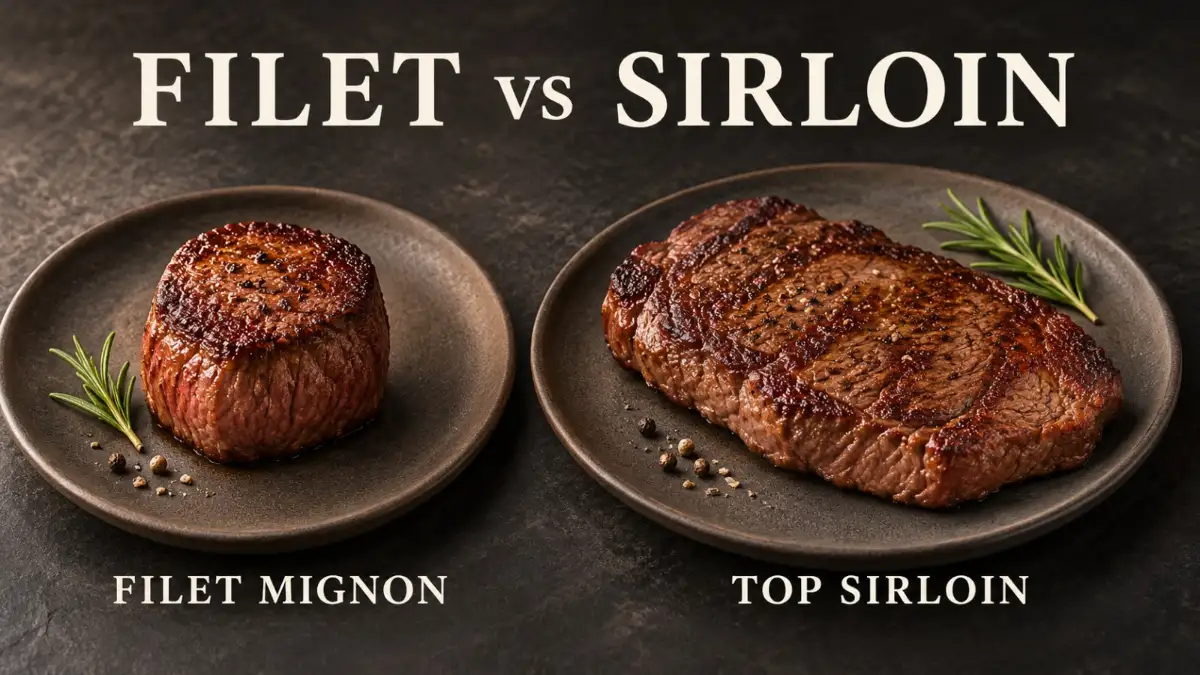
The main difference in filet vs sirloin is what you get for your money: filet mignon offers exceptional tenderness and a mild flavor, while top sirloin generally delivers a beefier taste at a lower price. Choose filet when a soft, delicate texture matters most. Choose sirloin when you want a flavorful steak that fits a smaller budget.
Here, “filet” means filet mignon, and the main sirloin comparison uses US top sirloin steak. Sirloin includes several cuts, so checking the full name on a package or menu helps you know what you’re buying.
Filet vs Sirloin at a Glance
| Feature | Filet mignon | Top sirloin |
| Anatomical source | Tenderloin beneath the backbone | Top portion of the sirloin, toward the rear of the animal |
| Tenderness | Exceptionally tender, with a fine texture | Generally firmer, with more chew |
| Flavor | Mild and subtle | Typically stronger and beefier |
| Marbling | Varies by grade and individual steak; can qualify as lean | Varies by grade, trimming, and individual steak; can qualify as lean |
| Typical shape | Often a compact, thick medallion | Often broader, though center-cut baseball steaks are thick and compact |
| Relative price | Usually more expensive | Generally more affordable |
| Suitable cooking methods | Grilling, pan-searing, or skillet-to-oven cooking | Grilling, pan-searing, or skillet-to-oven cooking |
These are typical differences. The particular steak’s grade, thickness, trimming, and preparation also affect the result.
Read Also: Cappacuolo: What It Is, How It Tastes, and Whether It’s Capicola.
What Cuts Are You Actually Comparing?
Filet mignon comes from the tenderloin, a muscle that does relatively little work. Its naturally tender structure gives filet its characteristic fine texture. That tenderness does not depend on having abundant marbling.
Top sirloin comes from a different part of the animal. It makes a satisfying standalone steak, but the broader sirloin category also includes bottom sirloin cuts such as tri-tip and sirloin bavette. Those cuts have their own textures and preparation needs, so “sirloin” alone is not always a precise description.
A sirloin filet can cause particular confusion. Also called a baseball steak, it is a thick, center-cut portion of top sirloin. Its compact shape may resemble filet mignon, but it remains sirloin and has a different texture.
Names also change across countries. In Australia, for example, “sirloin” can refer to the striploin steak Americans commonly call a New York strip. International readers should confirm the anatomical cut rather than relying on the name alone.
Which Offers the Tenderness, Flavor, and Value You Want?
Filet has the clear advantage in tenderness. It is the most tender beef steak and suits someone who wants minimal chew. Top sirloin is firmer, though a well-prepared steak can still be tender and enjoyable.
Flavor is more personal. Filet’s mild taste works well with simple seasoning or a sauce that does not overwhelm it. Sirloin usually offers a more pronounced beef flavor, making it appealing to someone who wants the meat itself to take the lead.
Neither cut needs an elaborate marinade to become a good steak. Seasoning can complement the meat, but it does not turn sirloin into tenderloin or guarantee tenderness.
Top sirloin usually costs less than filet mignon. Filet generally commands a premium, while top sirloin is often a practical choice for regular meals or serving several people. Actual prices depend on grade, seller, portion size, and promotions, so compare the price per pound as well as the package total.
For a restaurant order, consider what you value most:
- Choose filet if tenderness is worth paying extra for.
- Choose top sirloin if you prefer a beefier flavor and a lower bill.
- Check the full cut description if the menu says “sirloin filet,” since that is different from filet mignon.
How Should You Cook Each Cut?
Both filet mignon and top sirloin suit grilling and pan-searing. The steak’s thickness matters more than its name when deciding whether it needs a gentler finish.
For either cut, pat the surface dry, season it, and use a hot skillet or grill to develop browning. A thick filet or baseball-cut sirloin may benefit from finishing over indirect grill heat or in the oven after searing. A thinner sirloin needs closer attention because its center can cook quickly.
Avoid assuming every filet needs the same cooking time or that every sirloin should cook longer. Thickness, starting temperature, equipment, and heat level all change the timing. Use a food thermometer to check the center rather than relying on color or a fixed number of minutes.
For home food safety, cook beef steaks to 145°F/63°C before removing them from the heat, then rest them for at least three minutes. Culinary preferences for rare or medium-rare steak may involve lower temperatures; those preferences are separate from the recommended safety minimum.
Once rested, slicing sirloin across the grain shortens the muscle fibers and makes each bite easier to chew. Avoid overcooking either cut, since both can lose moisture.
How Do Filet and Sirloin Compare Nutritionally?
Both cuts can provide substantial protein and qualify as lean when appropriately trimmed. Neither is automatically the healthier choice.
A fair nutrition comparison uses the same cooked portion size, similar trimming, and equivalent preparation. Comparing a plain, trimmed sirloin with a larger filet topped with butter would tell you more about the serving than the cut.
Do not assume filet always contains less fat because it tastes delicate or feels tender. Fat content varies, and visible exterior fat is different from marbling within the muscle. Grade and trimming can change the comparison.
If nutrition influences your purchase, check the specific product information and consider portion size, sauces, and added cooking fats.
FAQs
Is petite sirloin the same as filet mignon?
No. “Petite sirloin” commonly describes a smaller steak from the sirloin area, often the bottom sirloin. Filet mignon comes from the tenderloin. Retail naming varies, so check the package’s full cut description.
Is the whole beef tenderloin the same as filet mignon?
They come from the same muscle, but they are different products. A whole tenderloin is a larger cut that can be roasted or portioned into steaks; filet mignon refers to individual tenderloin steaks.
Does filet mignon need to be wrapped in bacon?
No. Bacon adds flavor and exterior fat, but it is optional. An unwrapped filet can develop a browned crust and remain juicy with careful cooking.
Can you substitute sirloin for filet in a recipe?
Often, especially when the recipe calls for grilling or pan-searing individual steaks. Expect a firmer texture and beefier flavor, and adjust the cooking approach for thickness rather than following the original timing exactly.
Which cut is more practical for steak kabobs?
Top sirloin is generally the more economical choice and works well cut into evenly sized cubes. Filet can also be used, but its higher price may be harder to justify for this preparation.