
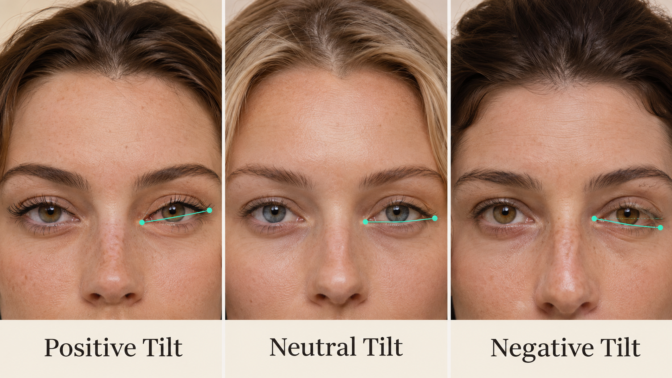
Positive canthal tilt means the outer corner of the eye sits higher than the inner corner, creating an upward-slanting appearance. It is one of the most discussed facial features in online beauty communities, from TikTok makeup tutorials to conversations about facial proportions.
If you are curious about your natural eye shape and eye orientation, this guide explains positive, neutral, and negative canthal tilt, the anatomy that influences eye corner position, how to measure canthal tilt, how other facial features affect the overall look, and how to analyze your features using AI-powered tools such as Facefy.
Understanding your natural eye structure can help you make more informed choices about makeup, styling, facial analysis, and even potential surgical options, while keeping the focus on facial diversity rather than treating one eye shape as the ideal.
What Is Positive Canthal Tilt?
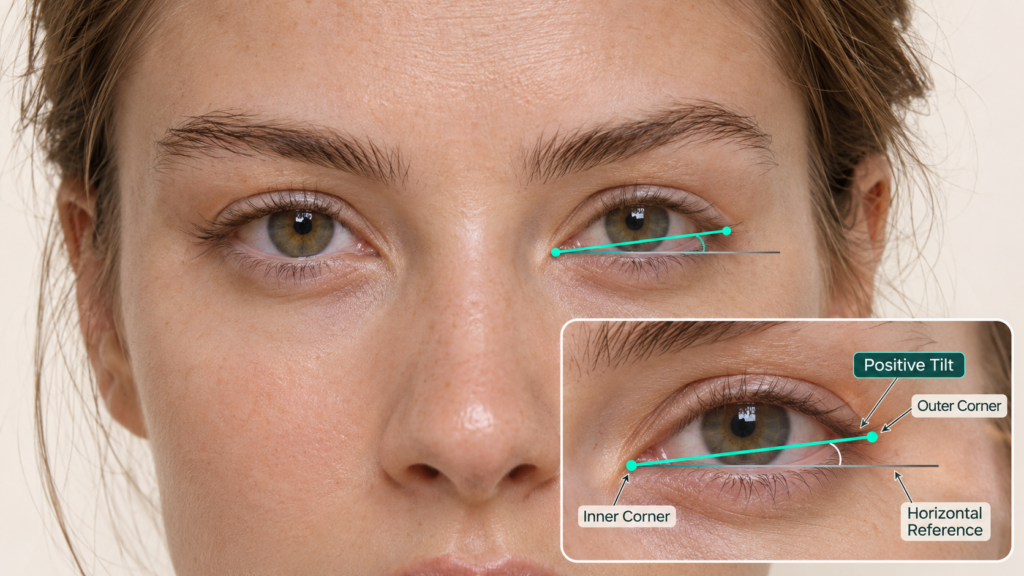
Positive canthal tilt occurs when the outer eye corner, called the lateral canthus, sits higher than the inner corner, or medial canthus.
The angle is measured by connecting these points and comparing the line with a horizontal reference.
There are three classifications:
- Positive canthal tilt: The outer corner sits higher, creating an upward-slanting appearance.
- Neutral canthal tilt: Both corners sit at approximately the same horizontal level.
- Negative canthal tilt: The outer corner sits lower, creating a downward-slanting appearance.
These classifications describe eye orientation rather than attractiveness.
Why Does Positive Canthal Tilt Get So Much Attention?
Positive tilt is frequently associated with almond-shaped eyes and the lifted appearance popular in beauty photography.
Some people perceive upward-slanting eyes as expressive or alert. However, these impressions vary with facial structure, cultural preferences, and individual taste.
There is no universally ideal canthal tilt angle.
What Determines Your Canthal Tilt?
Several anatomical characteristics influence the position of your eye corners.
Bone Structure, Orbital Anatomy, and Canthal Tilt
The orbital bones provide the framework surrounding your eyes. Their shape, cheekbone projection, and facial proportions influence eyelid and eye-corner positioning.
Genetics plays an important role in these characteristics.
Eyelid Tendons, Soft Tissue, and Canthal Tilt
The medial and lateral canthal tendons support the eyelids and help maintain their position.
Skin elasticity, eyelid anatomy, and surrounding soft tissues also influence visible eye orientation.
Age-Related Changes in Canthal Tilt
Changes in skin elasticity, tissue support, and eyelid positioning may affect the appearance of canthal tilt over time.
However, aging affects individuals differently. A naturally positive tilt does not necessarily become neutral or negative.
Camera Angles and Facial Expressions
Head rotation, camera height, facial expressions, and lens distortion can change apparent eye orientation.
For readers interested in exploring these characteristics, Facefy offers AI-powered facial analysis tools that help examine eye shape, proportions, and other visible features.
Its photograph-based approach provides a useful starting point for understanding natural facial characteristics before experimenting with styling techniques.
Positive vs. Neutral vs. Negative Canthal Tilt
Understanding these categories helps explain why eye orientation varies naturally.
Positive Canthal Tilt
With positive tilt, the outer eye corner sits above the inner corner.
This creates an upward-slanting appearance sometimes associated with cat-eye or fox-eye aesthetics.
However, these makeup styles can also be created on eyes with neutral or negative tilt.
A more pronounced angle is not necessarily more attractive.
Neutral Canthal Tilt
Neutral tilt means the eye corners are approximately level.
Neutral eyes can appear rounded, almond-shaped, hooded, or deep-set depending on surrounding anatomy.
Eyebrow positioning and eyelid structure also influence their appearance.
Negative Canthal Tilt
Negative tilt occurs when the outer eye corner sits below the inner corner.
This creates a downward-slanting orientation, sometimes described as downturned eyes.
Negative tilt is a normal variation and should not automatically be associated with tiredness, aging, or poor proportions.
How to Measure Your Canthal Tilt
You can make a basic assessment using a clear frontal photograph.
Step 1: Take a Straight-On Photograph
Position your camera at eye level and look directly toward the lens.
Keep your head upright, expression relaxed, and eyebrows naturally positioned.
Avoid beauty filters and close-up distortion.
Step 2: Identify Your Eye Corners
Locate the medial canthus near your nose and the lateral canthus at the outer corner.
These landmarks establish the line used to assess eye orientation.
Step 3: Compare the Angle With a Horizontal Line
Imagine a horizontal reference line passing through the inner corner.
If the outer corner sits higher, the tilt is positive. If approximately level, it is neutral. If lower, it is negative.
Make sure the photograph is properly aligned before comparing landmarks.
Step 4: Consider Both Eyes Separately
Natural facial asymmetry means your eyes may have slightly different orientations.
Small differences are common and do not necessarily indicate a problem.
For a more convenient assessment, Facefy’s positive canthal tilt analysis tool helps users explore eye-corner orientation through AI-powered photograph analysis.
The tool provides an additional perspective on visible eye geometry, although results should be interpreted as estimates rather than clinical measurements.
Facefy also offers a canthal tilt analyzer for examining eye orientation.
How Other Facial Features Influence Eye Appearance
Canthal tilt is only one component of eye anatomy.
Eyebrow Position
A raised outer eyebrow can emphasize an upward-looking eye shape, while a flatter eyebrow creates a more horizontal impression.
However, eyebrow shape does not determine anatomical canthal tilt.
Upper and Lower Eyelids
Eyelid exposure, crease position, and lower-eyelid contours influence perceived eye shape.
Visible white beneath the iris, sometimes called scleral show, can affect appearance independently of canthal tilt.
Facial Symmetry and Canthal Tilt
Differences in eyebrow height, eyelid shape, and eye positioning influence facial balance.
Facefy’s face symmetry checker provides an appearance-based way to explore these relationships.
Symmetry measurements describe visible proportions, not objective beauty.
Can You Improve the Appearance of Positive Canthal Tilt?
Your natural tilt is largely anatomical, but makeup and styling can influence perceived eye orientation.
Winged Eyeliner
Extending eyeliner slightly upward from the outer corner can emphasize a lifted appearance.
The angle and thickness should complement your eyelid structure.
Eyebrow Shaping
A subtle outer eyebrow arch can visually reinforce an upward direction.
Natural eyebrow growth and facial proportions should guide shaping decisions.
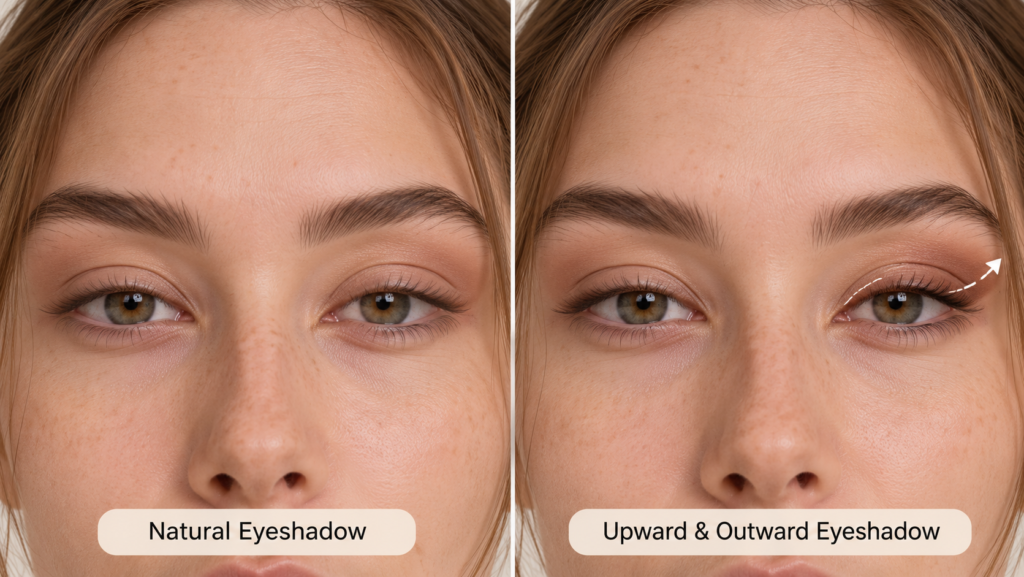
Eyeshadow Placement
Blending darker eyeshadow upward and outward can create an elongated appearance.
This technique can be adapted for hooded, monolid, and deep-set eyes.
Eyelash Styling
Curling eyelashes can make eyes appear more open.
Strategically placed false eyelashes may also influence perceived eye orientation.
Can Exercises or Surgery Change Canthal Tilt?
Facial exercises and massage are sometimes promoted as methods for increasing positive tilt.
However, convincing evidence that these techniques permanently reposition eye corners is lacking.
Surgical procedures such as lateral canthoplasty and canthopexy can alter or support outer eye-corner positioning.
Potential risks include asymmetry, scarring, eyelid malposition, and dry-eye symptoms.
Anyone considering surgery should consult a qualified oculoplastic surgeon. AI analysis cannot determine medical suitability.
How Accurate Is AI Canthal Tilt Analysis?
AI tools estimate eye-corner orientation by identifying visible facial landmarks.
Results depend on image quality, camera perspective, and head positioning.
For consistent comparisons, use similar lighting, camera distance, and facial expressions.
Even carefully captured photographs provide approximate assessments rather than clinical findings.
Final Thoughts on Positive Canthal Tilt
Positive canthal tilt describes an upward orientation of the outer eye corners relative to the inner corners.
It is one natural eye configuration alongside neutral and negative tilt.
Understanding your eye shape and surrounding facial anatomy can help you explore makeup, eyebrow styling, and other appearance choices.
Ultimately, canthal tilt is one characteristic within the diversity of human facial features. It does not determine attractiveness, health, or personal value.