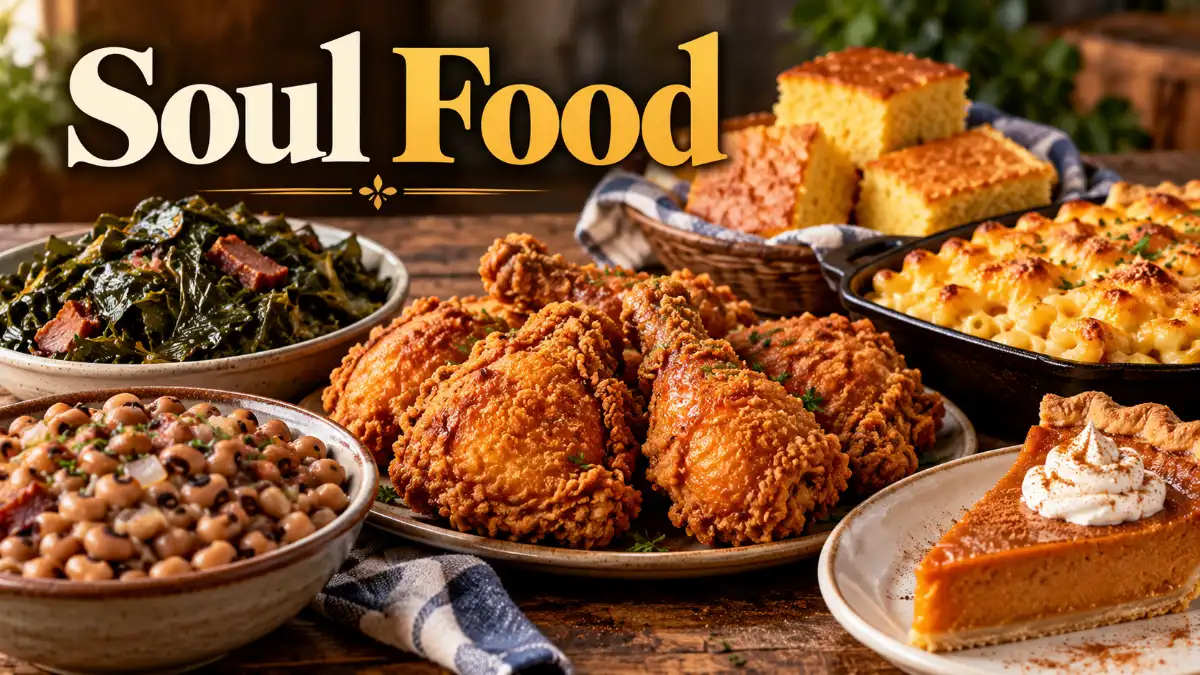
Soul food is a traditional African American cuisine rooted in the Southern United States, known for dishes such as fried chicken, collard greens, cornbread, black-eyed peas, macaroni and cheese, and sweet potato pie. Its origins combine African culinary knowledge with Southern ingredients and cooking traditions. More than comfort food, soul food preserves African American history, cultural identity, family recipes, and community connections.
Not every soul food dish is fried or rich in meat and butter. The cuisine also includes vegetables, beans, seafood, rice, and slow-cooked meals. Its story stretches from African agricultural traditions and the experiences of enslaved people to the Great Migration and the rise of African American restaurants. Today, soul food remains both a meaningful cultural tradition and a diverse style of home cooking.
What Is Soul Food?
Soul food refers to foods and cooking traditions closely associated with African American communities, particularly families whose roots lie in the American South.
Common cooking methods include frying, roasting, baking, simmering, and braising. Ingredients such as cornmeal, leafy greens, sweet potatoes, rice, and beans are especially familiar.
However, no single menu defines the cuisine. Recipes differ by region, household, religion, dietary preferences, and family history.
For some families, a Sunday dinner means fried chicken, collard greens, baked macaroni and cheese, and cornbread. Others may prepare catfish, cabbage, black-eyed peas, and rice.
The connection between these meals comes from the people, histories, and culinary traditions that shaped them.
History and Origins of Soul Food
African Culinary Roots
Africans forcibly transported to North America carried valuable knowledge of agriculture, food preparation, and cooking methods.
Crops and foods such as okra, rice, and black-eyed peas have significant connections to African food traditions. West African agricultural expertise also played an important role in the development of Southern rice cultivation.
The Smithsonian National Museum of African American History and Culture documents how African food knowledge influenced the cuisine of the United States.
Food Traditions During Slavery
Enslaved African Americans frequently had limited access to food and relied on available provisions, gardens, locally grown crops, and resourceful cooking techniques.
Vegetables, cornmeal, beans, and greens became important ingredients. Some households flavored vegetables with small amounts of meat when available.
These cooking practices involved agricultural knowledge, creativity, and the preservation of family traditions.
The cuisine should not be reduced to the idea that it originated entirely from unwanted scraps. African culinary expertise and broader Southern agricultural history were equally significant.
The Great Migration and the Soul Food Movement
During the Great Migration, millions of African Americans moved from the South to Northern, Midwestern, and Western cities.
They carried recipes and cooking traditions to communities in places such as Chicago, Detroit, New York, and Los Angeles.
The phrase soul food gained wider cultural prominence during the 1960s. Like soul music, it became associated with African American cultural pride and identity.
Restaurants, entrepreneurs, and cookbook authors helped introduce these dishes to wider audiences.
The Smithsonian’s African American food history collection describes the important role of restaurants, cookbooks, and culinary figures during this movement.
15 Popular Traditional Soul Food Dishes
These dishes represent some of the most familiar foods associated with Southern African American cooking. Not every family serves all of them, and several also belong to broader Southern culinary traditions.
1. Fried Chicken
Fried chicken is prepared by seasoning chicken, coating it with flour or another breading mixture, and frying it until golden.
Its crisp exterior and juicy interior make it a popular family dinner dish. Common sides include greens, cornbread, and macaroni and cheese.
2. Collard Greens
Collard greens are leafy vegetables traditionally simmered until tender.
Many recipes use onions, garlic, broth, and smoked meat. Vegetarian versions can achieve a savory flavor with smoked paprika, herbs, and vegetable broth.
3. Baked Macaroni and Cheese
Baked macaroni and cheese combines cooked pasta with cheese, milk, and seasonings before baking.
Some family recipes use eggs to produce a firmer texture. It frequently appears at holidays and special gatherings.
4. Cornbread
Cornbread is made primarily from cornmeal and baked in a skillet, pan, or baking dish.
Southern versions range from savory to lightly sweetened. It commonly accompanies beans, greens, soups, and stews.
5. Black-Eyed Peas
Black-eyed peas are cooked with vegetables, seasonings, broth, and sometimes smoked meat.
They are especially familiar during New Year’s meals, when some Southern traditions associate them with good luck and prosperity.
6. Fried Catfish
Catfish is coated in seasoned cornmeal and fried until crisp.
It is frequently served with hush puppies, coleslaw, lemon, and hot sauce, particularly in Southern seafood traditions.
7. Smothered Pork Chops
Smothered pork chops are cooked with a rich, savory gravy, often featuring onions.
They are commonly served with rice, potatoes, or vegetables that complement the gravy.
8. Candied Yams
Candied yams are usually made with sweet potatoes in many American kitchens.
The sweet potatoes are baked with butter, sugar, and spices, making them a familiar holiday side dish.
9. Braised Oxtails
Oxtails are cooked slowly until the meat becomes tender and develops a rich gravy.
They are often accompanied by rice, beans, or vegetables.
10. Southern Cabbage
Cabbage is simmered or sautéed with onions, garlic, peppers, and seasonings.
Some recipes contain smoked meat, while others rely entirely on vegetables and spices.
11. Chicken and Dumplings
Chicken and dumplings combine cooked chicken, a savory broth, and soft pieces of dough.
The dish is also widespread in Southern cooking beyond African American culinary traditions.
12. Hush Puppies
Hush puppies are small portions of seasoned cornmeal batter fried until golden.
They are commonly served with catfish and other Southern seafood dishes.
13. Sweet Potato Pie
Sweet potato pie features mashed sweet potatoes, sugar, eggs, warming spices, and a pastry crust.
It is especially associated with holidays and African American family celebrations.
14. Peach Cobbler
Peach cobbler is prepared by baking peaches beneath or alongside a biscuit-like topping or pastry.
It is often served warm, sometimes with ice cream.
15. Banana Pudding
Banana pudding is a layered dessert featuring bananas, vanilla pudding, and wafers.
Depending on the recipe, it may be topped with whipped cream or meringue.
Common Soul Food Ingredients
The cuisine uses familiar vegetables, grains, proteins, and seasonings.
| Ingredient | Common use |
| Collard greens | Slow-cooked vegetable sides |
| Cornmeal | Cornbread, catfish coating, hush puppies |
| Black-eyed peas | Bean dishes and stews |
| Sweet potatoes | Side dishes and desserts |
| Okra | Gumbo, stews, and vegetable dishes |
| Chicken | Fried, roasted, and stewed meals |
| Catfish | Fried or baked seafood |
| Rice | Main courses and side dishes |
| Onions and garlic | Flavoring vegetables, meats, and sauces |
| Paprika and cayenne | Seasoning savory foods |
Ingredient choices vary considerably. Family recipes and regional traditions influence how each dish is prepared.
How to Make Soul Food at Home
A traditional-inspired meal can be prepared using common ingredients and ordinary kitchen equipment.
For beginners, collard greens are a useful starting point because they demonstrate a familiar slow-cooking technique.
Easy Southern-Style Collard Greens Recipe
Recipe type: Vegetable side dish
Preparation time: 15 minutes
Cooking time: Approximately 40–50 minutes
Total time: Approximately 55–65 minutes
Servings: 4
Dietary style: Vegetarian, using vegetable broth
Ingredients
- 450 g fresh collard greens
- 1 tablespoon olive oil
- 1 medium onion, chopped
- 2 garlic cloves, minced
- 2 cups low-sodium vegetable broth
- 1 tablespoon apple cider vinegar
- ½ teaspoon smoked paprika
- Salt and black pepper to taste
- Optional red pepper flakes
Step-by-Step Instructions
- Wash the collard greens thoroughly to remove dirt.
- Remove the thick stems and chop the leaves into manageable pieces.
- Heat the olive oil in a large pot over medium heat.
- Add the onion and cook until softened.
- Stir in the garlic and smoked paprika for approximately 30 seconds.
- Add the greens and vegetable broth.
- Cover and simmer for 40–50 minutes, checking occasionally until the greens are tender.
- Stir in the apple cider vinegar.
- Season to taste and serve warm.
Cooking tip: Older or thicker greens may need additional cooking time. If the pot becomes dry before they soften, add a little more broth or water.
Serving suggestion: Pair the greens with cornbread, black-eyed peas, and roasted chicken or a vegetarian protein.
Editorial recipe note: This is a practical home-style formulation, not a recipe represented as personally kitchen-tested. Confirm cooking results and add original recipe photography before claiming firsthand testing.
Read Also: Chitlins: What They Are, How to Clean and Cook Them Safely
Soul Food vs. Southern Food: What’s the Difference?
The two cuisines share many recipes but differ in cultural scope and history.
| Soul Food | Southern Food |
| Closely associated with African American culinary heritage | Broad regional cuisine of the American South |
| Influenced by African foodways and African American history | Shaped by numerous communities and regional influences |
| Strong connection to African American family and cultural traditions | Includes varied traditions across Southern states |
| Includes greens, fried catfish, black-eyed peas, and cornbread | Includes barbecue, biscuits, grits, and regional seafood |
A dish can belong to both categories. The main distinction concerns cultural history rather than completely different cooking techniques.
Is Soul Food Healthy?
Soul food can contribute to a balanced diet. Its nutritional value depends on the ingredients, cooking methods, portion sizes, and overall eating habits.
Vegetables and beans provide fiber, vitamins, and minerals. Fish, poultry, and legumes can contribute protein.
However, some traditional preparations contain substantial amounts of sodium, saturated fat, added sugar, or frying oil.
Healthier Ways to Prepare Soul Food
Small adjustments can maintain familiar flavors while improving nutritional balance:
- Bake or roast chicken more frequently instead of deep-frying it.
- Use low-sodium broth for vegetables and stews.
- Include beans, greens, and other vegetables regularly.
- Flavor foods with garlic, onion, herbs, vinegar, and spices.
- Use unsaturated oils where suitable instead of relying heavily on solid fats.
- Adjust dessert portions and added sugar according to individual needs.
The American Heart Association’s guidance on healthy cooking oils explains the benefits of replacing some saturated fats with unsaturated fats.
These adjustments are optional approaches to everyday cooking. Traditional recipes also have cultural value that should be respected.
Regional Variations of Soul Food
The Carolinas and Coastal South
The coastal Southeast has distinctive African American food traditions, particularly those of Gullah Geechee communities.
Rice, seafood, vegetables, and dishes such as Hoppin’ John are important in this regional food history.
The National Park Service’s Gullah Geechee cultural history describes how communities preserved African cultural and agricultural knowledge.
Louisiana
Louisiana’s food traditions include distinctive Creole and Cajun cuisines.
African American culinary history intersects with dishes such as gumbo, red beans and rice, and regional seafood preparations.
These cuisines share some influences but should not be treated as identical.
Northern and Western Cities
During the Great Migration, African American communities carried Southern recipes to cities across the United States.
Restaurants and home cooks preserved familiar dishes while incorporating ingredients and preferences from their new surroundings.
Cultural Importance of Soul Food
Food plays an important role in preserving family memories and cultural knowledge.
Traditional dishes frequently appear at Sunday dinners, church events, family reunions, holidays, and community celebrations.
Recipes are often passed between generations through shared cooking experiences rather than formal written instructions.
African American chefs and food entrepreneurs have also shaped the cuisine’s public recognition.
Edna Lewis, an influential chef and cookbook author, celebrated seasonal Southern ingredients and rural cooking traditions.
Leah Chase, the celebrated New Orleans restaurateur, helped establish Dooky Chase’s Restaurant as an important culinary and community institution.
The Smithsonian’s Cultural Expressions exhibition recognizes food as an important part of African American creativity, identity, and everyday life.
Traditional Soul Food Dinner Menu Ideas
There is no universal soul food dinner menu. Meals vary by family, region, budget, and celebration.
| Occasion | Suggested menu |
| Sunday dinner | Fried chicken, collard greens, cornbread |
| Family gathering | Baked macaroni and cheese, smothered pork chops, cabbage |
| Seafood dinner | Fried catfish, hush puppies, coleslaw |
| Vegetarian dinner | Black-eyed peas, meat-free greens, cornbread |
| Holiday meal | Roasted turkey, candied yams, sweet potato pie |
| Comfort-food dinner | Chicken and dumplings, green beans, peach cobbler |
For a balanced meal, consider combining a vegetable dish, a protein source, and an appropriate serving of grains or another starch.
Frequently Asked Questions About Soul Food
1. What is soul food, and where did it originate?
Soul food is a traditional African American cuisine that developed primarily in the Southern United States. Its history connects African agricultural knowledge, regional Southern ingredients, and generations of cooking traditions. During slavery, African Americans preserved culinary knowledge while adapting to restricted food supplies and difficult living conditions. These traditions continued developing through emancipation, migration, and family cooking. Today, soul food includes dishes such as fried chicken, collard greens, black-eyed peas, cornbread, and sweet potato pie. It remains an important expression of African American cultural heritage.
2. What are the most popular traditional soul food dishes?
Popular soul food dishes include fried chicken, baked macaroni and cheese, collard greens, cornbread, black-eyed peas, fried catfish, smothered pork chops, and candied yams. Desserts such as sweet potato pie, peach cobbler, banana pudding, and pound cake are also familiar. These foods are commonly associated with family gatherings, Sunday dinners, holidays, and community celebrations. However, recipes differ across households and regions. Many families also prepare seafood, rice dishes, cabbage, beans, and slow-cooked meats.
3. Why is soul food important to African American culture?
Soul food is important because it preserves African American culinary history, family knowledge, and cultural identity. Recipes have passed from one generation to another through shared meals and cooking experiences. During the Great Migration, African American families brought Southern food traditions to other regions of the country. The phrase soul food became more prominent during the 1960s, reflecting growing cultural recognition and pride. Today, these foods continue to connect families, preserve memories, and celebrate community heritage.
4. Is soul food healthy, and can it be made healthier?
Soul food can be part of a balanced diet, depending on the ingredients and preparation methods. Foods such as collard greens, black-eyed peas, okra, and sweet potatoes provide useful nutrients, including fiber, vitamins, and minerals. However, recipes containing large amounts of salt, saturated fat, added sugar, or frying oil may be less appropriate for frequent consumption. Healthier alternatives include roasting chicken, using lower-sodium broth, increasing vegetables and beans, and selecting unsaturated oils. These changes can improve nutritional balance while maintaining recognizable flavors.
5. What is the difference between soul food and Southern food?
Soul food is closely associated with African American culinary history and cultural traditions, especially those rooted in the Southern United States. Southern food refers more broadly to the regional cuisines of the American South, shaped by diverse communities and historical influences. Fried chicken, cornbread, greens, and other dishes may appear in both cuisines. The difference is therefore not simply about ingredients or cooking techniques. Soul food specifically emphasizes the culinary contributions, historical experiences, and cultural identity of African American communities.