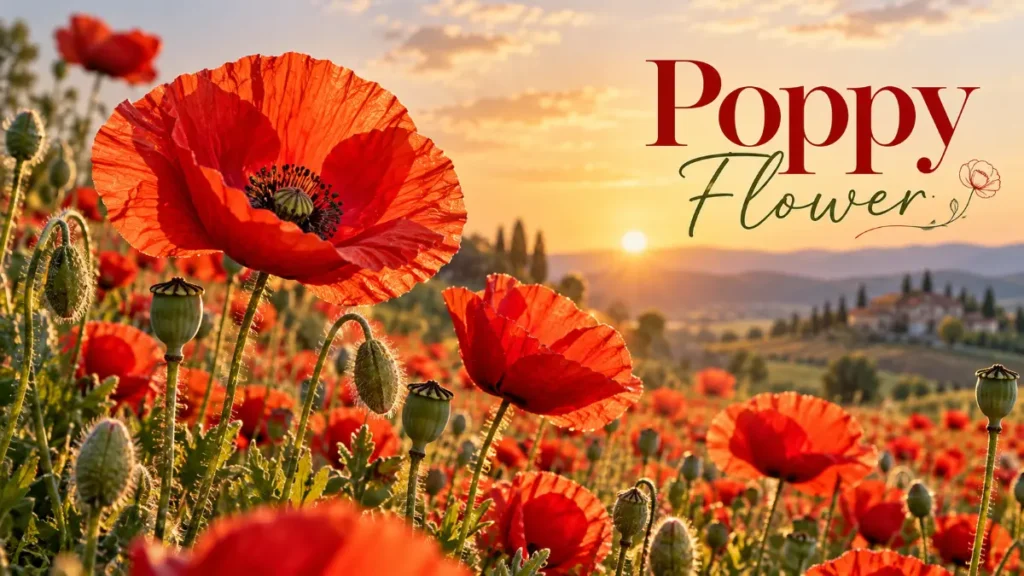
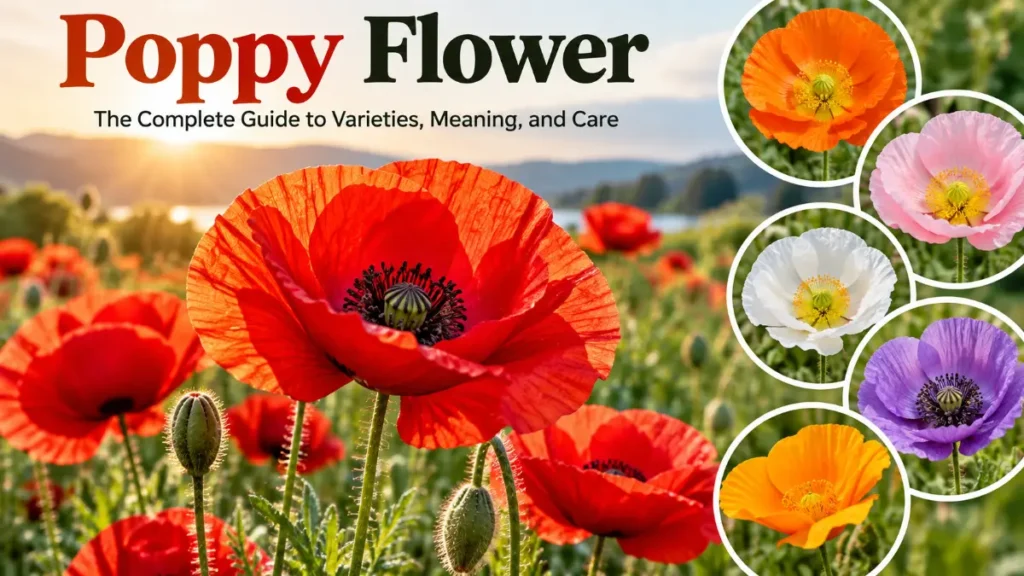
The poppy flower is known for its delicate, crepe-like petals, bold colours, and memorable seed heads. Yet “poppy” is a broad common name: some are true Papaver species, while others belong to related genera and need very different growing conditions.
Choosing the right poppy flower starts with understanding its botanical identity, life cycle, mature size, sunlight needs, and tolerance for heat or moisture. Corn poppies suit informal wildflower gardens; Oriental poppies create dramatic perennial-border displays; California poppies thrive in dry sun; and Himalayan blue poppies are specialist plants for cool, moist sites.
True poppies belong to the genus Papaver in the family Papaveraceae. California poppy is Eschscholzia californica, while plants sold as Himalayan blue poppies have traditionally been associated with Meconopsis; classification and accepted names can vary by species and source.
Poppy flower varieties
| Common name | Scientific name | Life cycle | Approximate height | General flowering period | Best garden use |
| Corn or field poppy | Papaver rhoeas | Annual | 30–90 cm | Spring to summer | Meadows and wildflower planting |
| Shirley poppy | Papaver rhoeas Shirley Group | Annual | 45–90 cm | Spring to summer | Cottage gardens and cut flowers |
| Iceland poppy | Papaver nudicaule | Short-lived perennial or annual | 30–60 cm | Cool season through summer | Containers and spring displays |
| Oriental poppy | Papaver Oriental Group | Herbaceous perennial | 60–100 cm | Late spring to early summer | Perennial borders |
| California poppy | Eschscholzia californica | Annual or short-lived perennial | Up to about 50 cm | Spring through summer; potentially early autumn | Dry gardens and containers |
| Himalayan blue poppy | Meconopsis taxa | Herbaceous perennial | Species dependent | Late spring to summer | Cool, sheltered gardens |
Height, bloom period, and long-term performance can vary with cultivar, climate, soil, and sowing time. RHS describes Eschscholzia californica as a spreading annual up to 50 cm tall, with summer flowers in orange, yellow, white, or red.
Corn poppy –Papaver rhoeas
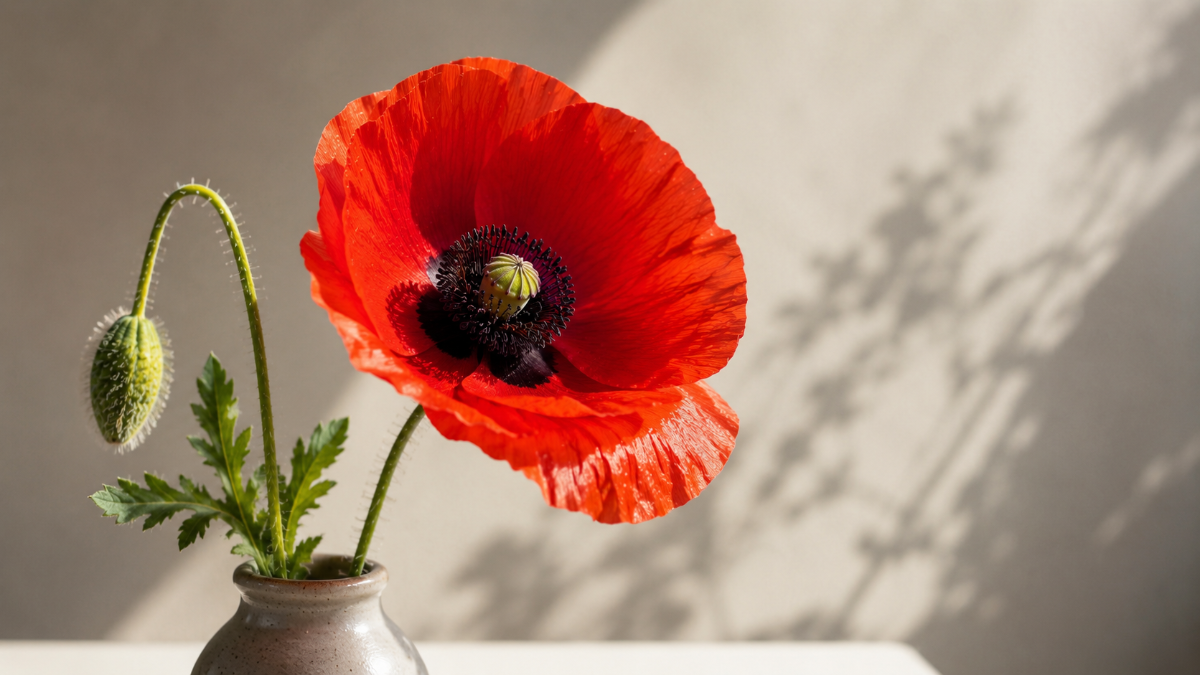
Corn poppy is also known as field poppy and is commonly associated with the Flanders remembrance tradition. It is an annual true poppy, typically recognised by its bright red flowers, four thin petals, fine hairy stems, divided leaves, and rounded seed capsules.
Corn poppy is one of the easiest poppy flower varieties for a naturalistic display. It works well in wildflower areas, open borders, and sunny spaces where plants can self-sow. Direct sowing is generally preferable to transplanting because young poppies often dislike root disturbance.
Best for: Wildflower gardens, informal planting, and beginner gardeners
Light: Full sun
Soil: Free-draining soil; avoid consistently wet ground
After flowering: Produces seed and completes its annual life cycle
Shirley poppy – Papaver rhoeas Shirley Group
Shirley poppies are cultivated forms of Papaver rhoeas, not a separate botanical species. Their flowers may be white, blush pink, rose, lavender, bicoloured, single, semi-double, or double.
These plants have the same general growing approach as corn poppies, but their pastel palette makes them particularly useful in cottage-style borders and cutting gardens. A mixed sowing can create a soft, informal display, while single-colour selections give a more coordinated design.
Best for: Cottage gardens and garden-cut flowers
Light: Full sun
Soil: Open, free-draining ground
After flowering: Can self-sow if mature seed capsules are left in place
Iceland poppy – Papaver nudicaule
The accepted name is Papaver nudicaule. Some older gardening literature uses Meconopsis nudicaulis as a synonym, but RHS lists Papaver nudicaule as the current name.
Iceland poppies have bowl-shaped flowers held on slender stems above a low rosette of foliage. Blooms may be white, yellow, orange, salmon, pink, or red. They are often treated as annuals in warm climates, although they can be short-lived perennials where growing conditions remain relatively cool.
Best for: Cool-season beds, spring displays, and containers
Light: Full sun in cooler climates
Soil: Moist but well-drained soil
After flowering: May weaken after persistent heat or several growing seasons
Oriental poppy – Papaver Oriental Group
Oriental Poppy
Oriental poppies are herbaceous perennials grown for their large, ruffled flowers and coarse, deeply divided foliage. Flowers are commonly scarlet, orange, pink, plum, or white, often with dark markings at the base of each petal.
You may see both Papaver orientale and Papaver Oriental Group in plant references. Botanical sources may use P. orientale, while horticultural catalogues often apply Oriental Group to cultivated garden forms and named varieties. RHS uses the Oriental Group in cultivar listings. Oriental poppies have a feature that surprises many new gardeners: summer dormancy. After flowering, foliage can yellow and disappear temporarily. This is commonly a normal seasonal pattern for established plants rather than an automatic sign of disease.
Best for: Sunny perennial borders
Light: Full sun
Spacing: About 45–60 cm, depending on cultivar and mature spread
Soil: Moderately fertile, humus-rich, well-drained soil
After flowering: Plan nearby companion plants to fill the temporary summer gap
RHS advises full sun and moist but well-drained or well-drained soil for Papaver orientale.
California poppy – Eschscholzia californica
California poppy is part of Papaveraceae but is not a true Papaver poppy. It has cup-shaped flowers in orange, yellow, cream, red, or mixed shades, held above distinctive finely divided blue-green foliage.
Its fruit is also useful for identification. Unlike the rounded capsules of many true poppies, California poppies form a long, narrow seed pod. It is especially suitable for sunny, dry, or drought-prone gardens.
Best for: Gravel gardens, dry borders, containers, and low-maintenance planting
Light: Full sun
Spacing: Roughly 20–30 cm
Soil: Sandy or free-draining soil
After flowering: Can self-sow in suitable sites
RHS notes that California poppies thrive in full sun and well-drained soil and can tolerate dry conditions once established.
Himalayan blue poppy – Meconopsis taxa
Himalayan blue poppies are specialist plants, valued for their blue flowers and woodland-garden character. They are less forgiving than corn, California, or Oriental poppies and may struggle in hot, dry, exposed settings.
Their soil must retain moisture without becoming waterlogged. They also benefit from shelter against hot afternoon sun and drying winds. This makes them a better choice for cool, moist gardens than for Mediterranean, tropical, or drought-prone climates.
Best for: Cool, sheltered, moisture-retentive gardens
Light: Partial shade or filtered light, particularly where summers are warm
Soil: Humus-rich, moist, well-drained, often slightly acidic soil
After flowering: Long-term success depends strongly on local climate and summer conditions
RHS recommends a cool, sheltered position with dappled shade and moist, humus-rich soil for Himalayan blue poppy cultivars.
How to identify a poppy flower
To identify a poppy flower accurately, look beyond the petal colour. Flower shape, foliage, stem texture, bud position, seed capsule, plant height, and behaviour after flowering are more reliable clues.
| Type | Flower | Leaves and stems | Fruit | Main identification clue | After flowering |
| Corn poppy | Usually red, with four thin petals | Divided green leaves; fine, often hairy stems | Rounded capsule | Airy annual growth | Seeds and dies |
| Shirley poppy | Pastel, bicolour, or double flowers | Similar to corn poppy | Rounded capsule | Ornamental cultivated flower forms | Seeds and dies |
| Iceland poppy | Bowl-shaped blooms in bright or pale colours | Low foliage; long flower stems | Narrow capsule | Blooms held above a compact plant | May act as annual or short-lived perennial |
| Oriental poppy | Large, ruffled blooms, often with dark basal marks | Deeply divided foliage; bristly stems | Large rounded capsule | Large perennial clump and dormancy | Foliage may disappear temporarily |
| California poppy | Orange or yellow cup-shaped flowers | Blue-green, ferny leaves | Long narrow pod | Feathery foliage and narrow pod | May self-sow |
| Himalayan blue poppy | Blue flowers with yellow stamens | Broad foliage and leafy stems | Species dependent | Cool, moist, shaded growing preference | May struggle in heat or drought |
For true Papaver species, the rounded capsule is often the easiest feature to check after petals drop. California poppy’s long seed pod is one of the clearest ways to separate it from corn or Oriental poppy.
Read More: Purple Flowers
How to grow poppies
Most common garden poppies prefer full sun, but not every plant called a poppy has the same requirements. California poppy handles dry sun; Oriental poppy wants a sunny but well-drained perennial border; Iceland poppy prefers cool conditions; and Himalayan blue poppy needs a protected site with reliable moisture.
How to sow and plant poppies
| Type | Direct sowing | Recommended approach | Key caution |
| Corn poppy | Yes | Sow thinly where plants will grow | Avoid repeatedly transplanting seedlings |
| Shirley poppy | Yes | Direct-sow in prepared ground | Thin overcrowded seedlings |
| Iceland poppy | Seeds or young plants | Start in cool conditions | Heat can reduce flowering quality |
| Oriental poppy | Usually established plants | Plant in a permanent border position | Make room for summer dormancy |
| California poppy | Yes | Sow shallowly in sunny, drained soil | Avoid waterlogged compost |
| Himalayan blue poppy | Usually young plants or carefully raised seed | Plant into cool, humus-rich soil | Do not let roots dry out |
Poppy roots can resent disturbance, which is why direct sowing is often the simplest approach for annual poppies.
Poppy flower care
Water new seedlings and recently planted perennials while they establish. After that, adapt watering to the species rather than following one rule for every poppy.
- Corn and Shirley poppies generally need limited intervention once established in suitable soil.
- California poppies tolerate dry conditions better than constant moisture.
- Oriental poppies require good drainage and should not sit in waterlogged winter soil.
- Iceland poppies perform better when temperatures remain relatively cool.
- Himalayan blue poppies need evenly moist soil and shelter from drying heat.
Avoid overfeeding. Rich soil or excessive fertilizer can encourage soft leaf growth at the expense of balanced flowering, especially for California poppies. RHS advises that Californian poppies do not need enriched ground and should be watered sparingly once established.
Can poppies grow in pots?
Yes. California poppies and Iceland poppies are generally the best container options.
Use pots with drainage holes and choose a compost mix appropriate for the species. California poppies need free drainage and full sun. Iceland poppies suit containers in relatively cool conditions. Corn and Shirley poppies can grow in larger, deeper containers if plants have enough space.
Oriental poppies are usually better in open soil because of their established perennial root system and eventual spread. Himalayan blue poppies are challenging in containers because compost can overheat, dry too quickly, or become waterlogged.
Common poppy problems
| Problem | Symptoms | Likely cause | First action |
| Aphids | Sticky, curled, or distorted new growth | Sap-feeding insects | Inspect plants early and manage promptly |
| Powdery or downy mildew | Marked, discoloured, or powdery foliage | Fungal disease, humidity, or poor airflow | Improve spacing and remove affected foliage |
| Root or crown decline | Yellowing, wilting, or collapse | Excess moisture or poor drainage | Improve drainage and reassess watering |
| Flopping stems | Stems bend after wind or rain | Exposure, heavy blooms, or overly soft growth | Use discreet supports or provide shelter |
| Poor flowering | Strong foliage growth but few blooms | Insufficient sun or unsuitable conditions | Reassess site and plant choice |
RHS lists aphids, downy mildew, powdery mildew, fungal wilts, and Verticillium wilt as possible problems for Oriental poppies.
FAQs
Poppy flower meaning, safety and ?
The red poppy has a well-established association with remembrance of those who died in war and conflict. The Royal British Legion explains that the poppy became a remembrance symbol in the aftermath of the First World War.
Other poppy flower meanings-such as peace, consolation, imagination, sleep, and resilience—are cultural or floristry associations rather than universal botanical definitions.
Do poppies come back every year?
It depends on the type.
Corn and Shirley poppies are annuals. They die after setting seed, but can return through self-sowing.
Iceland poppies can be short-lived perennials in suitable conditions but are frequently grown as annuals.
Oriental poppies are herbaceous perennials.
California poppies can behave as annuals or short-lived perennials depending on local climate.
Himalayan blue poppies are perennials but can be demanding outside cool, moist regions.
Do poppies need full sun?
Most popular garden poppies-including corn, Shirley, Oriental, and California poppies—prefer full sun. Himalayan blue poppies are different: they generally need cooler, sheltered conditions with partial shade or filtered light.
When do poppies bloom?
Corn and Shirley poppies usually bloom from spring into summer. Iceland poppies flower in cool conditions. Oriental poppies typically flower in late spring or early summer in temperate gardens. California poppies bloom from spring through summer and may continue into early autumn depending on sowing time and climate. RHS advises spring sowing for flowers through summer and early autumn.
Can you collect poppy seeds?
Yes. Let seed capsules mature and dry on the plant, then collect them on a dry day. Label seeds by species or cultivar and store them somewhere cool and dry. Seed collected from hybrid plants or cultivated groups may not produce seedlings identical to the parent plant.
Are poppies safe around pets and children?
Do not assume that any poppy is safe to ingest. Risk depends on the species, plant part, quantity consumed, and individual exposure. If accidental ingestion is suspected, seek advice from an appropriate medical, veterinary, or poison-information professional.
Papaver somniferum also has jurisdiction-dependent legal considerations. Its classification as a Papaver species is clear, but laws on cultivation and use vary by location.
Choosing the right poppy?
The best poppy flower is the one that fits your garden rather than simply the one with the brightest bloom. Choose corn or Shirley poppies for easy annual colour and self-sowing potential. Choose California poppies for a sunny, dry garden. Choose Oriental poppies for a dramatic perennial border and plan for their summer dormancy. Choose Iceland poppies for cool-season colour, and grow Himalayan blue poppies only if you can provide their preferred cool, moist, sheltered environment.