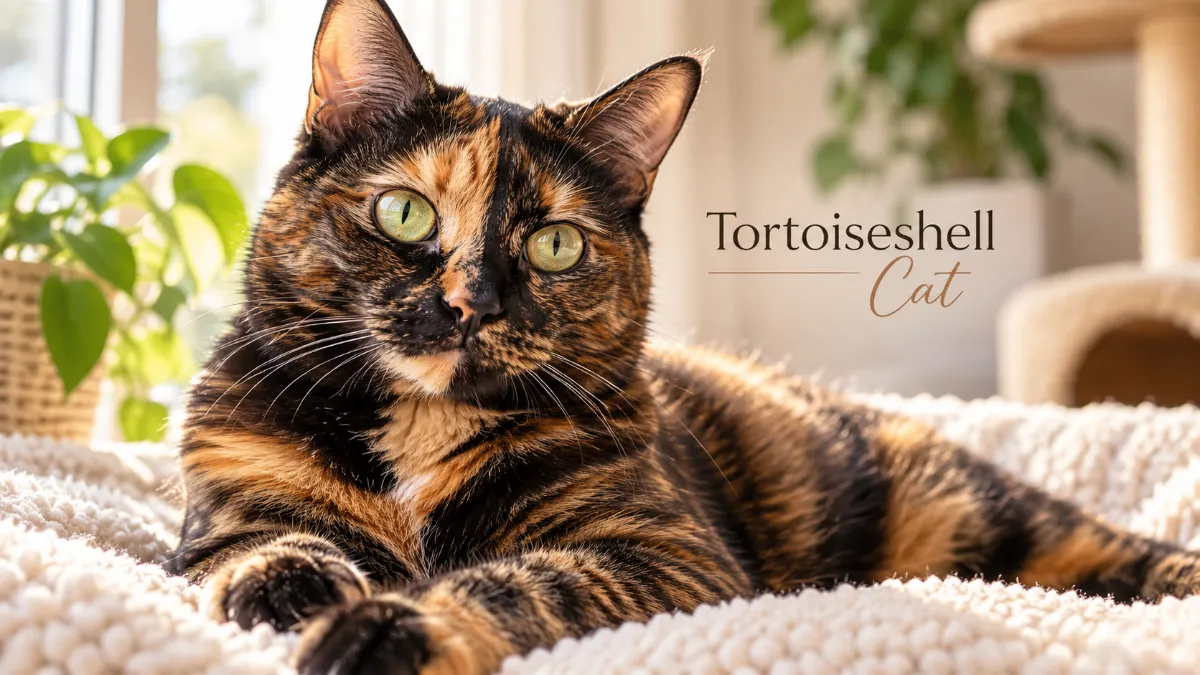
tortoiseshell Cat They are characterized by a two-color pattern in which red- or orange-based coloring (including cream) is intermixed with black or another dark color, and any combination thereof. Tortoiseshell does not identify a single breed, but describes what can be the color pattern of many different cats. Torties are primarily female, as the genes for orange and non-orange coloration is located on X chromosome. Their coats can be heavily mottled black and orange or softer blue-gray and cream variations also called dilute tortoiseshell.
This guide explains how to identify a tortie, distinguish one from a calico or torbie, understand the genetics behind the coat, evaluate the idea of “tortitude,” and make practical decisions about care and adoption.
What Is a Tortoiseshell Cat?
A tortoiseshell cat has a coat containing both red-based coloring-often described as orange, ginger, rust, or cream-and black-based coloring.
The colors may form tiny intermingled flecks, broad irregular patches, or something in between. Some cats are mostly dark with just a few orange areas, while others have much more obvious red coloring.
The International Cat Association, or TICA, describes torties as cats that combine red and black-based colors. Modifying genes can also change black to colors such as blue and red to cream.
The important point is that tortoiseshell describes color, not ancestry.
| Feature | Typical tortoiseshell cat |
| Breed | Not a breed |
| Basic colors | Red/orange + black-based color |
| Dilute colors | Cream + blue-gray |
| Sex | Predominantly female |
| Hair length | Short or long |
| Tabby combination | Often called a torbie |
| Personality | Depends on the individual |
| Special care because of coat | Generally none |
Why Are They Called Tortoiseshell Cats?
The name comes from the mottled brown, black, orange, and amber appearance traditionally associated with tortoiseshell material.
A cat’s markings can produce a similarly irregular mixture of warm and dark colors, which led to the descriptive name.
Today, “tortie” is the common shortened form used by cat owners, shelters, veterinarians, and cat organizations.
Is Tortoiseshell a Cat Breed?
No. Tortoiseshell is a coat description, not a breed.
For example:
- A Maine Coon can have tortoiseshell coloring.
- A Persian can have tortoiseshell coloring.
- A Domestic Shorthair can have tortoiseshell coloring.
- A Domestic Longhair can have tortoiseshell coloring.
Think of it this way:
Maine Coon = breed
Tortoiseshell = coat coloring
Tortoiseshell Maine Coon = breed + coat color
If you adopt a tortie from a shelter, the appearance of the coat alone usually cannot tell you the cat’s exact ancestry.
How to Identify a Tortoiseshell Cat
The easiest way to identify a tortie is to look at the combination, distribution, and pattern of the colors, rather than focusing on a single patch.
Classic Tortoiseshell
A classic tortie generally combines:
- black or another dark black-based color,
- red, orange, or ginger areas,
- an irregular mottled or patched distribution,
- relatively little obvious white in common U.S. usage.
For example, imagine a mostly black cat with orange areas scattered across the face, shoulders, legs, and tail. If the dark regions are solid rather than striped, that cat could reasonably be described as a classic tortie.
Some torties have finely blended coats that appear almost speckled. Others have larger areas of clearly separated color.
Dilute Tortoiseshell
A dilute tortie has the same basic genetic pattern, but dilution changes the visual intensity of the colors.
Typically:
Black → blue-gray
Red → cream
Instead of a high-contrast black-and-orange coat, a dilute tortie may have a soft blue-gray and pale cream pattern.
TICA notes that dilution can change black to blue and red to cream.
“Dilute tortie” is still a coat description, not a separate breed.
Tortoiseshell-and-White
Tortoiseshell terminology can vary somewhat between countries, registries, breeders, and casual cat owners.
In common U.S. usage, a cat with large areas of white plus clearly separated black and orange patches is frequently described as calico.
A cat whose coat remains predominantly tortoiseshell but has smaller amounts of white may be described as tortie-and-white.
TICA’s color system also recognizes tortie and torbie patterns combined with white.
The Quick “Is My Cat a Tortie?” Test
Use these four steps:
- Look for two pigment groups.
Can you see orange/red/cream along with black/brown/blue-gray? - Look at how the colors are arranged.
Tortie colors are usually mottled, intermingled, or irregularly patched. - Examine the dark areas for stripes.
Clear tabby striping in the black-based portions may indicate a torbie instead. - Check the amount of white.
Large areas of white with separate dark and orange patches are more consistent with what Americans commonly call calico.
Tortoiseshell vs Calico vs Torbie vs Tabby
These terms are often confused because they describe overlapping aspects of feline color and pattern.
Tortoiseshell vs Calico
Both torties and calicos can carry orange/red and black-based coloring.
The most practical distinction in common U.S. terminology is white spotting and color distribution.
A tortie usually has closely mixed or irregular patches of red and dark color with relatively little white.
A calico typically has obvious white areas along with more clearly separated patches of orange/red and black.
The exact terminology can vary in formal cat-fancy systems, so the distinction should be treated as a practical identification guide rather than a universal law.
Tortoiseshell vs Torbie
A torbie is a tortoiseshell cat that also shows a tabby pattern.
The name combines:
tortie + tabby = torbie
One of the best identification tricks is to ignore stripes that appear inside red or cream areas. Red cats can display visible striping even when the overall cat is not genetically a tabby.
Instead, examine the black-based portions.
If those dark areas appear solid, tortie is more likely. If they show clear tabby patterning, such as stripes or other structured markings, the cat may be a torbie. TICA specifically recommends looking at the dark-colored regions for this distinction.
Tortie vs Tabby
“Tabby” refers to a pattern rather than one color.
Tabby patterns can include:
- mackerel stripes,
- classic swirls,
- spots,
- ticking.
A tortie primarily describes the presence of red-based and black-based pigmentation.
A cat can possess both features, creating a torbie.
Dilute Tortie vs Dilute Calico
A dilute tortie generally combines blue-gray and cream with little prominent white.
A dilute calico typically combines those softer colors with more obvious white areas.
| Feature | Tortie | Calico | Torbie | Tabby |
| Red/orange present | Usually | Usually | Usually | May or may not |
| Black/dark coloring | Usually | Usually | Usually | Varies |
| Prominent white | Usually limited | Common | Varies | Varies |
| Clear tabby pattern in dark areas | No | May occur | Yes | Yes |
| A breed? | No | No | No | No |
Why Are Most Tortoiseshell Cats Female?
The strong female bias among torties comes from the way cat coat color genetics interacts with the X chromosome.
The Simple X-Chromosome Explanation
The sex-linked orange color locus in cats is carried on the X chromosome.
Most female cats have two X chromosomes: XX.
Most male cats have one X and one Y chromosome: XY.
A female can therefore inherit one X carrying the orange-associated version and another X carrying the non-orange version.
Because she possesses both, different groups of skin cells can express different color states.
That creates the familiar mixture of orange and dark patches.
A typical XY male has only one X chromosome, so he ordinarily receives one version at this X-linked locus rather than the two different versions needed for the classic tortie mosaic.
How X Inactivation Creates the Patchwork Coat
Female mammals do not simply run both X chromosomes at full activity in every cell.
Early in development, one X chromosome is largely inactivated in each cell. Which X remains active can differ among groups of cells.
Those cells then divide.
One region of skin may contain cell populations expressing the orange-associated version, while another region expresses the non-orange version.
The result is a visible mosaic across the coat.
Recent molecular research has added an important piece to the story. Researchers identified a roughly 5-kilobase noncoding deletion associated with altered regulation of the ARHGAP36 gene as the genetic basis of sex-linked orange coloring in domestic cats. The same research connects random X inactivation with the tortoiseshell and calico mosaic.
Why Every Tortie’s Pattern Is Unique
The developmental process does not follow a predetermined map that says where every orange or dark patch must appear.
As cell populations develop and expand, different areas can become dominated by different active-X states.
That is why one tortie may have a dramatic orange blaze across her face while another may have only tiny red flecks around the paws or tail.
Individual patch distributions can vary greatly.
Can Male Tortoiseshell Cats Exist?
Yes. Male torties exist, but they are uncommon.
The typical XY chromosome arrangement makes the ordinary tortie mechanism far less likely in males, but biology provides several exceptions.
How a Male Tortie Can Occur
Possible mechanisms include:
- an XXY chromosome configuration,
- genetic mosaicism,
- chimerism.
An XXY cat has two X chromosomes plus a Y chromosome, allowing two different X-linked color variants to potentially be present.
Mosaicism can arise when genetically different cell populations develop within one individual.
Chimerism involves cells originating from more than one early embryo or genetic lineage.
Because these situations are unusual, male torties are much less common than female torties.
Are Male Tortoiseshell Cats Sterile?
Male torties associated with an XXY chromosome pattern are commonly infertile.
However, saying every male tortie is sterile is too absolute because male tortie coloration can arise through more than one biological mechanism.
Fertility and health should therefore be assessed individually.
Should a Male Tortie See a Veterinarian?
The coat color itself is not a veterinary emergency.
However, if you have a confirmed male tortie, mentioning the unusual coloring during routine veterinary care can be useful.
A veterinarian can decide whether reproductive, chromosomal, or other investigation is medically relevant.
Tortoiseshell Cat Personality: Is “Tortitude” Real?
Many tortie owners affectionately describe their cats as having “tortitude.”
The term is entertaining, but it should not be treated as a personality diagnosis.
What Does “Tortitude” Mean?
“Tortitude” usually refers to the reputation that torties are:
- bold,
- vocal,
- energetic,
- independent,
- assertive,
- strong-willed.
You may certainly meet a tortie that fits this stereotype.
You may also meet a quiet tortie who hides when guests arrive, a highly affectionate tortie who follows her owner everywhere, or a laid-back senior tortie who spends most of the day sleeping.
Does Coat Color Determine Personality?
There is some research exploring associations between coat color and owner-reported behavior.
One study analyzed responses from more than 1,200 cat guardians and found differences in reported aggression among some color groups, including sex-linked orange females. However, the data came from guardian surveys, and the researchers also found relatively small differences in some handling and veterinary situations. That type of evidence does not justify predicting an individual cat’s temperament from her coat alone.
A cat’s behavior can be shaped by many factors:
- genetics unrelated to coat color,
- early socialization,
- age,
- previous experiences,
- current environment,
- stress,
- play and enrichment,
- pain or illness,
- interactions with people,
- relationships with other animals.
How to Evaluate an Individual Tortie’s Personality
If you are meeting a tortie at a shelter or rescue, watch the actual cat rather than assuming she has “tortitude.”
Observe:
- Does she approach people willingly?
- How does she respond to gentle petting?
- Does she enjoy interactive play?
- Is she comfortable with handling?
- What happens when an unfamiliar person enters?
- How does she behave around other animals?
- How quickly does she recover after something mildly stressful?
| Common claim | Better interpretation |
| All torties are aggressive | Temperament varies between individual cats |
| Torties are always independent | Some are extremely social |
| Torties dislike other cats | Compatibility depends on the individuals |
| Coat color predicts behavior | Color alone is not a reliable personality test |
What Breeds Can Be Tortoiseshell?
Tortoiseshell coloring can appear in multiple breeds whose standards allow the relevant colors.
Examples can include:
- American Shorthair,
- British Shorthair,
- Maine Coon,
- Persian,
- Cornish Rex,
- Japanese Bobtail.
Breed standards can change and differ between organizations, so anyone writing specifically about show standards should verify the current rules of the relevant registry.
Many torties seen in U.S. shelters are simply classified as Domestic Shorthair or Domestic Longhair rather than as a pedigree breed.
Can You Determine Breed From a Tortie Coat?
Usually not.
A tortie coat tells you about pigmentation. It does not prove ancestry.
A long-haired tortie with a fluffy tail, for instance, is not automatically a Maine Coon.
Similarly, a round-faced tortie is not automatically a British Shorthair.
A verified pedigree provides the clearest evidence for a recognized breed. Without one, breed labels based only on appearance should be treated cautiously.
Tortoiseshell Cat Size and Appearance
There is no single standard size for torties because they do not belong to one breed.
How Big Do Tortoiseshell Cats Get?
Adult size depends more on factors such as:
- breed and ancestry,
- sex,
- skeletal build,
- nutrition,
- age,
- body condition.
A tortie Maine Coon could be much larger than a tortie Domestic Shorthair, even though both share the same broad coat description.
That is why publishing one universal “tortoiseshell weight” can be misleading.
What Eye Colors Can Torties Have?
Torties can have different eye colors depending on their genetics and breed background.
Possible shades may include yellow, gold, copper, green, or other breed-appropriate eye colors.
Tortoiseshell coloring itself does not create one mandatory eye color.
Can Torties Have Long Hair?
Yes.
Tortie coloring can occur in both:
- short-haired cats,
- long-haired cats.
Coat length affects grooming needs far more than the tortie coloring does.
Tortoiseshell Cat Lifespan
There is no scientifically useful universal lifespan that applies specifically to torties.
Does Being Tortoiseshell Affect Lifespan?
The color pattern itself is not a good predictor of longevity.
A healthy tortie Domestic Shorthair and a pedigree tortie from another breed may have very different inherited risks, lifestyles, and medical histories.
Those factors are more informative than coat color.
What Actually Influences a Cat’s Lifespan?
Important influences include:
- genetic background,
- preventive veterinary care,
- healthy body condition,
- diet,
- dental health,
- infectious-disease exposure,
- chronic diseases,
- accident and trauma risk,
- indoor versus outdoor lifestyle,
- age at diagnosis and treatment of illness.
Rather than asking, “How long do torties live?” a more useful question is:
What health, lifestyle, and breed factors apply to this particular cat?
Are Tortoiseshell Cats Healthy?
In an ordinary female tortie, the coat pattern itself is not a disease.
Do Torties Have Special Health Problems?
There is no general rule that female torties develop a special set of illnesses simply because they are tortoiseshell.
Their health risks usually depend more on:
- breed,
- ancestry,
- age,
- weight,
- environment,
- reproductive status,
- preventive care,
- individual medical history.
Health Considerations for Male Torties
Male torties deserve a little more genetic context because some carry unusual chromosome configurations such as XXY.
Those chromosomal differences can be associated with infertility and may occasionally have other health implications.
A veterinarian can determine whether any specific investigation is needed.
Do not assume that a cat’s chromosome arrangement can be diagnosed just from a photograph of the coat.
Breed and Individual Health Matter More
Consider two cats:
A tortie Persian and a tortie Domestic Shorthair may look similar in color but have very different facial structure, coat care requirements, ancestry, and inherited health considerations.
The shared tortie coloring does not erase those differences.
When to Contact a Veterinarian
Seek veterinary advice when a cat develops concerning changes such as:
- persistent appetite loss,
- difficulty breathing,
- repeated vomiting,
- unexplained weight loss,
- difficulty or pain while urinating,
- severe lethargy,
- sudden major behavior changes,
- obvious pain.
Do not attribute a new behavior problem automatically to “tortitude.” Pain or illness can also change how a cat behaves.
How to Care for a Tortoiseshell Cat
There is no special tortie diet or universal tortie care routine.
Good care should be based on the cat’s age, health, weight, coat length, lifestyle, and individual needs.
Feeding and Weight Management
Feed a nutritionally complete diet appropriate for the cat’s life stage and health needs.
Practical habits include:
- measuring portions rather than continually topping up the bowl,
- providing fresh water,
- monitoring body condition,
- limiting excessive treats,
- adjusting intake when activity or health changes.
The correct food amount differs from cat to cat, so package directions are best treated as a starting point rather than a personalized prescription.
A veterinarian can help if you are uncertain whether your cat is underweight, overweight, or maintaining an appropriate body condition.
Grooming
Short-haired torties may need relatively little coat maintenance, although gentle brushing can help remove loose hair.
Long-haired torties generally need more frequent attention to prevent tangles and mats.
Check:
- behind the ears,
- armpits,
- belly,
- hind legs,
- tail area.
Also maintain appropriate nail care and monitor for new bald patches, sores, excessive scratching, or changes in coat quality.
Exercise and Enrichment
Indoor cats benefit from opportunities to climb, chase, scratch, explore, hunt, and observe.
Useful options include:
- wand toys,
- climbing trees,
- scratching posts,
- cardboard scratchers,
- puzzle feeders,
- rotating toys,
- boxes and tunnels,
- secure window observation areas.
Instead of leaving every toy available permanently, rotate some of them so the environment stays interesting.
Routine Veterinary and Dental Care
Preventive care should include veterinary examinations appropriate for the cat’s age and medical history.
Discuss with your veterinarian:
- vaccination,
- parasite prevention,
- dental health,
- spaying or neutering,
- weight management,
- age-related screening.
Again, none of these decisions should be based primarily on whether the cat is tortoiseshell.
Living With a Tortoiseshell Cat
A tortie’s coat may be distinctive, but the fundamentals of successful cat ownership are the same: provide safety, predictability, resources, enrichment, and time to adjust.
Introducing a Tortie to Another Cat
Do not put two unfamiliar cats together immediately and expect them to “work it out.”
A gradual process is usually easier:
- Give the new cat a separate room.
- Allow the cats to become familiar with each other’s scent.
- Feed them on opposite sides of a closed door or secure barrier.
- Progress to controlled visual contact.
- Allow short supervised interactions when both appear comfortable.
- Increase shared time gradually.
If either cat is repeatedly frightened or aggressive, slow the process down.
This method is not tortie-specific, it is simply good cat-introduction practice.
Introducing a Tortie to a Dog
Control the dog first.
The cat should always have:
- distance,
- escape routes,
- vertical space,
- a dog-free area.
Keep early sessions short and supervised.
Reward calm behavior and never force nose-to-nose contact.
A cat that feels trapped is much more likely to defend herself.
Helping a Newly Adopted Tortie Settle In
A new home can be overwhelming.
An initial safe room should contain:
- food,
- fresh water,
- litter box,
- hiding area,
- comfortable bed,
- scratching surface,
- toys.
Let the cat choose when to explore more of the home.
Some cats investigate within hours. Others may need days or longer.
Indoor Enrichment Checklist
- Multiple appropriate scratching surfaces
- Elevated resting or climbing space
- At least one secure hiding spot
- Daily interactive play
- Food or puzzle enrichment
- Quiet sleeping area
- Clean, accessible litter facilities
- Opportunities to observe the environment safely
Should You Adopt a Tortoiseshell Cat?
A beautiful coat can catch your attention, but it should not be the main reason you choose a particular cat.
The best match depends on the individual animal and your household.
Don’t Choose by Coat Color Alone
Before adopting, consider:
- energy level,
- sociability,
- confidence,
- handling tolerance,
- medical history,
- age,
- grooming requirements,
- compatibility with children,
- compatibility with existing pets.
For example, a quiet adult tortie that has already lived successfully with dogs may be a better match for a dog-owning household than an energetic young tortie with no dog experience.
Questions to Ask the Shelter or Rescue
Ask:
- Has this cat lived with other cats?
- Has she lived with dogs?
- How does she respond to unfamiliar people?
- Does she enjoy being handled?
- What food is she currently eating?
- Does she consistently use the litter box?
- Is there a known medical history?
- Has she been spayed or neutered?
- Are vaccination records available?
- Does she currently take medication?
- What is her activity level?
- Does she have any known fears or triggers?
Tortie Adoption Decision Table
| Your situation | What matters most |
| First-time cat owner | Temperament, health, care requirements |
| Existing cat | Previous cat experience and slow introductions |
| Dog household | Dog’s behavior and cat’s previous dog exposure |
| Children | Handling tolerance and supervision |
| Busy household | Access to quiet, protected resting areas |
| Long-haired tortie | Regular grooming commitment |
| Senior adopter | Energy level and physical care demands |
| Apartment living | Enrichment, climbing space, litter setup |
Read More: Dodgers vs Giants Rivalry
Unique Gap – Identify Your Tortie in 60 Seconds
Still unsure what coat pattern your cat has?
Use this quick decision method.
Step 1 – Look for Two Pigment Families
Look across the whole body.
Can you see:
red/orange/cream
plus
black/brown/blue-gray?
If the answer is no, the cat probably does not fit a conventional tortie description.
If yes, continue.
Step 2 – Examine the Dark Areas
Do not rely only on stripes visible in orange areas.
Instead, inspect the darker portions of the coat.
If the black-based sections look essentially solid, the cat is more consistent with a tortie.
If those areas have obvious structured tabby markings, consider torbie.
TICA specifically recommends using the black-based portions to help distinguish torties from torbies.
Step 3 – Assess the White
Does the cat have large areas of white separating obvious dark and orange patches?
In common U.S. terminology, that strongly suggests calico.
If white is minimal and the red and dark colors dominate the coat, tortie is more likely.
Step 4 – Check Whether the Colors Are Diluted
Ask whether the colors look softened:
Black → blue-gray
Red/orange → cream
If so, the cat may be a dilute tortie or dilute calico, depending largely on the distribution of white.
60-Second Decision Guide
Red + dark colors present?
→ No: Probably another color pattern
→ Yes: Continue
Dark areas clearly striped?
→ Yes: Consider torbie
→ No: Continue
Large amount of white?
→ Yes: Consider calico
→ No: Tortie is more likely
Blue-gray + cream instead of black + orange?
→ Yes: Dilute form
→ No: Classic/full-color form
Possible outcomes include:
- classic tortie,
- dilute tortie,
- torbie,
- dilute torbie,
- calico,
- dilute calico,
- another coat pattern.
Common Tortoiseshell Cat Myths and Mistakes
Several misconceptions are repeated so often that they can sound like facts.
Mistake 1 – Calling Tortoiseshell a Breed
A tortie is not automatically a particular breed.
Correct description:
breed/type + coat pattern
For example:
Domestic Shorthair tortie
or
tortoiseshell Persian
Mistake 2 – Assuming Every Tortie Has the Same Personality
“Tortitude” is a fun cultural label, not a reliable behavioral test.
One tortie may be bold and vocal while another is gentle and cautious.
Assess the cat in front of you.
Mistake 3 – Calling Every Three-Color Cat a Tortie
A cat showing dark color, orange, and a large amount of white may be better described as calico in common U.S. terminology.
A cat combining tortie coloring with obvious tabby markings may be a torbie.
Look at pattern and white distribution, not simply the number of visible colors.
Mistake 4 – Assuming Every Male Tortie Has the Same Genetic Cause
XXY chromosome configurations are an important explanation for some male torties, but they are not the only biological possibility.
Mosaicism and chimerism can also produce unusual combinations of coat color.
Mistake 5 – Assuming a Rare Coat Means a Cat Is More Valuable
Unusual coloring may be visually striking, but coat rarity alone does not establish financial value, pedigree, health, or quality.
A verified pedigree and recognized breed lineage are separate issues from color.
For a companion cat, temperament, health, and suitability for your household matter far more.
Fascinating Tortoiseshell Cat Genetics
Torties have played an important role in explaining mammalian genetics because their coats make cellular mosaicism visible.
What Scientists Recently Learned About Orange Fur
For decades, scientists knew that orange coat color in cats was linked to the X chromosome, but the precise molecular mechanism remained unresolved.
Recent research identified a roughly 5-kilobase noncoding deletion that changes regulation of the ARHGAP36 gene in pigment-producing cells.
The work showed that altered ARHGAP36 expression affects pigment-production pathways and helps explain sex-linked orange coloring in domestic cats.
This gives researchers a much more specific molecular explanation than the older description of the trait as simply an unknown “orange gene.”
Why Torties Became a Classic Example of X Inactivation
In a female carrying different color-associated versions on her two X chromosomes, random X inactivation produces populations of cells expressing different pigment instructions.
Because those populations are visible as patches of fur, the cat effectively turns an abstract genetics concept into something you can see.
That makes torties and calicos especially useful examples when explaining cellular mosaicism.
What Genetics Cannot Tell You
Coat genetics can explain a great deal about pigmentation.
It cannot reliably tell you whether an individual cat will be:
- affectionate,
- aggressive,
- intelligent,
- easy to train,
- comfortable with dogs,
- comfortable with children,
- long-lived,
- independent.
Color genetics explains the coat.
It does not write the cat’s entire personality or medical future.
Tortoiseshell Cat Facts at a Glance
If you only need the essentials, use this quick reference.
| Question | Quick answer |
| Is tortoiseshell a breed? | No |
| What colors are typical? | Red/orange plus black-based coloring |
| Are most torties female? | Yes |
| Can male torties exist? | Yes, but they are uncommon |
| What is a dilute tortie? | A blue-gray and cream version |
| What is a torbie? | Tortoiseshell coloring combined with tabby patterning |
| Is tortie the same as calico? | Not usually in common U.S. terminology |
| Does “tortitude” determine personality? | No |
| Do torties need special food? | No |
| Can long-haired cats be torties? | Yes |
Frequently Asked Questions About Tortoiseshell Cats
What is a tortoiseshell cat?
In torties the coat is a beautiful mosaic of red-based and black based colours. This same behavior is observed in the tortie coat of female cats, which follows X-linked color with random x-chromosome inactivation; different combinations of skin cells form their own pigment.
Are tortoiseshell cats a breed?
No. Tortoiseshell is not a breed, it is a coat color pattern.) This can be a spider who is of farm (Domestic Shorthair, Domestic Longhair) or breed such as the Main Coon or Persian whose genetics allow for the color. Old coat is not per se an indicator of descent.
Are all tortoiseshell cats female?
Not at all, still most are women. Well, this is because ordinary female cats have two X chromosomes and so they always carry either the orange or a non-orange x-linked gene. Because tortie coloration is mostly linked to the X chromosome, in rare cases males may have this fur pattern due to aberrant sex-chromosome combinations (e.g., XXY), mosaicism, or chimerism.
Q : Why are Male Tortoiseshells so Rare?
The male cat will always possess 1 X and 1 Y chromosome. The standard tortie where a pair of X-linked color states exist in different cell populations; this is more natural because females are XX. These genetic disorders are generally more hereditary in males.
What distinguishes a tortoiseshell cat from, let say, a calico?
In standard American English a tortie should have an even mix of deep red/orange and dark colors with the tiniest bits not quite white. This kind of cat will usually show white intermixed with bold flecks in orange/red and black–these are normal colors for calicos. The rules regarding formal naming conventions differ between cat registries.
What is dilute tortoiseshell cat?
Dilute torties refer to a specific color of coat in the traditional soft-style The coat tends to be blue-gray and cream rather than black, dark red / orange. A dilution is not a new kind of cat, it just fades the colour.
What is a torbie cat?
Torbie literally means torte (tortoiseshell) with tabby as the name indicates. If you are attempting to tell a torbie apart from tortie (this is definitely in the mixed bag coat type) look at those darker sections of blacked-based parts on this coat. This leans more toward torbie if that tabby striping or structured markings in those areas would be clearer.
Are tortoiseshell cats aggressive?
Not necessarily. While it is true that a few studies have observed differing levels of aggression reported as higher among owners with torties than those whose cats fell outside the tabby/dilute groups, this does not mean tons are aggressive by nature. Thinking and comparing these individual factors cat by cat is much more indeed important: socialization, genes, health, environment (including how many other animals are living in the home), age at adoption time with owner until rehomed.
Lifespan of a Tortoiseshell Cat
It is important to note that torties are not a specific breed, thus there isn8217t one right age for any cat to be called 8220a tortie. Genetics is only a minor factor in longevity; age also depends on lineage – what the animal was bred for (hunting or herding), whether its breed has genetic diseases, what health and body condition they had to start with (*veterinary care), diet (see Pasture vs.
How can I find out the breed if my tortoiseshell is a mix?
See torties is not a breed and you cannot easily tell from tortie color. Pedigree records are the strongest evidence of a breed’s foundation. For cats of unknown descent, phenotype does not equal proof. Torties that end up in shelters might be classified as Domestic Shorthair or domestic hair.