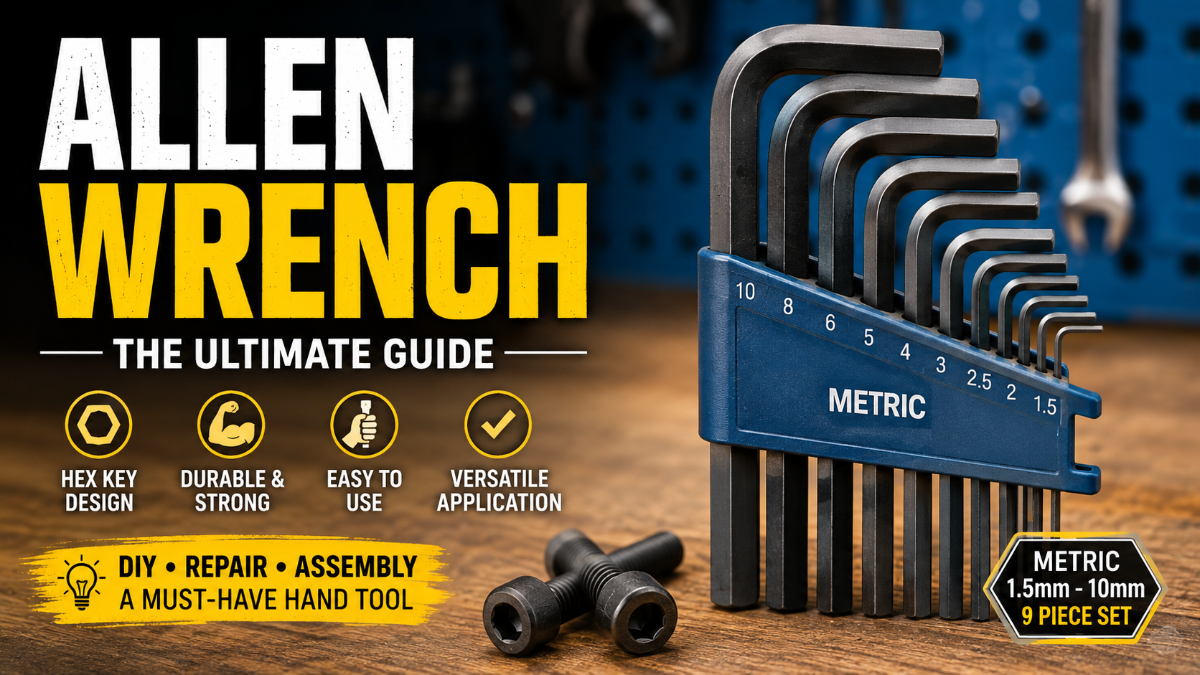
An Allen wrench is the small, hexagonal hand tool that turns screws and bolts with six-sided recessed sockets. If you have assembled a desk, adjusted a bicycle seat, tightened a chair frame, or worked on equipment with socket-head screws, you have likely used one.
The most reliable way to choose a hex key is not to guess from the bolt’s outside diameter. Identify the drive, use the correct metric or inch size, and confirm that the key reaches the bottom of the socket with no visible wobble.
Start With the Fastener, Not the Tool
The easiest way to avoid damaged hardware is to identify the fastener first. An internal hex socket has six straight, flat sides. A matching key transfers turning force across those flats when it is fully seated.
A hex key is not interchangeable with every recessed driver. Torx, Phillips, Pozidriv, square-drive, and security fasteners have different shapes and require their own tools.
| What you see in the fastener | Likely drive type | Tool to use |
| Six straight internal sides | Hex socket | Allen wrench or hex key |
| Six-sided socket with a centre pin | Security hex | Tamper-resistant hex key with a centre hole |
| Rounded six-lobed star | Torx | Torx key or Torx bit |
| Simple cross | Phillips | Phillips driver |
| Cross with extra smaller lines | Pozidriv | Pozidriv driver |
| Four-sided recess | Square/Robertson | Square-drive bit |
| Six flat sides around the outside | External hex | Socket or spanner |
A key that enters only partway, moves inside the recess, or slips as you turn it is not correctly engaged. Stop and identify the reason before applying more force.
The Names You Will See
“Allen wrench,” “Allen key,” “hex key,” and “hex wrench” are names commonly used for the same basic hand tool. “Hex key” is the broad descriptive term because the tool has a six-sided, hexagonal profile.
You may also see a hex bit. A hex bit has the same working profile but fits into a screwdriver handle, ratchet, drill driver, or torque wrench. It is useful when you need speed, access, or a controlled tightening value.
The Measurement That Matters
Hex keys are sized by their width across flats: the distance between two opposite flat faces of the hexagonal working end. They are not sized by the tool’s overall length or by measuring from one point to the opposite corner.
To check an unmarked key, use digital or vernier calipers:
- Clean the working end so debris does not affect the measurement.
- Position the jaws on two opposite flat sides.
- Read the size in millimetres or inches.
- Compare the result with marked keys in your set.
- Test the likely match in the fastener before turning it.
The dimensional requirements, marking, testing, and minimum hardness requirements for hexagon socket screw keys are set out in ISO 2936.
Metric and Inch Hex Keys Are Different Systems
Most Allen wrench sets use either metric sizes in millimetres or SAE/inch sizes in fractions of an inch. Keep both systems available if you work on a mix of furniture, bicycles, imported products, U.S.-made equipment, or mechanical assemblies.
The following is a quick reference to frequently encountered sizes. The columns are shown for convenience only; they are not a conversion guide and do not mean the listed sizes are substitutes.
| Common metric keys | Common SAE/inch keys |
| 1.5 mm | 1/16 in |
| 2 mm | 5/64 in |
| 2.5 mm | 3/32 in |
| 3 mm | 1/8 in |
| 4 mm | 5/32 in |
| 5 mm | 3/16 in |
| 6 mm | 7/32 in |
| 8 mm | 1/4 in |
| 10 mm | 5/16 in |
ASME B18.3 covers general and dimensional data for inch-series hexagon socket cap screws, shoulder screws, set screws, and hex keys.
Read More: YT to MP4
A useful rule for metric hardware
An M designation describes the nominal thread diameter, not the Allen wrench size. An M5 fastener does not automatically take a 5 mm key.
For standard metric socket-head cap screws, the socket size commonly follows this pattern:
| Thread designation | Matching hex key |
| M3 | 2.5 mm |
| M4 | 3 mm |
| M5 | 4 mm |
| M6 | 5 mm |
| M8 | 6 mm |
| M10 | 8 mm |
| M12 | 10 mm |
| M16 | 14 mm |
These values apply to the standard socket-head cap screw design. A button-head, countersunk, low-head, set screw, or proprietary screw with the same thread diameter can have a different internal socket. Confirm the fit at the fastener rather than relying on the M-size alone.
Choosing the Correct Allen Wrench
Use this sequence whenever you need to find the right tool:
- Inspect the recess. Confirm that it is a six-sided internal hex rather than Torx or another profile.
- Check for a centre pin. A pin indicates security hex hardware and requires a hollow-ended key.
- Try the likely metric or SAE key. Do not force it.
- Seat the key to the bottom. Dirt, paint, corrosion, thread-locker residue, or a damaged socket can block it.
- Check for play. The correct key should contact the sides firmly and should not rock.
- Choose the working end. Use a straight end for tight fasteners; use a ball end only where angled access is necessary.
- Follow torque instructions. Use a torque wrench if the equipment manufacturer specifies a value.
This approach is more dependable than selecting a key by visual guesswork or using the closest tool available.
How to Turn a Hex Socket Screw Safely
Once the key fits correctly, technique matters.
- Turn clockwise to tighten and counterclockwise to loosen most standard right-hand threaded fasteners.
- Keep the tool square to the screw head. Twisting the key sideways reduces contact and can round the socket.
- For more leverage, insert the long leg into the socket and turn the shorter leg outside the fastener.
- For faster spinning once the fastener is loose, insert the short leg and rotate the longer outside leg.
- Use steady pressure instead of sudden jerks.
- Stop if the key begins to slip, then inspect the tool and fastener before continuing.
For bicycle stems, handlebars, brakes, seatposts, suspension components, and carbon-fibre parts, the specified tightening torque matters. Use the correct hex bit or key with a suitable torque wrench rather than tightening by feel.
Choosing a Hex Key Style
The familiar L-shaped key works well for many jobs, but other versions can be more practical in certain situations.
| Tool style | Where it helps | When to avoid or limit it |
| Standard L-key | Furniture, occasional repairs, basic home tasks | Repetitive work can be slow or uncomfortable |
| Long-arm key | Deeply recessed or obstructed screws | Tight surroundings may limit the tool’s swing |
| Ball-end key | Accessing a screw at a slight angle | Initial loosening, high torque, and final tightening |
| T-handle key | Frequent bike or workshop jobs | Narrow spaces where the handle cannot turn |
| Folding key set | Portable kits for bikes, vehicles, and home use | Deep recesses where the holder blocks access |
| Hex bit | Ratchets, driver handles, and torque wrenches | Uncontrolled power-tool use that can over-tighten |
| Security hex key | Tamper-resistant hex sockets | Ordinary hex sockets without a centre pin do not require it |
Where Allen Wrenches Are Used
Furniture and flat-pack assembly
Bed frames, desks, dining chairs, shelving, cabinets, and exercise equipment often use hex socket connectors because they can be installed in confined areas. Start every bolt loosely, align the components, and tighten them in stages. This reduces cross-threading and helps prevent threaded inserts from pulling out of particleboard or MDF.
Bicycles and personal mobility equipment
Hex fasteners are common on seat clamps, bottle cages, saddle hardware, brake mounts, handlebar controls, and many stems. Key sizes vary by component, so use the size that fits—not a common size assumed from another bicycle part.
For parts that clamp carbon fibre or affect steering, braking, or rider position, follow the component maker’s torque marking or service instruction. A torque wrench is a safety tool in these applications, not merely an upgrade.
Workshop tools and mechanical equipment
Power tools, machines, automotive accessories, garden equipment, and exercise machines may use socket-head bolts for covers, guards, clamps, pulleys, and alignment hardware. Before loosening a bolt, note what it holds: it may position a component, retain a spring, or secure a safety guard.
Household fixes
A hex key is useful for tightening loose chairs and tables, adjusting compatible handles and fittings, assembling storage products, and maintaining home-gym equipment. Keeping a marked set in a basic tool kit avoids improvising with an incorrect driver.
Why Ball Ends Need Care
A ball-end hex key can engage a compatible socket at an angle, making it valuable when a straight approach is blocked. That convenience comes with a trade-off: the ball end does not provide the same full-depth contact as a straight end.
Use a ball end to start a fastener or turn it where access is awkward. Switch to the straight end to break a tight fastener free or for final tightening. If the part has a stated torque value, use the appropriate torque tool and fitting.
Common Problems and Practical Fixes
| Problem | Likely cause | Safer next step |
| Key does not enter | Wrong drive type, wrong size, or debris | Identify the recess and clean it before trying another key |
| Key will not bottom out | Packed dirt, paint, corrosion, centre pin, or damage | Clear the socket and inspect it closely |
| Key rocks in the socket | Metric/SAE mismatch, wrong size, or worn socket | Use the exact marked key and stop if play remains |
| Key slips under force | Worn key, partial engagement, or rounded socket | Stop turning; use an undamaged straight-end key if possible |
| Bolt will not loosen | Corrosion, thread-locker, or excessive tightening | Use controlled force with full engagement; avoid forcing a damaged recess |
| Ball end feels unstable | It is being used at too much angle or load | Switch to the straight end |
| Bolt needs a specified torque | The assembly has a defined tightening requirement | Use a torque wrench with a compatible hex bit |
Building a Useful Allen Wrench Set
For a general-purpose home tool kit, a set with clear markings and both metric and inch keys covers the widest range of household and repair tasks. The most useful features are practical rather than cosmetic.
Look for:
- Metric and SAE/inch sizes stored separately or clearly labelled
- Sharp, accurately formed working ends
- Straight keys for dependable high-torque engagement
- Ball ends for limited-access situations
- A durable holder that makes a missing size obvious
- Hex bits if you use a ratchet, driver handle, or torque wrench
- T-handles if you regularly perform bicycle or workshop maintenance
Avoid treating the small, unmarked key supplied with furniture as your only option. It may work, but a marked, properly sized key gives better control and makes future adjustments easier.
Care and Storage
Hex keys require little maintenance. Wipe off moisture, grease, and dirt after use; return them to a labelled holder; and replace keys with bent shafts or rounded working ends.
Do not use a hex key as a pry bar, punch, chisel, or substitute screwdriver. Such misuse can bend the tool or damage its tip, reducing its ability to engage a fastener correctly.
Key Takeaway
A hex key is a straightforward tool, but correct fit and technique make the difference between a quick repair and a stripped fastener. Identify the drive, match the metric or SAE size exactly, fully seat the key, and use a straight end for high-force work. Treat thread size and socket size as separate details, and use manufacturer torque instructions whenever they apply.
Frequently Asked Questions
Is there a difference between a hex key and an Allen wrench?
In normal use, no. Both names describe a six-sided tool designed for screws and bolts with internal hex sockets. “Hex key” is the generic descriptive name, while “Allen wrench” and “Allen key” are common terms used in instructions and retail listings. The important distinction is not the name but whether the tool matches the socket shape and size.
Can I replace a missing Allen wrench with a drill bit or screwdriver?
No. A standard drill bit or screwdriver does not have the accurate hexagonal profile needed to engage the flats inside a socket. Improvising can quickly round the recess and make the fastener difficult to remove. Use a properly sized hex key or hex bit instead. If you need powered driving, use a correct hex bit in a controlled driver and avoid over-tightening.
What should I do if the hex socket is full of paint or dirt?
Remove the obstruction before inserting the key. A small pick, brush, or other suitable cleaning method can help clear packed debris without damaging the recess. The key must reach the bottom of the socket to spread force across the drive surfaces. Turning a key that is only partly inserted is a common cause of rounded sockets.
Do ball-end Allen keys work at an angle?
Yes, ball-end hex keys are designed for modest angled access when the tool cannot line up directly with the screw. They are useful for starting or quickly turning compatible fasteners. Their angled engagement is not intended for breaking loose tight hardware or applying final torque. Use the straight end for those tasks.
How do I remove a screw with a rounded Allen socket?
First, stop using a loose key, as additional force can worsen the damage. Clean the recess and check whether an undamaged, exact-size straight key can still seat fully. If it cannot, the suitable removal method depends on access and screw condition; options may include a dedicated extractor or gripping an exposed head. Replace the damaged fastener after removal.