Few sports pack as much strategy, history, and physical intensity into a single afternoon as American football, and these American football facts show exactly why the game has held its grip on fans for over a century. Behind every touchdown celebration and last-second field goal lies a set of rules, records, and traditions that took over 150 years to develop. This collection of facts breaks down the sport through its numbers, its origin story, its rulebook, and the records that still define it today, giving new fans a clear picture of why the game looks and plays the way it does.
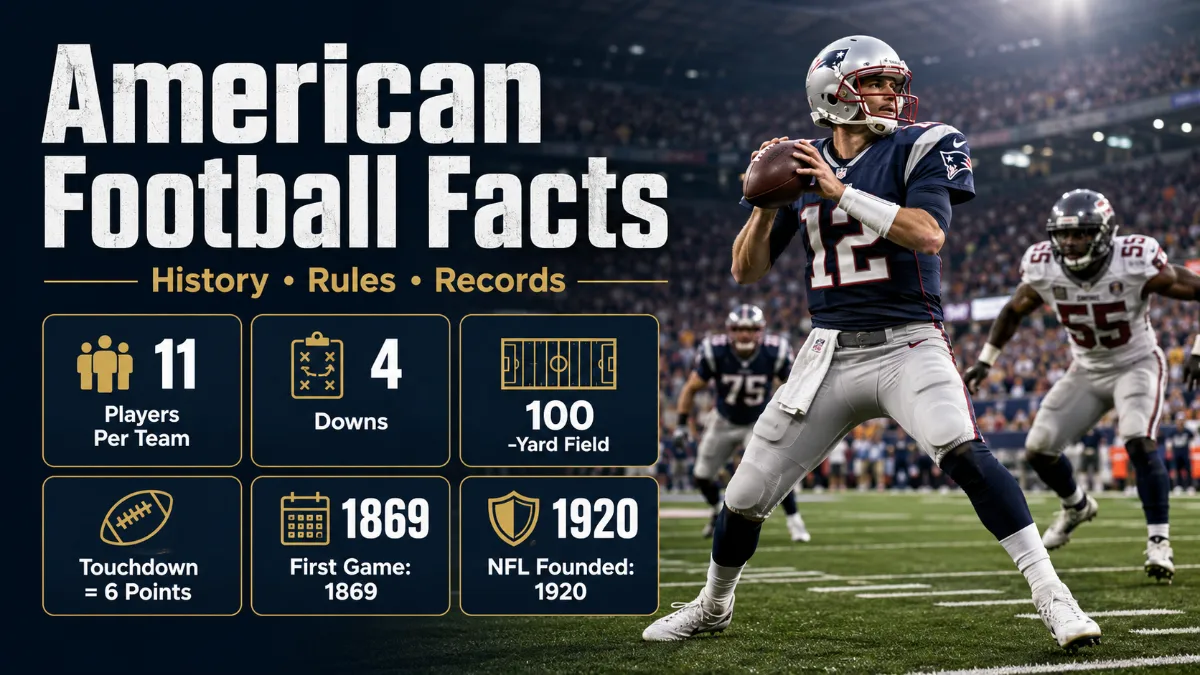
American Football Facts by the Numbers
Before diving into history or strategy, a handful of core numbers explain almost everything about how the sport is structured.
| Number | What It Represents |
| 11 | Players per team on the field at once |
| 4 | Downs the offense gets to gain 10 yards |
| 10 | Yards needed to earn a new set of downs |
| 100 | Length of the playing field in yards, between goal lines |
| 60 | Minutes of regulation play, split into four 15-minute quarters |
| 13 | Minutes of halftime, per the NFL’s official rulebook |
| 6 | Points awarded for a touchdown |
| 89,214 | Tom Brady’s career NFL passing yards, the most of any player |
| 1920 | Year the NFL was founded, in Canton, Ohio |
Where the Game Actually Came From
Most fans know the NFL, but far fewer know the deeper history behind how the sport actually began. It emerged gradually from college matches that borrowed rules from both soccer and rugby, long before anyone called it “American football.”
The turning point traces to a match on November 6, 1869, between Rutgers and Princeton, generally recognized as the first American football game. Rutgers won 6-4, but the contest bore little resemblance to today’s sport: 25 players per side, no forward passing, and scoring driven mainly by kicking the ball rather than carrying it, following rules borrowed from the London Football Association.
The sport gained a distinct identity a few years later. At the Massasoit Convention of 1876, delegates from Harvard, Yale, Princeton, and Columbia adopted rugby-style rules, setting the stage for a coach who would reshape the game entirely. Walter Camp, playing and later coaching at Yale, spent the 1880s introducing the line of scrimmage, the down-and-distance system, and the shift from 15 to 11 players per side, the structural DNA that still defines football today.
Professional play arrived quietly by comparison. In 1892, William “Pudge” Heffelfinger accepted $500 to play a single game for the Allegheny Athletic Association, the first documented instance of a player being paid to compete. And in 1906, following mounting concern over serious injuries in college football, the forward pass was legalized, a rule change credited with making the sport safer and eventually reshaping it into the passing-driven game fans watch now.
Read More: Flagstar Bank
Milestones That Shaped the Sport
This football history is easiest to absorb as a quick timeline.
| Milestone | Year | Why It Mattered |
| First recognized game (Rutgers vs. Princeton) | 1869 | Established the earliest version of organized American football |
| Massasoit Convention | 1876 | Standardized rugby-influenced rules across major colleges |
| Walter Camp’s reforms | 1880s | Introduced downs, scrimmage, and 11-player teams |
| First paid player (Pudge Heffelfinger) | 1892 | Marked the beginning of professional football |
| Forward pass legalized | 1906 | Reduced injuries and opened up modern passing offenses |
| NFL founded as the APFA | 1920 | Created a formal professional league structure |
| League renamed the NFL | 1922 | Established the name still used today |
The National Football League itself began on September 17, 1920, when representatives from teams across Ohio, Indiana, Illinois, and New York gathered at a car dealership in Canton, Ohio, to found the American Professional Football Association. The league took its current name two years later, in June 1922. Jim Thorpe served as its first president while still playing, and of the ten founding franchises, only the Chicago Cardinals (today’s Arizona Cardinals) and the Decatur Staleys (today’s Chicago Bears) are still operating.
Understanding the Objective and the Scoring System
One of the most practical things to know as a new viewer is the sport’s core objective: move the ball into the opposing end zone more effectively than the other team, within a strict set of rules governing possession.
Offenses are given four downs, individual play attempts, to advance the ball 10 yards. Reaching that mark resets the count for another set of four downs. Falling short typically means one of three choices on 4th down: punting to flip field position, attempting a field goal, or risking a direct attempt to convert, depending on the score, time remaining, and field position.
Scoring follows a fixed point structure:
| Method | Points Awarded | Description |
| Touchdown | 6 | Offense advances the ball into the opponent’s end zone |
| Extra point | 1 | Kick attempt following a touchdown |
| Two-point conversion | 2 | Offensive play run from the 2-yard line instead of an extra-point kick |
| Field goal | 3 | Ball kicked through the uprights during live play |
| Safety | 2 | Credited to the defense when the offense is responsible for the ball going dead in its own end zone, whether by tackle, fumble, or penalty |
A regulation NFL game runs four 15-minute quarters, for 60 minutes of playing time, separated by a 13-minute halftime as defined in the league’s official rulebook. If regulation ends tied, the game moves to overtime. Starting with the 2025 season, NFL regular-season and postseason overtime generally gives both teams an opportunity to possess the ball, regardless of what happens on the opening drive, unless that drive ends in a defensive score. Regular-season overtime remains limited to 10 minutes and can end in a tie, while postseason play continues in 15-minute periods until a winner is determined.
Each team carries a 53-man roster during the regular season, but only 11 players per side are on the field at any given moment, rotating between offensive, defensive, and special teams units depending on possession.
Who Does What on the Field
Understanding player roles is one of the most useful things a beginner can learn, since football’s 11-man units are built around three distinct jobs: moving the ball, stopping the opponent, and handling kicking situations.
On offense, the quarterback directs the play and throws passes, running backs carry the ball and catch short passes, wide receivers and tight ends work as pass-catching targets, and the offensive line blocks to protect the ball and open running room. On defense, the defensive line pressures the quarterback and stops the run at the point of attack, linebackers defend against both runs and short passes, and cornerbacks and safeties cover receivers and provide support against big plays.
Special teams step in for kicking situations: kickers handle field goals and extra points, punters kick the ball away on 4th down to change field position, and return specialists try to gain yardage on punts and kickoffs. Understanding these three units makes it far easier to follow why certain players are on the field for certain plays.
Ball Security: Turnovers and Penalties Every Fan Should Recognize
Two things can end an offensive drive early, and both are among the possession-related American football facts worth knowing: losing the ball or breaking a rule.
A turnover usually occurs when possession changes hands because of an interception or a lost fumble. An interception happens when a defender catches a forward pass intended for an offensive player, while a fumble occurs when a ball carrier loses control of the ball and the opposing team recovers it. A turnover on downs is a separate change of possession that occurs when the offense fails to gain the required 10 yards within four downs.
Penalties, by contrast, are self-inflicted setbacks. A false start happens when an offensive player moves illegally before the snap. Offside is called when a player is illegally positioned in or beyond the neutral zone at the snap; NFL rules distinguish this from encroachment and other related neutral-zone violations. Holding penalizes illegally restraining an opponent who isn’t the ball carrier, pass interference covers illegal contact that prevents a catch, delay of game results from failing to snap the ball before the play clock runs out, and roughing the passer punishes illegal hits on the quarterback after a throw. None of these rules are complicated once you know what to watch for, they simply enforce fair, controlled competition.
Records the NFL Record Book Still Recognizes
The record books hold some of the most memorable American football facts, especially around individual careers, and while a few marks have shifted with the rise of pass-heavy offenses, others have stood for decades.
Tom Brady owns the league’s career passing marks, with 89,214 passing yards and 649 passing touchdowns across 23 seasons between 2000 and 2022. He also holds the record for most Super Bowl titles by a player, with seven, six won with the New England Patriots and one with the Tampa Bay Buccaneers. Trailing Brady on the all-time passing list are Drew Brees (80,358 yards) and Peyton Manning (71,940 yards).
At the franchise level, the Patriots and Pittsburgh Steelers are tied for the most Super Bowl titles, with six each. Twenty different franchises have won at least one Super Bowl since the game began following the 1966 season.
Super Bowl history has produced some striking extremes. The highest-scoring Super Bowl by combined points remains Super Bowl XXIX, a 49-26 win for the San Francisco 49ers over the San Diego Chargers that totaled 75 points. Separately, the 49ers also hold the record for the largest margin of victory, with a 45-point win over the Denver Broncos (55-10) in Super Bowl XXIV. On the opposite end, the lowest-scoring Super Bowl saw the Patriots edge the Los Angeles Rams 13-3 in 2019.
The single biggest turnaround in the game’s history came in Super Bowl LI, when New England erased a 25-point deficit to beat the Atlanta Falcons 34-28 in overtime, the first Super Bowl ever decided that way. It wasn’t the last: Super Bowl LVIII, in February 2024, also went to overtime, with the Kansas City Chiefs beating the San Francisco 49ers 25-22.
American Football Facts Beyond the NFL
The NFL dominates football coverage, but the sport is played at several other levels, most notably college football, which shares the same essential structure with a few key differences.
| Category | NFL | College Football |
| Competition level | Professional | University (NCAA) |
| Downs required | 4 downs for 10 yards | 4 downs for 10 yards |
| Rulebook | NFL Official Playing Rules | NCAA Football Rules |
| Overtime | Both teams get an opportunity to possess the ball (2025 rules) | Alternating possessions initially start at the opponent’s 25-yard line; from the third overtime onward, teams alternate two-point conversion attempts instead |
| Active roster | 53 players | Varies by division |
Despite these differences, the fundamentals, downs, scoring, and field dimensions, remain consistent across levels, which is part of why fans can follow both college and professional football without relearning the sport.
Facts Fans Often Get Wrong
Even long-time viewers repeat a few outdated or inaccurate American football facts. Here’s where the record actually stands.
Myth: The 55-10 Super Bowl blowout was the highest-scoring Super Bowl.
Fact: That 1990 game holds the record for the largest victory margin (45 points), but the highest combined score belongs to Super Bowl XXIX, which finished 49-26 for a 75-point total.
Myth: NFL halftime lasts 12 minutes.
Fact: The official NFL rulebook sets halftime at 13 minutes, separate from the much longer Super Bowl halftime show.
Myth: Only one Super Bowl has ever gone to overtime.
Fact: Super Bowl LI (2017) was the first, but Super Bowl LVIII (2024) also required overtime, with Kansas City defeating San Francisco 25-22.
Myth: NFL overtime rules only give both teams a possession opportunity in the playoffs.
Fact: That distinction ended with the 2025 season, when the league extended a similar format to regular-season overtime as well.
Frequently Asked Questions About American Football Facts
Is American football the same sport played in colleges and the NFL?
Yes, at its core. Both use the same objective, scoring system, and four-down structure, though details like overtime procedures and roster rules differ between NCAA and NFL play.
What is the significance of the line of scrimmage?
The line of scrimmage marks the starting point for each play and determines where blocking, tackling, and pass-rushing rules take effect. It was one of Walter Camp’s key 1880s innovations and remains central to how every down is structured.
Why do NFL teams sometimes attempt a two-point conversion instead of kicking an extra point?
Teams choose a two-point try when the game situation calls for a higher-risk, higher-reward play, typically late in close games when one extra point wouldn’t change the outcome as effectively. It requires running an offensive play from the 2-yard line rather than a routine kick.
How many Super Bowls has any single team won?
The New England Patriots and Pittsburgh Steelers are tied for the most, with six championships each, out of the twenty franchises that have won at least one Super Bowl since the format began after the 1966 season.
What’s the difference between a fumble and an interception?
A fumble happens when a ball carrier loses control of the ball, which either team can then recover. An interception occurs specifically when a defender catches a forward pass intended for an offensive player, immediately giving the defense possession.
Why was the forward pass considered such a major rule change?
Before 1906, football relied heavily on dangerous running formations that caused frequent serious injuries. Legalizing the forward pass gave offenses a safer, more open way to advance the ball, eventually transforming the sport into the passing-driven game seen today.
What happens during NFL overtime if neither team scores?
In the regular season, the 10-minute overtime period can end in a tie if the score remains level after both teams have had a possession opportunity. In the postseason, play continues until a winner is determined.
Who holds the record for most career passing touchdowns?
Tom Brady holds this record with 649 career passing touchdowns, a mark set across 23 NFL seasons alongside his record 89,214 career passing yards.
Why is the safety worth fewer points than a touchdown but still significant?
A safety is worth 2 points and, more importantly, gives the scoring team possession of the ball afterward through a free kick, making it valuable for field position as well as the scoreboard.
What was the largest comeback in Super Bowl history?
The New England Patriots’ rally from a 25-point deficit to defeat the Atlanta Falcons 34-28 in Super Bowl LI remains the largest comeback in Super Bowl history, and it was also the first Super Bowl decided in overtime.
Taken together, these American football facts cover everything from the sport’s 1869 origins to its modern rulebook, giving readers a complete, accurate reference for how the game actually works.
What was the largest comeback in Super Bowl history?
The New England Patriots’ rally from a 25-point deficit to defeat the Atlanta Falcons 34-28 in Super Bowl LI remains the largest comeback in Super Bowl history, and it was also the first Super Bowl decided in overtime.
Taken together, these American football facts cover everything from the sport’s 1869 origins to its modern rulebook, giving readers a complete, accurate reference for how the game actually works.