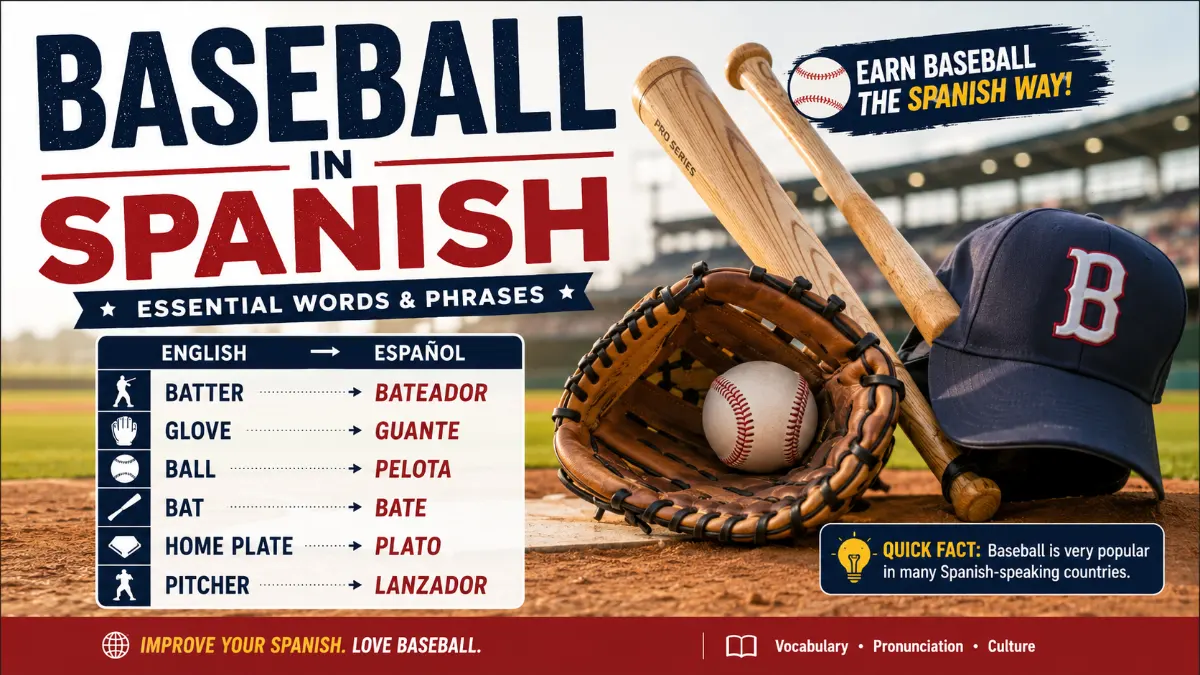
Baseball in Spanish is called béisbol or beisbol. Both forms are accepted in standard Spanish, but the preferred spelling and stress can vary by place. Use with first-syllable stress in Spain and much of Latin America, use beisbol with final-syllable stress in Mexico, Central America, and several Caribbean countries. For an English-speaking learner, the most useful next step is not memorizing a single translation – it is learning the phrases people actually use before, during, and after a game.
This guide takes a conversation-first approach to baseball in Spanish. You will learn the essential words needed to follow a score, understand a broadcast, talk about a player’s performance, ask simple questions at a game, and recognize regional alternatives without treating one country’s terminology as universal.
Start With the Core Word
The two accepted spellings reflect different stress patterns, not different sports. In either case, the noun is masculine: say el béisbol or el beisbol.
| If you see or hear | Say it roughly as | What it means | Useful example |
| béisbol | BAYS-bol | baseball | El béisbol es muy popular aquí. – Baseball is very popular here. |
| beisbol | bays-BOL | baseball | ¿Te gusta el beisbol? – Do you like baseball? |
| beis | bays | informal short form for baseball | Vamos a jugar beis. – Let’s play ball. |
The Real Academia Española and the Association of Spanish Language Academies recognize both béisbol and beisbol. FundéuRAE notes that beisbol is especially common in Mexico, Guatemala, Colombia, Venezuela, Cuba, and the Dominican Republic, while béisbol is common in Spain and other parts of Spanish-speaking America. The shortened form beis is also documented especially in Mexico and Central America.
A Pronunciation Shortcut That Works
For béisbol, put the emphasis at the beginning: BAYS-bol. For beisbol, put it at the end: bays-BOL. The accent mark is not decorative: it tells you that béisbol does not follow the default final-syllable stress expected for a word ending in l.
You do not need to change every surrounding word when you change forms. For example, both un partido de béisbol and un partido de beisbol mean “a baseball game.” Choose the form that matches the country, team, broadcaster, or audience you are speaking with.
Build a Useful Game-Day Vocabulary
A long dictionary list can be hard to retain. It is easier to learn Spanish baseball terms in groups that match the flow of a game: people, the playing area, pitching and batting, then the score.
People You Will Hear About
| English | Common Spanish term | Regional or practical note |
| Player | Jugador / Pelotero / Beisbolista | Pelotero and Beisbolista are common in baseball contexts |
| Team | Equipo | El equipo local = home team |
| Manager | Mánager | English-derived form often used in baseball |
| Coach | Entrenador | Also used broadly in sports |
| Pitcher | Lanzador / Pícher | Pícher is a recognized adaptation used frequently in American Spanish |
| Catcher | Receptor | Widely understood |
| Umpire | Árbitro / Juez / Ampayer | Ampáyer is regional, especially in Mexico, Central America, and the Caribbean |
| Fan | Aficionado / Fanático | Aficionado is broadly useful |
The terms lanzador and pícher deserve special attention. Lanzador is a clear Spanish equivalent of “pitcher.” Pícher is an adapted form of the English word and is frequently used in American Spanish. In formal or neutral writing, lanzador is a safe choice, in live baseball conversation, you may hear either one.
The Field, Bases, and Dugout
| English | Spanish |
| Baseball field | Campo de béisbol / Terreno de juego |
| Diamond | Diamante |
| Home plate | Home / Plato |
| First base | Primera base |
| Second base | Segunda base |
| Third base | Tercera base |
| Dugout | Dugout / Caseta |
| Bench | Banco |
| Bullpen | Bullpen |
| Outfield | Jardín |
| Infield | Cuadro interior / Infield |
| Foul territory | Territorio de foul |
Some field vocabulary keeps English influence, especially in professional baseball coverage. That is normal. Spanish-language broadcasters may switch between a Spanish equivalent and an adapted or borrowed term depending on local custom. Listening for the surrounding context matters more than expecting a one-to-one dictionary match every time.
At the Plate and on the Mound
| English action or result | Spanish expression | Plain-English meaning |
| To pitch | Lanzar / Pichear | Deliver the ball to the batter |
| To hit | Batear / Conectar | Strike the ball |
| To catch | Atrapar / Capturar | Receive the ball |
| Strike | Strike | A strike |
| Ball | Bola | A ball outside the strike zone |
| Strikeout | Ponche | A batter is out on strikes |
| Walk | Base por bolas | Batter reaches base on balls |
| Hit | Imparable / Hit | A successful hit |
| Bunt | Toque de bola | A softly batted ball |
| Steal a base | Robar una base | Advance by stealing |
| Double play | Doble matanza / Doble play | Two outs on one play |
You may notice that bola often appears for the umpire’s “ball” call, while pelota often refers to the physical baseball. In real usage, regional habits vary, but this distinction is a useful starting point for learners.
Read More: Jordan Walker Ross
Understand the Scoreboard in Spanish
Once you know how a game is scored, baseball vocabulary becomes much easier to follow. These are the words that commonly appear in a box score, recap, or broadcast.
| Scoreboard word | Spanish | Example in context |
| Inning | Entrada | Estamos en la séptima entrada. – We are in the seventh inning. |
| Run | Carrera | Anotaron tres carreras. – They scored three runs. |
| Score | Marcador | El marcador está empatado. – The score is tied. |
| Lead | Ventaja | Tienen una ventaja de dos carreras. – They have a two-run lead. |
| Tie | Empate | El juego sigue empatado. – The game remains tied. |
| Win | Victoria | Fue una gran victoria. – It was a great win. |
| Loss | Derrota | El equipo sufrió una derrota. – The team suffered a loss. |
| Extra innings | Entradas extra | El partido se fue a entradas extra. – The game went to extra innings. |
For a home run, you will hear jonrón and Cuadrangular. Jonrón is a recognized Spanish adaptation of the English home run and is especially widespread in the Americas. Cuadrangular is another accepted term. Rather than trying to decide which one is “the real” translation, recognize both and follow the local preference.
A Simple Broadcast Example
Here is the kind of sentence you might hear during a game:
El lanzador permitió dos carreras en cinco entradas, pero el relevo mantuvo la ventaja.
It means: “The pitcher allowed two runs in five innings, but the relief pitching kept the lead.”
This one sentence gives you several high-value terms at once: lanzador (pitcher), carreras (runs), entradas (innings), Relevo (relief pitching), and ventaja (lead).
Know the Defensive Positions
Baseball positions in Spanish are usually understandable even when a country has its own preferred option. Learn the most neutral term first, then recognize alternatives when you encounter them.
| Position number | English position | Neutral Spanish option | Alternative you may hear |
| 1 | Pitcher | Lanzador | Pícher |
| 2 | Catcher | Receptor | Cátcher |
| 3 | First baseman | Primera base | Inicialista |
| 4 | Second baseman | Segunda base | Camarero |
| 5 | Third baseman | Tercera base | Antesalista |
| 6 | Shortstop | Paracorto | Torpedero / Campocorto |
| 7 | Left fielder | Jardinero izquierdo | – |
| 8 | Center fielder | Jardinero central | – |
| 9 | Right fielder | Jardinero derecho | – |
For shortstop, the RAE’s language guidance recommends Spanish options such as paracorto or Torpedero for the player and campo corto for the area of the field. This is especially useful because English short and shortstop still appear in some baseball settings. You may also encounter campocorto in everyday usage, so treat it as a term to recognize rather than the only answer.
The word jardinero literally means “gardener.” It may sound surprising at first, but it is a standard baseball label for an outfielder because the outfield is often called el jardín. Therefore, jardinero central means center fielder, not a person who works in a garden.
Speak Naturally Before, During, and After a Game
The best way to make vocabulary active is to use it in situations. The following phrases are different from isolated translations because they show the grammar and word order you need in a real interaction.
Before the First Pitch
- ¿A qué hora empieza el partido? – What time does the game start?
- ¿Quién abre como lanzador hoy? – Who is starting at pitcher today?
- Voy a ver el juego con unos amigos. – I’m going to watch the game with some friends.
- Ese equipo tiene una buena ofensiva. – That team has a good offense.
- ¿Cuál es tu equipo favorito? – What is your favorite team?
While Watching the Game
- ¡Qué buena atrapada! – What a great catch!
- El corredor está a salvo. – The runner is safe.
- El corredor fue puesto out. – The runner was called out.
- Necesitan una carrera para empatar. – They need one run to tie.
- El bateador está en cuenta completa. – The batter has a full count.
- ¡Ese fue un jonrón enorme! – That was a huge home run!
After the Final Out
- Ganaron por una carrera. – They won by one run.
- El partido estuvo muy cerrado. – The game was very close.
- Perdieron en entradas extra. – They lost in extra innings.
- El lanzador tuvo una gran salida. – The pitcher had a great outing.
- Mañana juegan otra vez. – They play again tomorrow.
Avoid These Common Learner Mistakes
A few small errors can make baseball Spanish sound unnatural. They are easy to avoid once you know what to watch for.
Do Not Treat Every English Baseball Word as Universal
Spanish baseball language includes direct adaptations, translations, and local expressions. You may hear pícher, cátcher, or ampáyer in one region and lanzador, receptor, or árbitro in another. This does not mean one speaker is wrong. It means baseball vocabulary is regionally alive.
Do Not Forget the Article With the Sport
When speaking generally, use the masculine article: el béisbol or el beisbol. For example:
- Correct: El béisbol me gusta mucho.
- Natural: Me gusta mucho el béisbol.
- Less natural for a learner: Me gusta mucho béisbol.
Some regions may omit the article after certain verbs in informal speech, but jugar al béisbol is a reliable standard pattern for writing and general Spanish.
Do Not Assume an Accent Mark Is Optional
If you mean the first-stress version, write béisbol with the accent. Writing beisbol changes the standard stress pattern to the final syllable. Both spellings are correct only because they represent different accepted pronunciations.
Do Not Translate “Out” Too Literally Every Time
In game commentary, out may remain as out, while other speakers say fuera or use a fuller phrase such as fue puesto out. Listen to the local style. For a beginner, understanding all three is more valuable than forcing one form into every sentence.
A 10-Minute Practice Routine
Use this quick routine to make the words stick. It is designed for a learner who wants functional baseball Spanish rather than a passive list of terms.
- Say both versions aloud five times: BAYS-bol and bays-BOL.
- Pick one regional form for today’s practice and keep it consistent in your sentences.
- Memorize five game words: lanzador, receptor, carrera, entrada, and jonrón.
- Describe one imaginary play: El bateador conectó un jonrón en la sexta entrada.
- Read a short Spanish-language game recap and underline every word you recognize.
- Say one opinion sentence: Me gusta el béisbol porque es estratégico.
Repeat the exercise with five new words the next day. Vocabulary grows much faster when each new term appears in a sentence about an actual game situation.
Final Takeaway
For baseball in Spanish, remember the two accepted forms first: béisbol and beisbol. Then build outward from the words that unlock a game – lanzador, receptor, entrada, carrera, ponche, and jonrón. You do not need to master every regional variation at once. Start with neutral, widely understood terms, recognize common alternatives, and let the country or broadcast you are following guide your vocabulary over time.
Frequently Asked Questions
Is “beis” a real Spanish word for baseball?
Yes. Beis is an informal shortening of béisbol or beisbol. The RAE’s Diccionario panhispánico de dudas documents it especially in Mexico and Central American countries. It is best treated as casual speech rather than a replacement for the full word in formal writing. If someone says vamos a jugar beis, they mean “let’s play baseball” or “let’s play ball.”
What is the Spanish word for a pitcher: lanzador or pícher?
Both are used. Lanzador is a clear Spanish word meaning the player who throws the ball to the batter. Pícher is an adapted Spanish spelling of the English pitcher and is frequently used in the Americas. If you want a broadly neutral option, use lanzador. When watching baseball coverage from Mexico, the Caribbean, or other parts of Latin America, recognize pícher as a normal baseball term.
How do you say catcher in Spanish?
The widely understood word is receptor. You may also hear cátcher, an adapted form of the English word catcher, especially in American Spanish. In a neutral learning context, receptor is a useful choice because it is immediately clear and works in complete phrases such as el receptor atrapó la pelota (“the catcher caught the ball”).
What does “ponche” mean in baseball?
In baseball, ponche means a strikeout. A batter receives a ponche when the at-bat ends with three strikes. The word is common throughout Spanish-language baseball coverage, though commentators may also explain the result with a longer phrase such as el bateador se ponchó (“the batter struck out”). It is one of the most helpful terms to learn if you follow live commentary.
Is “jonrón” proper Spanish?
Yes. Jonrón is an established Spanish adaptation of the English expression home run, and the RAE defines it as the baseball play in which a batter hits the ball out of the field and can complete the bases to score a run. Its plural is jonrones. You may also hear cuadrangular, so recognizing both words will help you follow broadcasts from different countries.
How do you say “the batter is safe” in Spanish?
For a runner, you can say el corredor está a salvo (“the runner is safe”). In baseball commentary, speakers may also use safe as a borrowing. For a batter who reaches base, the most natural wording depends on how it happened: el bateador llegó a primera base (the batter reached first base) or el bateador recibió una base por bolas (the batter drew a walk).
What does “entrada” mean in baseball Spanish?
Entrada means inning. For example, la tercera entrada is the third inning, and la última entrada is the final inning. Because entrada can also mean an entrance, ticket, or admission in other contexts, the baseball meaning is determined by the game situation. If you see entradas extra, it means extra innings.
How do Spanish speakers say “double play”?
You may hear doble play or doble matanza. Doble play retains an English-influenced structure and is common in baseball settings, while doble matanza is a Spanish expression for a play that produces two outs. Both are useful to recognize, especially when reading game recaps or listening to fast-paced radio commentary.
Can I call an umpire “ampáyer”?
You can, but it is regional. The RAE documents ampáyer as an adaptation of umpire used in some parts of the Americas, especially Mexico, Central America, and the Caribbean. For a neutral term that will work broadly, use árbitro or juez. The best choice depends on the local baseball culture and the tone of the conversation
What is the best way to learn baseball vocabulary in Spanish quickly?
Learn words in game situations, not as disconnected pairs. Begin with the score words – carrera, entrada, empate, and ventaja – then add the core people – lanzador, receptor, and bateador. Watch a short Spanish-language highlight, pause after each play, and repeat one sentence describing it. This connects the vocabulary to an image and an action, which makes it easier to remember and use.